Monday, 7 December 2020

Identifying waders. Part 3: Sanderling, Knot and Curlew sandpiper

 Part 3 for Stortford Nature group. These 3 common species can cause difficulties with beginners and, in the case of the Curlew sandpiper, with more experienced birders. All three are seen on migration whilst Sanderling and Knot will also be found throughout the winter, often, in the case of Knot in huge numbers A few pointers here to help with field identification.

Top tip: Always take a note book and pencils ready to make field notes. You don't have to be an artist to do these, just the rough shape of the bird is fine. What is more important is the notes on call (if any) leg and beak colouration, special features such as eye stripe if present, wing bars seen in flight and tail feather patterning. Other things may be noticed and these should all noted. A good field sketch with annotated notes will help id the bird at home with books etc. On several occasions I have come across a rarer wader, such as Western sandpiper, Semipalmated sandpiper White rumped sandpiper and Temmink's stint and my field notes have pinpointed the species that I thought it may have been. Nowadays so many birders rely on getting a photo and these may well not show the salient plumage features. A note book takes up far less space than a Collins bird guide and it is hard to look at a bird and flick through pages at the same time. Especially so when you need to then read the text for the detail. I never take a field guide when out birding, even when bird watching in a new country, always notes and scribbled diagram. I include a mock up here which shows one of the three birds we are looking at. See if it helps work out which one?


2 pages of field notes. One for any flight details and other whilst on ground. Note also, I have included a comment on habits whilst feeding

Knot:

Rarely seen in its full red breeding plumage so just concentrate on the regular sightings of none breeding plumage. A fairly large wader, average length dark but not jet black bill but the main thing is: note the leg colour. Greeny/yellow. Often muddy so need to check before thinking they're black or dark brown. Habit, as shown here on Titchwell beach, often found probing around on barnacle infested rocky outcrops as well as checking out sea weed washed up on the beach. Flocks together at high tide with 10,000's at Snettisham in West Norfolk and also 1000's on Holme beach. As you travel further east along the Norfolk coastline they decrease in number. Note also the pattern around the head, a light brown crown with white cheeks but a light brown line from the base of the bill to the back of the head. Dark wing tips protrude above the tail.


Very rare to see one in flight, always in flocks. Immediately apparent is the overall light brown colour to the bird but the wings show a white central wing bar with black leading edge to the wings and a fading dark area to the trailing edge on both primary and secondary feathers. Note the top left bird still showing signs of breeding plumage but the wing bar still remains as does the dark bill.


In the 2 photos above note the differences in leg colour. First photo clearly shows yellow legs, indicating a 1st winter bird whilst the 2nd shot shows olive green legs, a full adult bird. Both photos from Holkham Beach December 2020.

Sanderling


Another Titchwell beach bird here and what is the first difference between this species and the Knot? This one feeding on a piece of razorfish, I think.

Black legs noted immediately. First photo, even at distance shows a grey bird with a jet black bill, white belly and dark along the leading edge of the wing whilst 2nd snap (Tavira, The Algarve) shows dark feathers on the wings indicating juvenile. Note the crown is grey with white cheeks but just a hint of greyness running through the eye from the base of the bill.


Sanderling are very fast flyers, as are most waders and it can be tricky to get any detail on their wing plumage. However, the white wing bar stands out, contrasting with the dark edges to the tail. Compare with Knot above to see the extent of this wing bar. Also, in flight, the wing will indeed just appear black/white/black. Note tail pattern here, white edged with grey in the corners.

Habit, rarely found away from sandy shores near the breaking waves where it runs extensively at the high water mark, often in large groups.

Curlew sandpiper;


A bird that usually only appears during migration (late March/early May) and more frequent (Late August/mid October.) A difficult bird top sort out when in with a flock of dunlin! This one is just coming out of breeding plumage when it will have been bright red. However, the long and clearly decurved bill will stand out if in a flock of dunlin. The other feature that will be clear to separate Dunlin is the white eye stripe (supercilium.) Dunlins do show these but they are much more prominent in curlew sandpipers.


In better light, both the decurved bill and white eye stripe is much clearer. It is longer legged to but when wading in a few inches of water that is none too helpful a hint. Can be noted when on mud banks. Again. the legs are dark and the general colouration is a darker brown than the Knot. Another feature that distinguishes Curlew sands from dunlin is the delicate peachy wash on the breast as clearly seen here.


In flight, tail is the obvious clue as shown here. Black terminal band with a contrasting white. A very weak white wingbar that may even not be visible but the clearly decurved bill is clearly evident here. Altogether a much darker wing pattern.

OK: have a go at these. No answers on a postcard but do leave a comment on the facebook page if you like, also stating what my fieldnotes described and what was the main thing that gave you the answer? Note, one of these may hark back to a previous description!!

Photo 1


Photo 2 the bird on the right. One on the left is a Little stint.


Photo 3


Photo 4


Photo 5 


Sunday, 6 December 2020

Wader Identification: Part two, Godwits

 So moving on to godwits. 2 species to deal with here which superficially look alike but there are enough differences to sort them out pretty rapidly. 

The two species are Black tailed godwit and Bar tailed godwit. The names describe the tails perfectly but occasionally these may not be visible.

Black tailed godwit;

A long legged, long beaked bird found in large flocks, feeding on the mud and also capable of wading into deeper water to the extent that they can actually be seen swimming. As with dunlin there are several sub species but we won't dwell on those complexities here. Most of the time they will be seen in non breeding plumage, a basically grey/faun colour showing a long bill, pink at the base and darker towards the tip


2 photos here of none breeding plumage. Note the legs are dark and also the colouration of the bill. In the top photo the bill is wet but the dark tip can still be seen. The black tail feathers can be seen in both photos

The 2nd photo is full none breeding plumage. The flanks are plain whereas in the first there is a hint of edging showing it is or has moulted.


Both these photos show Black tailed godwit almost in full breeding plumage. In the first example note the flanks have already moulted and regrown back the grey/brown colour whereas in the 2nd example the orange and black feathers are more prominent. In both, straight bill and in the first photo a glimpse of the dark leg. Tail shows a black band as always. Also, note the barred markings on the belly.


In flight, identification becomes easy, even with the briefest of views. As well as showing the wide black terminal band on the tail, ONLY the Black tailed godwit has white wingbars as clearly seen in these two images, top one from Norfolk, second one from Aviero, Portugal. Also in flight the feet protrude further than the tail feathers, but good views needed to pick that feature out.

So to sum up: Black tailed godwit: black band on tail, straight bill pink ending in black at the tip, dark grey legs. prominent white wingbar in flight.

Bar Tailed godwit.

Again, a long legged and long billed wading bird that visits our shores either side of migration. However, the bird appears dumpier in the field and its legs are noticeably shorter than black tailed. The bill has a perceptible upturn to it. Very obvious when you encounter a mixed flock.


Bar tailed godwit in winter plumage. Dark legs again and the colouration on the bill is similar to Black tailed but the upturn of this bill can just be seen in this shot. Notice also, in none breeding plumage that the flank feathers are not plain as in the black tailed godwit. The barring on tail feathers is frequently not visible as is the case here. Note all three photos show the white eye stripe, even at distance in the 3rd photo from Titchwell beach. No white eye stripe on black tailed godwits

In photo one either a spring bird just entering into breeding plumage or a moulting bird coming out of breeding plumage as noted by the orange tinge on the neck


In breeding plumage there is no barring on the belly as in Black tailed. There is considerably less orange feathering on the wings whilst the dark legs and upturned bill remain the same. Note also, in both plumages there is a white eye stripe on bar tailed which is not found on black tailed. 


In flight, no white wing bar and the barred tail is evident along with a white triangular rump. Note that only the toes protrude beyond the tail feathers whereas in the black tailed the protrusion also includes the whole feet.

The Bar tailed photos in flight and summer plumage have been googled as I didn't have any that showed the pointers clearly enough. The rest are are all mine.

To sum up: Bar tailed godwit: more mottled appearance in winter plumage, barring on tail, upturned bill and white rump with no wingbars in flight.


This bird, which I'm sure you can work out for yourself was at Titchwell in 2015. I managed to get the photo showing the colour rings and the code was RORZ (Red Orange Red Z.) I sent the photo off to find out more. This female was ringed as a nestling four years previously. The data showed she arrived in The Wash in 2015, 2014, 2013 and 2012 at almost the same date each year. Only a remarkable 3 day change over the 4 years. 

Godwits pair for life but amazingly the females head to western Europe from Greenland and Iceland whilst the males prefer the sunnier climes of West Africa such as The Gambia. Even more incredible is that the pair meet up back at the breeding ground within 72 hours. If a bird has not found its partner in those 72 hours he or she will pair with another singleton. Just crazy really that they set off from different time zones and latitudes and arrive back in the same field at the same time.

A good task. Use Google images and put in Bar tailed godwit winter plumage and see if you can spot any that are labelled bar tailed that are black tailed. I noted a few.

Saturday, 5 December 2020

Beginners guide to common wading birds. Part 1: Know Your Dunlin.

 Having put a post on Stortford Nature Facebook about identifying corvids and saying if anyone had other identification issues I'd be happy to advise, I got a request for gulls and waders! Wow, that is an easy intro. Here goes. Thanks Dave Bromage!

First rule of watching waders is to know the common species. When I was 7-11 or so I used to bird watch waders around The Wirral and was always told, "Know your dunlin." The most common species so first tip is to spend time watching these. Get a feel for their shape, their movement when feeding, how they run and move, how they flock together. Once familiar with them it becomes easier to spot a bird on the mud that appears to be a different bird. It may look plumper, longer bill, more of a white stripe over the eye. Then start to note the colour of beak and legs. Warning, they may be covered in mud so not always guaranteed. A redshank shows orange legs but these can appear mud coloured due to the fact they're muddy!

So; lets start with Dunlin. The most common wader, a small rounded and plump bird found on mud from late August through to April but in high numbers during migration season (March - early May and then August- early October.) Consequently, it shows several plumages as shown below. Mainly it will be a grey/brown bird whilst breeding plumage shows a golden back with an obvious black belly.


In breeding plumage the dunlin is unmistakeable. Note the slightly decurved bill and the black legs on these two individuals. One from Norfolk, one from Aviero in mid Portugal. Both on migration north to their breeding grounds. Also, note the white eye stripe, (supercilium) as this helps with winter plumage.


Two Dunlin in changing plumage. Note the dark belly just coming on the second bird whilst the golden wing and mantle feathers are showing through on the first bird. In both, the decurved black bill and black legs remain the same. Photos from Norfolk (first) and Tavira in The Algarve (2nd)

When dunlin migrate through the UK and some overwinter at places like North Norfolk they become a much greyer in plumage. This is their none breeding plumage that will be apparent from September through until March. It can still vary. There are 4 sub species of dunlin all showing their own diagnostic characteristics but here is not the place to go into the complexities of all of that. 


The two photos above show the progression to winter plumage as shown in the final snap. Note also that dunlin invariably feed in a flock. They tend to walk in the same direction, occasionally running. However, as always, the slightly decurved black bill and black legs, along with the rounded dumpy shape remain the same. Also, note that the white supercilium (eye stripe) remains and joins just at the base of the upper mandible.


Dunlin in flight. Very fast flying so tough to note too much detail. White underwings, darker on top, black belly when in breeding plumage. Note the black "spine" to the plumage that comes to a point at the end of the tail. Often too fast to note this but can be picked up in photos. 


Top photo of these three, standard dunlin in moult. However, second photo serves as a good example of seeing other birds that to begin with look similar. Note the bird on the right. Smaller, straighter bill which is clearly shorter and a more prominent white eyebrow, mainly behind the eye rather than meeting at the base of the bill. Time to look more closely as this is not a dunlin. A Little stint which I shall cover in another episode. Final photo, Aviero, south of Porto in Portugal, just shows a group of mid breeding plumage Dunlin doing what they do.


Final photo. Differences in size and colouration around the face raise alarm bells. Dunlin right and a Little stint left. 

So, highly recommended. Sit a while overlooking a scrape where Dunlin are present. Watch them behave and wander. Note their takeoff and landing. Check the beak and legs and then begin to get into the finer details of their plumage. Not easy but it does become less confusing with time. I've only been doing wader watching for 55 years and still say "What's that, 3rd bird from the left of the greylag goose?" and it will be a long billed dunlin.


Thursday, 3 December 2020

Return to Wallington Road

 Yesterday I returned to where I had been earlier in the week, hoping to catch sights of the birds of prey present. Arriving at 1pm I soon encountered the pale breasted buzzard seen last time before heading up the road towards Wallington. On the right were two Red kites in a tree with a smaller bird. I parked and through the binoculars noted it was the male merlin. It flew off just as I took a long distance photo. Several kestrels were about, too before I headed to where the Short eared owl seems to appear from, along the public footpath to Bygrave. After a while, I headed off to get some late lunch before returning to the same place. Around 2.30pm it appeared from nowhere, working its way along the hedge line before disappearing from view. I scanned the fields and now, on the other side of the road was either the same bird, or a second one. It was wide ranging, following hedges before flying over ploughed and winter barley fields to the next hedge. At no point was I anywhere near to it so all shots are either as they came of the camera, or heavily cropped. Several corn buntings were in a tree, a flock of common gulls flew overhead as did a few skylarks. At one point, a peregrine flew through, again, to distant for a photo. 

I now know where I think the owl roosts and will return and position myself in a hedge much closer to where it hunts to get better photos.

Perched on a hedge some 300 yards away

Size of lorries on A505 and the huge field dwarf the SEO

Seems to have spotted me from 500 yards away

Checking another hedge

Spotted something

Quartering the wild strip along the edge of a field

Another hedge to check

Off again

female kestrel


3 Red kites and a Carrion crow

Watching another kite feeding on the ground

Merlin is off as I take the first photo

Distant Common buzzard

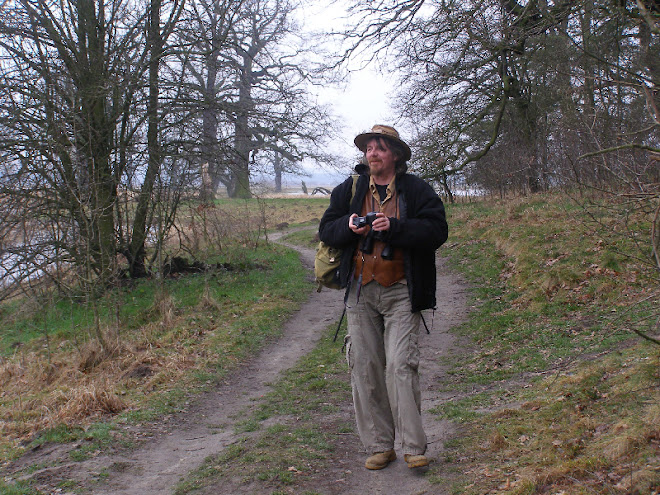
This is me

This is me
At the end of another Norfolk Coastal footpath walk. 47 miles, 3 days 99 species of bird. September 2009

Caley Wood view

Caley Wood view
sunshine through the canopy 29.05.08

A walk along the Warta Valley, Poznan, Poland. Feb 2007

A walk along the Warta Valley, Poznan, Poland. Feb 2007
Best birds on this walk: black and middle spotted woodpecker and short toed treecreeper

About Me

My photo
A primary school teacher for 30 years, I retired from teaching in July 2009 to set up my own science enhancement and communication company. The Primary Works offers science clubs, workshops and staged science shows nationwide. I have always been interested in bird watching since my early years. Apparently my first tick was after inquiring about a chaffinch and then receiving the Observer book of birds. By the age of 9 I had moved on to Tory Peterson's collins guide and was now involved on YOC birding holidays to Northumbria, Essex coast, Slimbridge and Yorkshire. My twitching rule is that I will willingly travel 1km for each gram the bird weighs. However, I have had many rarities just by being in the right place. I have travelled widely throughout Europe and also visited Australia and Sri Lanka. In 2016 I spent time at Portland Bird Obs and two trips to Aviero, Portugal. 2017 found me back in Sri Lanka in Feb/March, then July and back for New Year's Eve celebrations in December. Also returned to The Camargue in May for a 4 day trip. Few plans for 2018, but nothing yet booked apart from a trip to the IOW.

Grey heron

Grey heron
Over the allotment 28.09.08

Southern Hawker

Southern Hawker
Ridge footpath 27.08.08

Juvenile green woodpecker (17.08.08)

Juvenile green woodpecker (17.08.08)
Note the stripes, denoting a bird fledged this year.

common blue

common blue
Ash Valley G.C. 15.08.08

Indian balsam (impatiens glandulifera)

Indian balsam (impatiens glandulifera)
River Ash

azure damselfly

azure damselfly
River Ash 28.07.08

marbled white

marbled white
Discovered at Westland Green 22.07.08

ruddy darter

ruddy darter
Bush Wood 21.07.08

honeysuckle 19.07.08

honeysuckle 19.07.08
growing in hedgerow in Chapel Lane

cinnabar moth caterpillar

cinnabar moth caterpillar
Photographed on ragwort 19.07.08

Bittersweet

Bittersweet
Study of petals 11.06.08

male yellowhammer

male yellowhammer
08.06.08

common blue butterfly

common blue butterfly
06.06.08

River Ash

River Ash
looking south from the bridge at Hadham Ford

Common poppy (papaver rhoeas)

Common poppy (papaver rhoeas)
in rape field 29.05.08

Caley Wood sunshine

Caley Wood sunshine
29.05.08

Millenium Wood fox

Millenium Wood fox
24.05.08

common comfrey (symphytum officinale)

common comfrey (symphytum officinale)
06.05.08 banks of the River Ash

Garlic Mustard or Jack by the Hedge,(Alliara petiolata)

Garlic Mustard or Jack by the Hedge,(Alliara petiolata)
flowers, leaves and fruit edible . Good in salad and pesto

April showers

April showers
Double rainbow 30.04.08

Caley Wood bluebells

Caley Wood bluebells
22.04.08

Yellow Archangel

Yellow Archangel
Chapel Lane (20.04.08)

sunlight 16.04.08

sunlight 16.04.08
looking south west from Bush Wood

snowy buds

snowy buds
06.04.08 in Bush Wood

Looking north west

Looking north west
05.04.08 evening shower approaching

Back Garden

Back Garden
Easter Sunday (23.03.08)

Brick Kiln Hill

Brick Kiln Hill
Looking east (23.03.08)

No play today

No play today
The 2nd hole at Ash Valley golf course

Teasel head

Teasel head
Bush Wood (21.03.08)

Reflections

Reflections
daffodils at Bush Wood pond (21.03.08)

Swollen River Ash

Swollen River Ash
The river at the bottom of Winding Hill 16.03.08

Daybreak over the chapel

Daybreak over the chapel
Thursday 13th March

Wild daffodils (narcissus pseudonarcissus)

Wild daffodils (narcissus pseudonarcissus)
growing in Bush Wood

January snowdrops

January snowdrops
Banks of River Ash, north of Much Hadham

Good Moon

Good Moon
From garden 24.01.08

Village Green

Village Green
Looking east towards Acremore Street

Looking south before Hadham Ford

Looking south before Hadham Ford
rare January blue sky

Useful sites

The following are some useful websites that may interest readers of this blog.
Firstly, Bishop's Stortford Natural History Society http://bsnhs.webplus.net/

Fellow birder, Gary Whelan's blog. Gives reports from our trips out together plus reports from his trips abroad. http://hairybirders.blogspot.co.uk
http://www.hertsbirdclub.org.uk/ The official herts bird club website. Frequently updated, listing bird sightings around the county. Offers links to many other websites. Both of these sites also offer links to yahoo discussion groups.
http://www.birdforum.net/ An international site. You can enter as a guest but become a member( free) to post comments, bird sightings and just about anything to do with wild birds. Good news updates, classified section for binoculars, cameras etc.
http://www.guidedbirdwatching.com/ A new site set up where you can contact people worldwide who will help you find good birds in their country. UK section being set up presently.
http://www.britainsbirder.co.uk/
Fellow birders blog. Strtford resident, Graeme Smith regulary birds the area south of Stortford as well as around Spellbrook and the River Stort from Spellbrook to Twyford Locks. Some superb bird photography: Graeme uses a digital camera attached to his powerful telescope to get detailled images of the birds he sees. Well worth a browse.
Two local sites that may be of interest can be found at
http://www.thehadhams.com/ www.thepelhams.net/content/section/12/139/

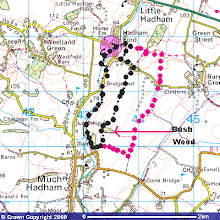
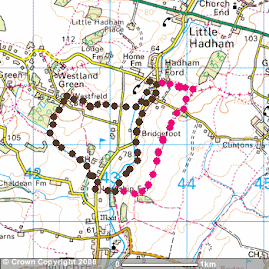
South Easterly walk

South Easterly walk
black, normal, red extended walk

South Westerly route.

South Westerly route.
Black usual, red extended

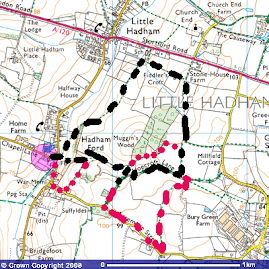
North Easterly walk

North Easterly walk
black short, walk. Red, extended

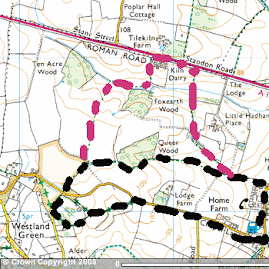
North West Patch

North West Patch
black route regular. Red route the extended wander