Saturday, 5 December 2020

Beginners guide to common wading birds. Part 1: Know Your Dunlin.

 Having put a post on Stortford Nature Facebook about identifying corvids and saying if anyone had other identification issues I'd be happy to advise, I got a request for gulls and waders! Wow, that is an easy intro. Here goes. Thanks Dave Bromage!

First rule of watching waders is to know the common species. When I was 7-11 or so I used to bird watch waders around The Wirral and was always told, "Know your dunlin." The most common species so first tip is to spend time watching these. Get a feel for their shape, their movement when feeding, how they run and move, how they flock together. Once familiar with them it becomes easier to spot a bird on the mud that appears to be a different bird. It may look plumper, longer bill, more of a white stripe over the eye. Then start to note the colour of beak and legs. Warning, they may be covered in mud so not always guaranteed. A redshank shows orange legs but these can appear mud coloured due to the fact they're muddy!

So; lets start with Dunlin. The most common wader, a small rounded and plump bird found on mud from late August through to April but in high numbers during migration season (March - early May and then August- early October.) Consequently, it shows several plumages as shown below. Mainly it will be a grey/brown bird whilst breeding plumage shows a golden back with an obvious black belly.


In breeding plumage the dunlin is unmistakeable. Note the slightly decurved bill and the black legs on these two individuals. One from Norfolk, one from Aviero in mid Portugal. Both on migration north to their breeding grounds. Also, note the white eye stripe, (supercilium) as this helps with winter plumage.


Two Dunlin in changing plumage. Note the dark belly just coming on the second bird whilst the golden wing and mantle feathers are showing through on the first bird. In both, the decurved black bill and black legs remain the same. Photos from Norfolk (first) and Tavira in The Algarve (2nd)

When dunlin migrate through the UK and some overwinter at places like North Norfolk they become a much greyer in plumage. This is their none breeding plumage that will be apparent from September through until March. It can still vary. There are 4 sub species of dunlin all showing their own diagnostic characteristics but here is not the place to go into the complexities of all of that. 


The two photos above show the progression to winter plumage as shown in the final snap. Note also that dunlin invariably feed in a flock. They tend to walk in the same direction, occasionally running. However, as always, the slightly decurved black bill and black legs, along with the rounded dumpy shape remain the same. Also, note that the white supercilium (eye stripe) remains and joins just at the base of the upper mandible.


Dunlin in flight. Very fast flying so tough to note too much detail. White underwings, darker on top, black belly when in breeding plumage. Note the black "spine" to the plumage that comes to a point at the end of the tail. Often too fast to note this but can be picked up in photos. 


Top photo of these three, standard dunlin in moult. However, second photo serves as a good example of seeing other birds that to begin with look similar. Note the bird on the right. Smaller, straighter bill which is clearly shorter and a more prominent white eyebrow, mainly behind the eye rather than meeting at the base of the bill. Time to look more closely as this is not a dunlin. A Little stint which I shall cover in another episode. Final photo, Aviero, south of Porto in Portugal, just shows a group of mid breeding plumage Dunlin doing what they do.


Final photo. Differences in size and colouration around the face raise alarm bells. Dunlin right and a Little stint left. 

So, highly recommended. Sit a while overlooking a scrape where Dunlin are present. Watch them behave and wander. Note their takeoff and landing. Check the beak and legs and then begin to get into the finer details of their plumage. Not easy but it does become less confusing with time. I've only been doing wader watching for 55 years and still say "What's that, 3rd bird from the left of the greylag goose?" and it will be a long billed dunlin.


Thursday, 3 December 2020

Return to Wallington Road

 Yesterday I returned to where I had been earlier in the week, hoping to catch sights of the birds of prey present. Arriving at 1pm I soon encountered the pale breasted buzzard seen last time before heading up the road towards Wallington. On the right were two Red kites in a tree with a smaller bird. I parked and through the binoculars noted it was the male merlin. It flew off just as I took a long distance photo. Several kestrels were about, too before I headed to where the Short eared owl seems to appear from, along the public footpath to Bygrave. After a while, I headed off to get some late lunch before returning to the same place. Around 2.30pm it appeared from nowhere, working its way along the hedge line before disappearing from view. I scanned the fields and now, on the other side of the road was either the same bird, or a second one. It was wide ranging, following hedges before flying over ploughed and winter barley fields to the next hedge. At no point was I anywhere near to it so all shots are either as they came of the camera, or heavily cropped. Several corn buntings were in a tree, a flock of common gulls flew overhead as did a few skylarks. At one point, a peregrine flew through, again, to distant for a photo. 

I now know where I think the owl roosts and will return and position myself in a hedge much closer to where it hunts to get better photos.

Perched on a hedge some 300 yards away

Size of lorries on A505 and the huge field dwarf the SEO

Seems to have spotted me from 500 yards away

Checking another hedge

Spotted something

Quartering the wild strip along the edge of a field

Another hedge to check

Off again

female kestrel


3 Red kites and a Carrion crow

Watching another kite feeding on the ground

Merlin is off as I take the first photo

Distant Common buzzard

Sunday, 29 November 2020

Foggy Times at Wallington

 This afternoon set off for Wallington near Baldock to check along the lane for several birds of prey: merlin, Hen harrier, Short eared owl as well as Corn buntings, a species long since departed from East Herts.

Drove through thick fog around Cottered and nearly turned around but upon arriving at Wallington Road the fog was now a little thinner. I scanned the fields where a few other birders were and the Merlin was found on the ground, some 400 yards away. A pale breasted Common buzzard sat atop a telegraph pole, Corn buntings sat on the wires and a pair of stonechat posed on top of umbellifers. A tractor and quad bike disturbed the lot so off up the lane for the SEO. A couple out walking had seen it some 15 minutes previously but after 2 hours in worsening light, I headed home having not seen it. Try again in better light conditions later in the week. 

Some record shots here.

Corn buntings and goldfinches

Pair of Corn buntings

Fog bound Common buzzard

As clear as I can get the Merlin shots
Merlin


Sunday, 1 November 2020

Things to look out for in November and December

 With a new national lockdown commencing on Thursday for at least 4 weeks, I suspect there will be many who will be making the most of this time to get out for walks in the countryside. 

Last lockdown I put up a series of walks that are all around Bishop's Stortford and I shall paste links to these at the end of this blog entry.

Whilst there are considerably fewer insects about now there are plenty of other wildlife species that, with a little searching in the correct habitat will be relatively easy to find.

Birds:

Probably the easiest to find will be the larger birds such as crows, rook, jackdaws and gulls. These can be seen, often in large numbers on playing fields and ploughed fields. A check on the football fields at Grange Paddocks would be a good start for these and with a pair of binoculars it is not too tricky to pick out different birds. Black headed gulls (red beak, spot behind the eye) Lesser black backed gull (dark grey, yellow legs) Herring gull (pink legs, lighter grey with brown speckling on head and neck and Common gull (smaller, light grey, yellow bill with black stripe and greeny/yellow legs) may all be present.

In here: 7 Black headed gulls, 4 Common gulls, 3 Lesser black backed gull, 1 Herring gull and a random Lapwing. Can you spot them?


Carrion crows (black bill) Rook (silver grey pointed bill and showing shaggy feathers on legs) and Jackdaws (smaller with a grey nape and sparkling blue/grey eye) will also be present in numbers. 

Large flocks of starlings will also be feeding on the ground. At first sight a black bird but upon closer inspection, often covered with white spots and in sunlight, showing purples, greens and blues.

Also thrushes and blackbirds. Fieldfares (large birds, speckled breast shaded golden and very noisy. their chack chack call gives away their presence can be found both feeding on the ground and in berry trees as can the smaller Redwing with its very distinctive white eyebrow and red "armpits" when in flight. Usually silent but can give a thin, wispy call when in flight parties. The large mistle thrush with speckled breast and overall grey appearance and smaller Song thrush with its arrow head spots on the breast can also be found in good numbers.

Meadow pipit


In seed bearing trees, particularly alders there will be a good chance of seeing both Lesser redpoll and Siskin. Latter a greeny/yellow finch in female and first year birds with the male being a striking yellow and black bird. Often in parties of up to 70 at a time. The Lesser redpoll is a light grey bird that can feed, like the siskin, hanging upside down from the alder cones. It shows a small red patch on the forehead, the rest of the plumage a grey/white streaking.


Residents such as Chaffinches, Goldfinches and Greenfinches will be seen in good numbers wherever there is food, both seeds and berries. Bullfinches become more obvious at this time of the year as the leaves drop and they often gather together in parties so if you see one flying, showing a very obvious white rump, hang around a while as there is every possibility there will be more following. Their call is like a squeaking iron gate. Fairly quiet but distinguishable.

Chaffinch

Jay numbers increase in winter with many migrating over the North Sea from Scandinavia. These are colourful birds that associate with oak woods. Magpies, of course will be everywhere.

Little grebe


On ponds and rivers there may well be an increase in wildfowl, with the ever present mallards making up most of the numbers but always worth checking for other species such as Gadwall, Shoveler, pochard and teal. Coots and Moorhens will also be present and on larger stretches of water, Little grebe will be found, such as along the Stort both north and south of Spellbrook locks. 

drake Teal

drake shoveler

Gadwall pair


Birds of prey can be seen more frequently in winter as the short hours of daylight force them to maximise their hunting times, so Kestrels (the only bird of prey that hovers) found along hedgerows whilst Sparrowhawks will visit gardens, especially if you have bird feeders about whilst Red kites and Common buzzards will almost certainly be a daily sight.

Great spotted woodpeckers can be seen more frequently as the leaves drop from deciduous trees but always check for the smaller (sparrow sized) Lesser spotted woodpecker. By the end of December it will be likely that the GSW will already be drumming its territorial call. This lasts for a few seconds and is regularly repeated.

Great spotted woodpecker (female as no red on neck)


Tawny owls and Little owls will be calling at night. Twitt twoo call of the tawny is well known. I liken the call of the little owl to the soundtrack to the shower scene in the film Psycho. You'll recognise it when you hear it.

Tawny owl found on the side of the road. Made full recovery at a vets who named it Deidre. I put the gardening gloves on as the talons are razor sharp.

Along rural hedgerows the yellowhammer will be overwintering in good numbers. Also here, as just about everywhere, Great, Blue and Long tailed tits and, if near conifers, a chance of a Coal tit, showing a white oblong on the back of the head. Also, in trees growing in hedgerows both nuthatch and tree creeper are possible.

Tree creeper

Plenty of other birds will be encountered, this just to give a flavour of what may be found on any wander along the footpaths surrounding Stortford.

Insects:

The butterflies and dragon/damselflies have just about finished now. On a sunny day before the first frost it may be possible to come across one or two. There will be some wasps still about, craneflies, and several fly species. All these can be found by checking any flowerheads on footpaths as well as in the garden. Here are a few from my garden today, 01.11.2020


Signs of insects can be found, especially in leaf mines on the brown leaves. Look for marks on the leaves that look like tunnels. These will be made by tiny caterpillars that munch there way around the leaves. This leaves a very distinctive trail that, when the tree species is known and the pattern of the mine is known, can be identified to species. Children love looking for these and they are very easy to find. To get started, check on well known trees like apple, hazel and hawthorn. Hold the leaf up to the light and you may be able to see the caterpillar still inside. Alternatively, there will be a hole where the cat has eaten its way out to pupate.

Garden or Woodland Activity: Stuff an old pair of tights with leaves picked up from the woodland floor or the garden lawn. When full, leave under a hedge all winter and into spring and in about April, bring it in to a warmer place such as a garage or shed. In mid May, tip out the contents whereupon you'll come across loads of tiny moths, a few beetles and several fly species that were all pupating in or on the leaf litter. 

Worth also picking up leaf litter in woodland habitats to check for ground beetles. There are a few that can be found throghout the winter.

Spiders:

Most spiders will be finished by now, but a wander around the garden with a torch may turn up several species as well as checking sheds, garages and corners of ceilings. One that is still in the garden is Araneus diadematus, the Garden cross spider. Females make a web each day and usually sit in the middle of it. Look for this near security lights or outside patio lights. This sort of habitat can also attract other spider species, too. Sitting here in my shed/office I can see 3 spiders, two species as I am typing. Here's one of them.

Zygiella x notata

Links to walks:

https://littlehadhambirding.blogspot.com/2020/05/local-walk-6-west-from-tescos-to-bury.html

https://littlehadhambirding.blogspot.com/2020/05/local-walk-5-thorley-church-spellbrrok.html

https://littlehadhambirding.blogspot.com/2020/05/local-walk-4-start-and-finish-at.html

https://littlehadhambirding.blogspot.com/2020/05/local-walk-3-little-hadham-area.html

https://littlehadhambirding.blogspot.com/2020/05/local-walk-2-flitch-way-with-extension.html

https://littlehadhambirding.blogspot.com/2020/05/walks-around-stortford-walk-1-from.html

Hope these help and that the walks are not too muddy. Note, they are at present!! I shall add extra details as I think of them in edits here. Plenty to find, just have to look a little closer. Good luck and I look forward to hearing about where you went and what you saw. 

Saturday, 17 October 2020

2020 Bird Year list

I don't often keep a year list of birds but thought this year has been so different I thought it would be worth recording for posterity. This is a list, as far as I can recall up until 17th December.
Goldcrest

Song thrush


  1. Red throated diver
  2.  Little grebe
  3.  Great crested grebe
  4.  Fulmar (Weybourne beach, Norfolk)
  5.  Gannet
  6.  Cormorant
  7.  Cattle egret (Burnham Overy Staithe)
  8.  Little egret
  9. Great egret (Titchwell)
  10.  Grey heron
  11.  Spoonbill (Stiffkey, Norfolk)
  12.  Mute swan
  13.  Pink footed goose
  14.  Greylag goose
  15.  Canada goose
  16.  Barnacle goose
  17.  Brent goose
  18.  Shelduck
  19.  Egyptian goose
  20.  Mallard
  21.  Gadwall
  22.  Shoveler
  23.  Teal
  24.  Pochard
  25.  Tufted duck
  26.  Common scoter
  27.  Goldeneye
  28.  Red kite
  29.  Marsh harrier
  30.  Hen harrier (Wighton, Norfolk)
  31.  Common buzzard
  32.  Sparrowhawk
  33.  Kestrel
  34.  Hobby
  35.  Peregrine
  36.  Red legged partridge
  37.  Grey partridge
  38. Pheasant
  39.  Water rail
  40.  Coot
  41.  Moorhen
  42.  Oystercatcher
  43.  Avocet
  44.  Little ringed plover
  45.  Ringed plover
  46.  Grey plover
  47.  Golden plover
  48.  Lapwing
  49.  Knot
  50.  Sanderling
  51.  Turnstone
  52.  Dunlin
  53.  Green sandpiper
  54.  Redshank
  55.  Greenshank
  56.  Black tailed godwit
  57.  Bar tailed godwit
  58.  Curlew
  59.  Snipe
  60.  Red necked phalarope (Salthouse, Norfolk)
  61.  Ruff
  62.  Great skua (Titchwell)
  63.  Black headed gull
  64.  Herring gull
  65.  Lesser black backed gull
  66.  Greater black backed gull
  67.  Common gull
  68.  Mediterranean gull (Titchwell)
  69.  Sandwich tern
  70.  Common tern
  71.  Wood pigeon
  72.  Collared dove
  73.  Cuckoo (heard)
  74.  Tawny owl
  75.  Little owl
  76.  Short eared owl (Wallington nr Baldock)
  77.  Barn owl
  78.  Swift
  79.  House martin
  80.  Sand martin
  81.  Swallow
  82.  Hoopoe (Wighton, Norfolk)
  83.  Kingfisher
  84.  Rose ringed parakeet
  85.  Green woodpecker
  86.  Great spotted woodpecker
  87.  Skylark
  88.  Rock pipit
  89.  Meadow pipit
  90.  Pied wagtail
  91.  Yellow wagtail
  92.  Grey wagtail
  93.  Wren
  94.  Dunnock
  95.  Robin
  96.  Redstart
  97.  Wheatear 
  98.  Song thrush
  99.  Mistle thrush
  100.  Fieldfare
  101.  Redwing
  102.  Blackbird
  103.  Ring ouzel (Garden Drove, Warham Greens, Norfolk)
  104.  Barred warbler (Burnham Overy Staithe, Norfolk)
  105.  Garden warbler
  106.  Blackcap
  107.  Lesser whitethroat
  108.  Whitethroat
  109.  Sedge warbler
  110.  Cetti's warbler
  111.  Reed warbler
  112.  Willow warbler
  113.  Chiffchaff
  114.  Radde's warbler (Wells Woods, Norfolk. Only the 3rd I have ever seen in UK)
  115.  Yellow browed warbler (Wells Woods, Norfolk)
  116.  Pallas's warbler (Holkham Pines, Norfolk)
  117.  Goldcrest
  118.  Spotted flycatcher
  119.  Pied flycatcher (Wells Woods, Norfolk)
  120.  Red breasted flycatcher (Wells Woods, Norfolk)
  121.  Great tit
  122.  Coal tit
  123.  Marsh tit
  124.  Blue tit
  125. Long tailed tit
  126.  Bearded reedling
  127.  Nuthatch
  128.  Tree creeper
  129.  Brown shrike (Warham Greens, Norfolk)
  130.  Magpie
  131.  Jay
  132.  Carrion crow
  133.  Raven (Garden!)
  134.  Jackdaw
  135.  Rook
  136.  Starling
  137.  House sparrow
  138.  Chaffinch
  139.  Brambling (Burnham Overy Staithe)
  140.  Linnet
  141.  Lesser redpoll
  142.  Goldfinch
  143.  Greenfinch
  144.  Siskin
  145.  Bullfinch
  146.  Reed bunting
  147.  Yellowhammer
  148.  Snow bunting
  149.  Siskin
  150.  Woodcock
  151.  Goosander
  152.  Corn bunting
  153.  Merlin
  154.  Stonechat
  155.  Iceland gull (Weybourne beach, Norfolk)
  156.  Red breasted merganser
  157.  Eider
  158.  Wigeon
  159.  Great northern diver
Redstart


Knot

Stonechat

Iceland gull

Short eared owl

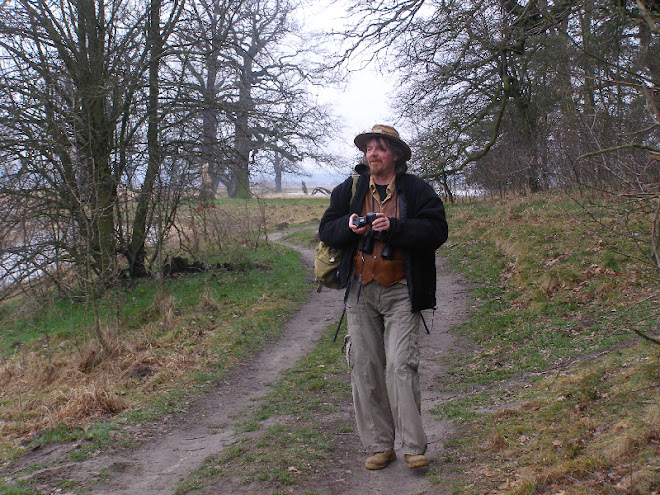
This is me

This is me
At the end of another Norfolk Coastal footpath walk. 47 miles, 3 days 99 species of bird. September 2009

Caley Wood view

Caley Wood view
sunshine through the canopy 29.05.08

A walk along the Warta Valley, Poznan, Poland. Feb 2007

A walk along the Warta Valley, Poznan, Poland. Feb 2007
Best birds on this walk: black and middle spotted woodpecker and short toed treecreeper

About Me

My photo
A primary school teacher for 30 years, I retired from teaching in July 2009 to set up my own science enhancement and communication company. The Primary Works offers science clubs, workshops and staged science shows nationwide. I have always been interested in bird watching since my early years. Apparently my first tick was after inquiring about a chaffinch and then receiving the Observer book of birds. By the age of 9 I had moved on to Tory Peterson's collins guide and was now involved on YOC birding holidays to Northumbria, Essex coast, Slimbridge and Yorkshire. My twitching rule is that I will willingly travel 1km for each gram the bird weighs. However, I have had many rarities just by being in the right place. I have travelled widely throughout Europe and also visited Australia and Sri Lanka. In 2016 I spent time at Portland Bird Obs and two trips to Aviero, Portugal. 2017 found me back in Sri Lanka in Feb/March, then July and back for New Year's Eve celebrations in December. Also returned to The Camargue in May for a 4 day trip. Few plans for 2018, but nothing yet booked apart from a trip to the IOW.

Grey heron

Grey heron
Over the allotment 28.09.08

Southern Hawker

Southern Hawker
Ridge footpath 27.08.08

Juvenile green woodpecker (17.08.08)

Juvenile green woodpecker (17.08.08)
Note the stripes, denoting a bird fledged this year.

common blue

common blue
Ash Valley G.C. 15.08.08

Indian balsam (impatiens glandulifera)

Indian balsam (impatiens glandulifera)
River Ash

azure damselfly

azure damselfly
River Ash 28.07.08

marbled white

marbled white
Discovered at Westland Green 22.07.08

ruddy darter

ruddy darter
Bush Wood 21.07.08

honeysuckle 19.07.08

honeysuckle 19.07.08
growing in hedgerow in Chapel Lane

cinnabar moth caterpillar

cinnabar moth caterpillar
Photographed on ragwort 19.07.08

Bittersweet

Bittersweet
Study of petals 11.06.08

male yellowhammer

male yellowhammer
08.06.08

common blue butterfly

common blue butterfly
06.06.08

River Ash

River Ash
looking south from the bridge at Hadham Ford

Common poppy (papaver rhoeas)

Common poppy (papaver rhoeas)
in rape field 29.05.08

Caley Wood sunshine

Caley Wood sunshine
29.05.08

Millenium Wood fox

Millenium Wood fox
24.05.08

common comfrey (symphytum officinale)

common comfrey (symphytum officinale)
06.05.08 banks of the River Ash

Garlic Mustard or Jack by the Hedge,(Alliara petiolata)

Garlic Mustard or Jack by the Hedge,(Alliara petiolata)
flowers, leaves and fruit edible . Good in salad and pesto

April showers

April showers
Double rainbow 30.04.08

Caley Wood bluebells

Caley Wood bluebells
22.04.08

Yellow Archangel

Yellow Archangel
Chapel Lane (20.04.08)

sunlight 16.04.08

sunlight 16.04.08
looking south west from Bush Wood

snowy buds

snowy buds
06.04.08 in Bush Wood

Looking north west

Looking north west
05.04.08 evening shower approaching

Back Garden

Back Garden
Easter Sunday (23.03.08)

Brick Kiln Hill

Brick Kiln Hill
Looking east (23.03.08)

No play today

No play today
The 2nd hole at Ash Valley golf course

Teasel head

Teasel head
Bush Wood (21.03.08)

Reflections

Reflections
daffodils at Bush Wood pond (21.03.08)

Swollen River Ash

Swollen River Ash
The river at the bottom of Winding Hill 16.03.08

Daybreak over the chapel

Daybreak over the chapel
Thursday 13th March

Wild daffodils (narcissus pseudonarcissus)

Wild daffodils (narcissus pseudonarcissus)
growing in Bush Wood

January snowdrops

January snowdrops
Banks of River Ash, north of Much Hadham

Good Moon

Good Moon
From garden 24.01.08

Village Green

Village Green
Looking east towards Acremore Street

Looking south before Hadham Ford

Looking south before Hadham Ford
rare January blue sky

Useful sites

The following are some useful websites that may interest readers of this blog.
Firstly, Bishop's Stortford Natural History Society http://bsnhs.webplus.net/

Fellow birder, Gary Whelan's blog. Gives reports from our trips out together plus reports from his trips abroad. http://hairybirders.blogspot.co.uk
http://www.hertsbirdclub.org.uk/ The official herts bird club website. Frequently updated, listing bird sightings around the county. Offers links to many other websites. Both of these sites also offer links to yahoo discussion groups.
http://www.birdforum.net/ An international site. You can enter as a guest but become a member( free) to post comments, bird sightings and just about anything to do with wild birds. Good news updates, classified section for binoculars, cameras etc.
http://www.guidedbirdwatching.com/ A new site set up where you can contact people worldwide who will help you find good birds in their country. UK section being set up presently.
http://www.britainsbirder.co.uk/
Fellow birders blog. Strtford resident, Graeme Smith regulary birds the area south of Stortford as well as around Spellbrook and the River Stort from Spellbrook to Twyford Locks. Some superb bird photography: Graeme uses a digital camera attached to his powerful telescope to get detailled images of the birds he sees. Well worth a browse.
Two local sites that may be of interest can be found at
http://www.thehadhams.com/ www.thepelhams.net/content/section/12/139/

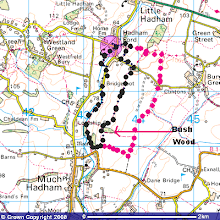
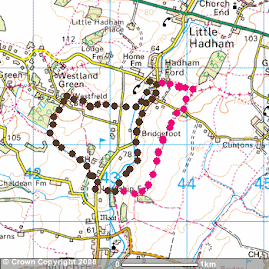
South Easterly walk

South Easterly walk
black, normal, red extended walk

South Westerly route.

South Westerly route.
Black usual, red extended

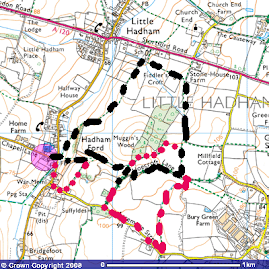
North Easterly walk

North Easterly walk
black short, walk. Red, extended

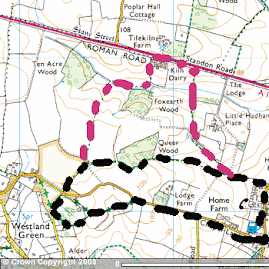
North West Patch

North West Patch
black route regular. Red route the extended wander