Wednesday, 3 December 2014

Micro Moth review

This year I have fully recorded all micro moths to the Skinner 125W garden trap, totalling in all 123 species, along with several more from outings to local woods.
Several species were good records for Hertfordshire and one a good record for the UK, so all in all, a pleasing year. I also have photographic records of micros for June 2011 - Nov 2012 and shall go through these to add to the list on the right hand side of this page.
The first and last micro of the year was the common plume, Emmelina monodactyla with Diurnea fagella being taken in March, along with Ypsolopha mucronella. A 20 plume moth was also taken on the last day of March
Ypsolopha mucronella
Into April and still very quiet for micros, Agonopterix alstromeriana, Agonopterix arenella, Syndemis musculana and Notocelia cynosbatella were the only representatives for the whole month.
Syndemis musculana
May started equally quietly, with plenty of nettle tap moths, bee moths, before a Phtheochroa rugsana was taken on the 19th. There then followed a flurry around the 20th with 4 species taken in one night, including Eulia ministrana. By the end of May, my micro total was up to a paltry 22 species, with nothing out of the ordinary
Phtheochroa rugosana
By the end of June this total had jumped to 47 species, with more unusual moths being: Lozotaenia forsterana, Parapoynx stratiotata, Ephestia unicolorella ssp woodiella, Hedya ochroleucana and plenty of the splendid Pseudargyrotoza conwagana.
Pseudargyrotoza conwagana
Into July, taking the running total to 104, with plenty of good moths:
Batia lunaris: 03.07.14
Carcina quercana 04.07.14
Argyresthia goedartella 05.07.14
Catoptria falsella 06.07.14
Oncocera semirubella: 21.07.14 a new moth for the garden and one that was reported in the 2006 Herts records as Herts extinct. A good moth indeed.

Lozotaeniodes formosanus 21.07.14 and another new moth for me.
Pandemis corylana 29.07.14 was the 100th micro of the year.

August began quietly with Yponomeuta plumbella being taken on the 6th, and then the excitement really kicked in with a moth I had not seen before and was confident it was not in any field guides I had. Eventually identified at 1.30 in the morning with Graeme Smith's help as a Diaphania perspectalis, the box moth an invasive pest originally from Japan. Nevertheless, a great moth to get in the trap. An Acleris rhombana on the 18th and by the 25.08.14 I had taken my 3000th moth for the year, a lesser yellow underwing. How unexciting!

Diaphania persectalis

Agriphila geniculea, common moth for August.
This was the period of the grass moths, Agriphila tristella, Catoptria falsella, Crambus pascuella and, whilst trapping in nearby Millennium Wood, 5 Agriphila selasella. these were shown to the county recorder for correct identification as a very good moth for the county. All 5 were identified as selasella
Agriphila selasella
Agriphila straminella
Identifcation of Ag selasella
Same scheme for Ag tristella
Both identification guides compiled by Graeme J Smith of Bishop's Stortford. Many thanks.

Agriphila tristella


Into September and Bryotropha affinis and Cacoecimorpha pronubana were the 115th and 116th micros on the 6th with Hypsopygia glaucinalis on the 17th.  Acleris sparsana on the 23rd and the month concluding with Clepsis consimilana on the 30th, this being the 120th for the year.
Clepsis consimilana
However, the probable real highlight of the year arrived on the 15th October and one of the last micros of the year, a Diasemiopsis ramburialis. A seriously rare inland migrant from North Africa, perhaps, certainly southern Europe.
Diasemiopsis ramburialis

Distribution map of D. ramburialis. Note Herts dot is only previous record: 1963 and very few inland records.
The final micro record of the year, the 123rd was another visitor from foreign shores, but a much more expected species, Udea ferrugalis, the rusty dot pearl. This was taken on the 26th October.
So, a fascinating year recording and, once I have trawled through previous records, I shall have a definitive number of species taken at the garden trap. Roll on July 2015! As Graeme pointed out: probably not too many micro moth-ers have taken both D. perspectalis and D. ramburialis in the same year, very lucky indeed.
Edit: spent the whole day going through over 340 archive photos dating back to 2011 of micro moths. Have added a fair few to my records of ones that I can definitely now identify due to more knowledge and better selection of texts. These have now been added to the records on the right. Just 17 left to identify.

End of the Mothing Year: Review of macro moths 2014

With temperatures now below moth flight temperatures, I have decided to put the trap away until the New Year and only then when the evening temperatures increase. A very successful year with several new species of macro moth discovered and recorded, with the following being highlights: These are new moths for the garden record, in total 11 new species.

31.03.14: Pine Beauty (Panolis flammea)
01.06.14: Burnet Companion (Euclidia glyphica)
01.06.14: Mother Shipton (Callistege mi)
03.06.14: Chocolate Tip(Clostera curtula)
12.07.14: Shark (Cucullia umbratica)
20.07.14: Lesser Common rustic (Mesapamea didyma)
20.07.14: Maple Pug (Eupithecia inturbata) no photo.

25.07.14: Small Phoenix (Ecliptopera silaceta)
05.09.14: Oak Nycteoline (Nycteola revayana)
26.09.14: Deep Brown Dart (Aporophyla lutulenta)
01.11.14: Pale November moth (Epirrita christyi)

In all, 212 species of macro moth, with a few unusual records as well as these first sightings for my parish list.

Flame carpet were more common this year than ever before, with 7 records for the garden Skinner 125W.


On 22.05.14 I took only my 2nd record of lobster moth, a good find indeed.


On 22.06.14 a lilac beauty was taken, a 3rd garden record. 2 more were to follow over the following week.
The following day, I took the 1st of 5 waved blacks for 2014. A moth I have taken every year since I began running a nightly trap in 2011.

On the 15.08.14, A 2nd garden Jersey Tiger was taken. This time it was the rarer lutescens form. This is the type that, as shown here, has orange and not red hindwings
Finally, on 26.10.14 I took the first of 4 merveille du jour, always a good end of season moth.

So, all in all, a total of 212 macro species as well as 123 micro species, totaling 335 moth species for the garden trap in 2014. In all, my list for macro moths now stands at a reasonable 290 for the garden.
In total, I have forwarded 3622 moth records to Colin, our County Recorder.
I look forward to next year and passing, with luck, the 300 macro moth species for the garden and also adding to the total of 413 moth species in total. 500 would be a reasonable target, so best get busy with sorting out the more difficult micros. A return trip to Sri Lanka in January should be excellent as I plan on taking head torch and mothing net. Catching should be easy whilst identifying them, somewhat more tricky as I don't seem to be able to find a field guide for the moths of Sri Lanka. There are, however, a few on line photo guides, so I shall be downloading these soon and begin studying what ones I shall be taking in January.

Couple of local wanders

Monday found me wandering along local footpaths, back from a coffee at Tesco. Very little to be seen and, with the light very poor, nothing worthwhile to photograph. Car headlights remained on until after midday!
Several green woodpecker, a single great spotted woodpecker along with increasing numbers of fieldfare and redwing. On the polo fields off Millfield Lane, 32 pied wagtails, 27 meadow pipits remain whilst the yellowhammers noted in good number the previous week have now moved on. However, a mixed flock of 92 gulls were also present. Majority were common gulls with 12 black headed gulls and a few lesser black backed gulls. A common buzzard was heard over Muggins Wood.
Today, a quick trip to the Hadham Hall lagoon and even less to note. The resident barn owl was at its roost but almost nothing else. A gas gun remains nearby, firing every 20 minutes, so I expect this to be the reason for no birds in what is usually a good area for linnets, yellowhammers, tufted duck and occasionally a reed bunting. 2 views of the lagoons here, plus a distant shot of a barn owl before it retreated into its treehole.

looking south east from Newspring Wood

same location looking south showing poor light conditions.
I have finally decided to put the moth trap away until February time as the catches are now minimal. One moth in the last two weeks, an Emmelina monodactyla taken on 30th November. Night time temperatures are, at present, so low no moth will be flying anyway.
Emmelina monodactyla

close up of wing markings

Saturday, 29 November 2014

Grey Day at Amwell

A midday visit to Amwell Reserve seemed like a good idea but the light quality was very poor.
From the vantage point, 3 goldeneye could be viewed on the opposite side of Great Hardmead Lake along with wigeon, shoveler, teal, mallard and gadwall. Good numbers of great crested grebe and lapwings along with a flyby snipe and kingfisher. 2 marsh tits were seen along the path to Hollycross Lake but no siskins and redpolls that I had hoped to photograph.
lapwings

mute swan overhead.

Friday, 28 November 2014

Good bird for the parish

Had a couple of hours spare midday yesterday, so off for a wander around Hadham Hall. A crow scaring gas gun firing meant nothing on the lagoon, but overhead, 2 ravens. Only the 2nd time I have seen ravens within the parish, the 1st being in April of this year, so a really good bird to see.
Back at the Hall, 10 siskins flew over and a tested my new camera lens in manual focus mode on a few greenfinches at the top of a tree. Had mixed results, to say the least!
Raven dwarfing a chasing jackdaw


greenfinch in manual mode. Not too bad.

Wednesday, 26 November 2014

Latest additions to year list

With December just around the corner, time to update the year list with latest additions from locally seen birds, a Norfolk trip and 2 days in Kent at Dungeness, Reculver and Chilham near Canterbury.

209 shore lark (Reculver, Kent)
210 whooper swan (Titchwell, Norfolk)
211 razorbill (West Runton, Norfolk)
212 black redstart (Sheringham, Norfolk)
213 great grey shrike (Chilham, Kent)
214 barnacle goose (Scotney Pits, Kent)
215 yellow legged gull (Dungeness, Kent)
216 siskin (Widford, Herts)
217 water pipit (Titchwell, Norfolk)
218 woodcock (Westland Green, Herts)
219 caspian gull (Amwell)
220 Goosander (Ashley Lake, Lea Valley, Herts)

With a few more trips planned over the next 2 weeks I would be happy with a year list of in excess of 225.
Archive photo: white stork over Tavira, The Algarve.

Filming on the River Ash

Today, I spent a few hours in and around the River Ash in Widford, just north of Ware. We were being filmed for the Herts and Middlesex Wildlife Trust, showing how we monitor the quality of the river by catching and counting certain invertebrates such as caddis fly larva, mayfly larva and freshwater shrimps.
After netting for 3 minutes we tipped the net contents into  a tray and sorted out each species by placing them in a compartment of a tray. We found plenty of shrimps, several caddis fly larvae and a good selection of mayfly larva. Also, but not in our count, several minnows and bullhead fish. All showing a good water quality of this chalk stream.
We were in a great habitat, siskins in the alders were a first for me this winter, along with plenty of corvids, a solitary little egret and great and blue tits. Looks a superb habitat for barn owls and there was an A frame nesting box present to attract this species. All in all, a most enjoyable 2 hours.
Janine and I identifying the invertebrates with Nigel filming and Jack on sound


Categorising the catch


The samples are placed into compartments so it's easier to count them.

Tuesday, 25 November 2014

Day in Kent

I was booked to offer a presentation on The birds of The Algarve and Baixo Alentejo regions of Portugal for Gravesend RSPB group, so off before 5.15a.m. for a morning around Dungeness. Over the bridge whilst it's still free is always a bonus and on the beach at Dunge for first light. Nothing, apart from a yellow legged gull near Prospect Cottage, a little gull towards the patch and a few gannets. Off to the ARC pit which was full of choppy water with one great white egret showing distantly.
Dungeness sunrise looking south east


Barnacle geese at Scotney Pits

Tufties in choppy water at The ARC pit
So little about, so I headed to the RSPB reserve, which had the VC closed, so no coffee. However, in the car park, as I wandered towards Dennis's hide, 3 tree sparrows. From the hide, 6 great white egrets on the far bank, close to the Long Pits.
3 of the 6 great white egrets

Joined by a fly in little egret

Posy tree sparrow, as below

Following my coffee disappointment, I headed off to Chilam near Canterbury. Within a minute of parking in the parish hall car park I noted a great grey shrike upon wires before it flew to various trees and posts around the small humped back bridge in Branch Lane. A good bird. In hawthorns were blackbirds, fieldfares and a solitary redwing whilst in the sedge in the field opposite the car park, a mistle thrush. A kestrel flew over and a grey wagtail moved on from near the bridge as I tried for a decent photo of the shrike. The light was poor, so I messed around with camera settings as I used my new lens for the first time. All tricky, but relatively pleased with these results.
Great grey shrike on a grey day!

Just got lucky with this shot in really poor light


hungry blackbird
All in all, a right pleasant morning and, so off to Gravesend for the presentation and a wonderfully receptive audience before a drive home that saw me back in the village by 5.30. A lovely day and now preparing for a day filming for Herts and Middlesex WT on the River Ash tomorrow morning, catching and identifying invertebrates. Should be a great time. Where are my waders?

Sunday, 23 November 2014

210th macro for the garden 2014

A quick trip out to local woods last night seemed like a good idea as it was calm and 12C. However, after an hour with the headtorch and net I had one moth, a mottled umber, along with views of a tawny owl and a fox. Back home, the Skinner trap was on and had attracted a December moth, a new moth for the year.
As the evening wore on I took 2 more mottled umbers, taking my annual total for moths in the garden to a respectable 3621, with 210 macro species and 132 micro species in total this year.
mottled umber

December moth
Only a few species I would anticipate on taking in the remaining 5 weeks of the year; winter moth and sprawler. Anything else would be a most welcome bonus. A few Palpita vitrealis about at present, mainly on the south coast, but one taken in nearby Bishop's Stortford last night, so worth keeping the trap running.

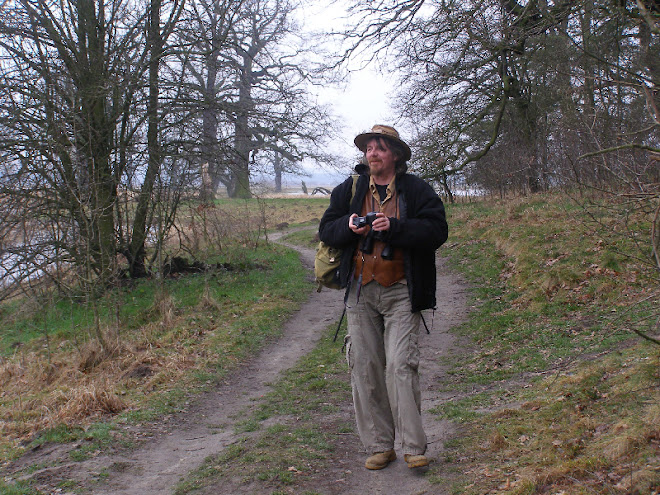
This is me

This is me
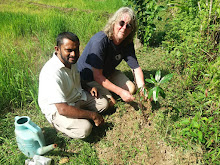
At the end of another Norfolk Coastal footpath walk. 47 miles, 3 days 99 species of bird. September 2009

Caley Wood view

Caley Wood view
sunshine through the canopy 29.05.08

A walk along the Warta Valley, Poznan, Poland. Feb 2007

A walk along the Warta Valley, Poznan, Poland. Feb 2007
Best birds on this walk: black and middle spotted woodpecker and short toed treecreeper

About Me

My photo
A primary school teacher for 30 years, I retired from teaching in July 2009 to set up my own science enhancement and communication company. The Primary Works offers science clubs, workshops and staged science shows nationwide. I have always been interested in bird watching since my early years. Apparently my first tick was after inquiring about a chaffinch and then receiving the Observer book of birds. By the age of 9 I had moved on to Tory Peterson's collins guide and was now involved on YOC birding holidays to Northumbria, Essex coast, Slimbridge and Yorkshire. My twitching rule is that I will willingly travel 1km for each gram the bird weighs. However, I have had many rarities just by being in the right place. I have travelled widely throughout Europe and also visited Australia and Sri Lanka. In 2016 I spent time at Portland Bird Obs and two trips to Aviero, Portugal. 2017 found me back in Sri Lanka in Feb/March, then July and back for New Year's Eve celebrations in December. Also returned to The Camargue in May for a 4 day trip. Few plans for 2018, but nothing yet booked apart from a trip to the IOW.

Grey heron

Grey heron
Over the allotment 28.09.08

Southern Hawker

Southern Hawker
Ridge footpath 27.08.08

Juvenile green woodpecker (17.08.08)

Juvenile green woodpecker (17.08.08)
Note the stripes, denoting a bird fledged this year.

common blue

common blue
Ash Valley G.C. 15.08.08

Indian balsam (impatiens glandulifera)

Indian balsam (impatiens glandulifera)
River Ash

azure damselfly

azure damselfly
River Ash 28.07.08

marbled white

marbled white
Discovered at Westland Green 22.07.08

ruddy darter

ruddy darter
Bush Wood 21.07.08

honeysuckle 19.07.08

honeysuckle 19.07.08
growing in hedgerow in Chapel Lane

cinnabar moth caterpillar

cinnabar moth caterpillar
Photographed on ragwort 19.07.08

Bittersweet

Bittersweet
Study of petals 11.06.08

male yellowhammer

male yellowhammer
08.06.08

common blue butterfly

common blue butterfly
06.06.08

River Ash

River Ash
looking south from the bridge at Hadham Ford

Common poppy (papaver rhoeas)

Common poppy (papaver rhoeas)
in rape field 29.05.08

Caley Wood sunshine

Caley Wood sunshine
29.05.08

Millenium Wood fox

Millenium Wood fox
24.05.08

common comfrey (symphytum officinale)

common comfrey (symphytum officinale)
06.05.08 banks of the River Ash

Garlic Mustard or Jack by the Hedge,(Alliara petiolata)

Garlic Mustard or Jack by the Hedge,(Alliara petiolata)
flowers, leaves and fruit edible . Good in salad and pesto

April showers

April showers
Double rainbow 30.04.08

Caley Wood bluebells

Caley Wood bluebells
22.04.08

Yellow Archangel

Yellow Archangel
Chapel Lane (20.04.08)

sunlight 16.04.08

sunlight 16.04.08
looking south west from Bush Wood

snowy buds

snowy buds
06.04.08 in Bush Wood

Looking north west

Looking north west
05.04.08 evening shower approaching

Back Garden

Back Garden
Easter Sunday (23.03.08)

Brick Kiln Hill

Brick Kiln Hill
Looking east (23.03.08)

No play today

No play today
The 2nd hole at Ash Valley golf course

Teasel head

Teasel head
Bush Wood (21.03.08)

Reflections

Reflections
daffodils at Bush Wood pond (21.03.08)

Swollen River Ash

Swollen River Ash
The river at the bottom of Winding Hill 16.03.08

Daybreak over the chapel

Daybreak over the chapel
Thursday 13th March

Wild daffodils (narcissus pseudonarcissus)

Wild daffodils (narcissus pseudonarcissus)
growing in Bush Wood

January snowdrops

January snowdrops
Banks of River Ash, north of Much Hadham

Good Moon

Good Moon
From garden 24.01.08

Village Green

Village Green
Looking east towards Acremore Street

Looking south before Hadham Ford

Looking south before Hadham Ford
rare January blue sky

Useful sites

The following are some useful websites that may interest readers of this blog.
Firstly, Bishop's Stortford Natural History Society http://bsnhs.webplus.net/

Fellow birder, Gary Whelan's blog. Gives reports from our trips out together plus reports from his trips abroad. http://hairybirders.blogspot.co.uk
http://www.hertsbirdclub.org.uk/ The official herts bird club website. Frequently updated, listing bird sightings around the county. Offers links to many other websites. Both of these sites also offer links to yahoo discussion groups.
http://www.birdforum.net/ An international site. You can enter as a guest but become a member( free) to post comments, bird sightings and just about anything to do with wild birds. Good news updates, classified section for binoculars, cameras etc.
http://www.guidedbirdwatching.com/ A new site set up where you can contact people worldwide who will help you find good birds in their country. UK section being set up presently.
http://www.britainsbirder.co.uk/
Fellow birders blog. Strtford resident, Graeme Smith regulary birds the area south of Stortford as well as around Spellbrook and the River Stort from Spellbrook to Twyford Locks. Some superb bird photography: Graeme uses a digital camera attached to his powerful telescope to get detailled images of the birds he sees. Well worth a browse.
Two local sites that may be of interest can be found at
http://www.thehadhams.com/ www.thepelhams.net/content/section/12/139/

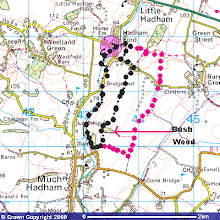
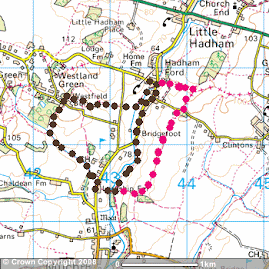
South Easterly walk

South Easterly walk
black, normal, red extended walk

South Westerly route.

South Westerly route.
Black usual, red extended

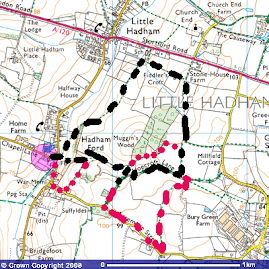
North Easterly walk

North Easterly walk
black short, walk. Red, extended

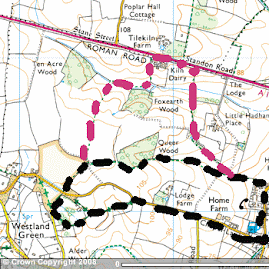
North West Patch

North West Patch
black route regular. Red route the extended wander