Wednesday, 18 June 2014

Week in Madeira

Robin in the Botanical Gardens.
Spent a week on the superb island of Madeira on what was, basically, a non birding holiday. Managed a few trips around Funchal as well as a trip all around the east of the island. Certainly spectacular scenery but very few birds to note and again, only several species of butterfly.
First birds I encountered were in the small garden of our hotel with a canary being a lifer for me. These were present in the conifer most days, but still not too easy to get a reasonable photo. A few of my efforts here.


juvenile canary
A bird that was seen in every park and many gardens, including the wonderful Botanical gardens, (accessed by 2 cable car rides) was the blackcap. These were heard singing everywhere.
male blackcap in hotel garden

female blackcap at the Botanical gardens

another male, singing in a park
One morning I headed down to The Lido for a spot of seawatching. Usual fare, i.e. yellow legged gulls and terns, mostly common, but after a short while, a roseate winged its way past.
yellow legged gull

common tern

suspected roseate tern

roseate tern
On further searches, I have been informed that roseate breed around the harbour at Funchal, so pleased to note these. They appeared to be on a rock just off the Lido, shown here.
Other common birds were blackbirds, chaffinches, kestrels, endless feral pigeons and on 2 occasions, grey wagtail. A common buzzard was seen in trees as we headed towards Santana, but no other birds of prey.

Disappointingly, my pelagic trip with Madeiran Wind birds was cancelled due to high winds out to sea to the east of the island. Consequently, no petrels or shearwaters to report.
Butterfly watching was dominated by the magnificent monarch. Only recorded this once before, at Portland by the doctors surgery in 2012. Everyday gave great flyby views but rarely settled and when one eventually did, in a park, it had to be the most worn specimen on the island!
Other butterflies were equally non camera cooperative but did manage to fire off a few poor quality shots to get these. Again, end of season, worn examples.
worn short tailed blue

Southern small white

long tailed blue.
These are only putative identifications and if anyone can offer other suggestions I would be grateful. Finally, the most common sight on the island, including the patio outside our room were the lizards. as yet, not identified to species. These were everywhere and on some warm walls in Funchal, present in large numbers. A selection of shades of colour were evident, ranging from green through blues to the regular brown colour.
Edit: surprise surprise: these lizards are called..................... guess.............................. yep: Madeiran lizards. Lacerta dugesii
on church wall at Camacha


Finally, at the top of Pico da Arrierio, the 3rd highest peak on the island at 1818m, there were small pipit like birds, another lifer as they were Bethelot's pipit, a common bird for the Canary Islands. Sadly, the only good sighting I got was of one on top of a telegraph pole and was keen to id it first and it rose before I could train the camera on it.
A brilliant place to visit and much more left to see so, I suspect, we shall be returning in the next few years.

Sunday, 8 June 2014

red Kites

I received a phone call from a resident of the village saying that the hay in a field near home was being cut and that there were plenty of birds overhead. I wandered round to encounter 1 kestrel, 2 common buzzards, 4 red kites and numerous corvids. Great views of the kites as they swooped low over the newly mown hay.
red kite


2 red kites

kestrel

kestrel

Saturday, 7 June 2014

Good Day in Norfolk

Friday morning and a late start for me due to a late night previously. Therefore, I was on the road by 8.30, heading to Burnham Overy Staithe, between Hunstanton and Cromer. The target here was the rare Spectacled Warbler, only the 8th record for UK. It had been reported from low sueda vegetation near the dunes at the end of the sea wall and footpath from B.O.S., about a mile from the village centre and sailing club.
As I wandered along the path, constantly being overtaken by those in a hurry to see the rare bird, I recorded, spoonbill, little tern, common tern, oystercatcher and several other waders. Cormorants and a solitary little egret flew overhead. At the "twitch" there were about 50 or so, strung out in a long line. The bird was seen frequently, calling and carrying nest building material to a low bush at the back of the patch it clearly favoured. This was my first UK sighting of a spectacled warbler, having seen and heard plenty around The Camargue. Basically a small whitethroat with a dark patch on the lores and a much shorter and scratchy call. Getting photos was not easy as it only stayed still for a second or two, before flitting elsewhere. Clearly, he was not going to find a mate, but there was the chance he would be present at the weekend when the majority of birders would be able to see him.
oystercatcher

spoonbill

the twitch

spectacled warbler

Add caption


reed bunting
As with all twitches, there are a few folk whose enthusiasm gets the better of them and at one point a meadow pipit popped on to a nearby branch. to the cacophony of 30 cameras firing off 5 shots per second. However, the humour was good and the bird's territory respected.
As I wandered back, I tried for little and common tern photos, but the heat was creating a haze that hindered sharp shots, as noted in the ones above.
little tern

black headed gull and little tern

common tern
Also, as I wandered back, a skylark decided to dust bath just infront of me.
After this, and bumping into Colin, a birder I know, I headed off to Titchwell, a few miles to the west. Here, all was fairly quiet bird wise but very busy human wise. Not too much about apart from several red crested pochards on Thornham Pool, 2 greenshanks at the back of Freshmarsh as well as fly over little gull and more little terns.
cygnets, Thornham Pool

avocet

black tailed godwit showing coloured rings, reported to staff.

By now it was mid afternoon and I decided to head east, towards Lowestoft, so I stopped for a coffee at Cley NWT base. As I sat there watching the very quiet reserve, news broke of a local red backed shrike at Walsey Hills. Initial comments were that it had flown so I headed off to Gramborough Hill as there is  likely habitat there, to be met by several birders who had seen it well on the fence post, before it headed south over the fields. Out with the scope and there, distantly on a small bush was a female red backed shrike. It then headed east along Meadow Lane. I thought it might be worth popping down to Kelling Water Meadow, the other end of Meadow Lane to get a possible photo, but I was concerned about time, as I needed to be set up at Lowestoft for a 7.30pm show on the Birds of Sri Lanka.
I stopped off at West Runton clifftop for a few minute sea watch, but only new bird was sand martin. Then, off to Lowestoft via Cromer and Gt. Yarmouth.
I managed to get there in time to enjoy some fish and chips before the talk to a good audience, eventually arriving home at 12.45a.m. Indeed, a long day.
The only other noteworthy sighting was of a quail that ran out in front of the car as I drove towards South Creake, not far from Sculthorpe Reserve.
Bird species, red ones are year listers:
cormorant, little egret, grey heron, spoonbill, mute swan, greylag goose, canada goose, shelduck, mallard, gadwall, shoveler, teal, red crested pochard, tutfed duck, red kite, marsh harrier, common buzzard, kestrel, hobby, red legged partridge, quail, pheasant, moorhen, coot, oystercatcher, avocet, ringed plover, lapwing, turnstone, dunlin, redshank, greenshank, black tailed godwit, bar tailed godwit, black headed gull, mediterranean gull, herring gull, little gull, little tern, sandwich tern, common tern, wood pigeon, collared dove, swift, green woodpecker, skylark, sand martin, swallow, house martin, meadow pipit, (50 sp) pied wagtail, wren, dunnock, robin, blackbird, blackcap, whitethroat, spectacled warbler, sedge warbler, cetti's warbler, reed warbler, willow warbler, chiffchaff, great tit, blue tit, long tailed tit, red backed shrike, magpie, jay, jackdaw, carrion crow, starling, house sparrow, chaffinch, goldfinch, greenfinch, reed bunting, yellowhammer. In total 78 species. Not too bad for a June day

Tuesday, 3 June 2014

Red Letter day with moths

Having been running a trap every night for 3 years now there are still many macro species I expect to find, but obviously new moths are becoming harder to get. Therefore, pleasing to open the trap this morning and immediately note a chocolate tip on the egg boxes. A first for me and garden albeit one I had anticipated.
Described in Herts. moths as uncommon resident with only 160 records since 1890, so, indeed, a pleasing moth to see. Only my second new moth of the year, following on from a Pine beauty in March.
Chocolate tip
Another flame carpet was also taken along with regulars such as privet hawk, buff ermine, whilst buff tip and common wave were new for the year. All in all, with a few micros and pugs still to identify, a good night.
In all: 26 moths of 23 species. One of my better nights this year.
Common wave

Buff tip

Monday, 2 June 2014

More moths 02.06.14

2 year records at the trap this morning: a fern and spectacle. The fern is not a common garden record, this being my 3rd trapping whilst the spectacle will be present on a regular basis for the next few months, I expect.
2 privet hawkmoths, a poplar hawkmoth, scorched wing, common swift, mottled rustic, large nutmeg, common pug and a heart and dart made up the more regular moths along with a micro that is presently awaiting identification and residing in the fridge.

Fern

spectacle

Sunday, 1 June 2014

Quick check at Hadham Hall

A morning check around the irrigation lagoon at Hadham Hall this morning was eventful in that several new day flying moths were recorded as well as a new plant for the parish and the first emperor dragonfly of 2014.
The moths on the wing were the expected, but never recorded in the parish before, Mother Shipton and the burnet companion. Both common moths and just a matter of time before I found them.
Mother shipton

burnet companion
As well as the emperor dragonfly, azure damselflies and common blue damselflies were present in good numbers (100+.) Also, several male common blue butterflies were nectaring on the plants, particularly, the clover.
common blue (male)

common blue damselfies

azure blue damselflies
Bird wise, a solitary tufted duck was on the lagoon, some moorhens and coots whilst 5 swallows were feeding over the water. Both green and great spotted woodpeckers were heard and a pair of red legged partridge were flushed from the wheat field. Linnets, yellowhammers and whitethroats were all in good voice, as were a few skylarks.
moorhen

coot

tufted duck

swallow

An unusual plant was found, a common broomrape, a new species for the parish records. Several of these parasitic plants were just flowering. They derive all sustenance from their host plant, in the case of common broomrape, it feeds on clover.
common broomrape

More new moths

Several new moths to the trap on a warm and cloudy night. A 2nd garden record of flame carpet was the highlight moth, taken around midnight, roosting on the fence I painted white next to the trap.
Also new for the year was a well marked small clouded brindle, a snout along with 2 micro moths, Cydia pomonella (codling moth) and Pandemis cerasana (barred fruit tree tortrix)
Others were several buff ermines, brown rustic, udea olivalis and a common swift. Hopefully, after a warm day the clouds will again roll in and another good night will ensue.
small clouded brindle

barred fruit tree tortrix

codling moth

flame carpet

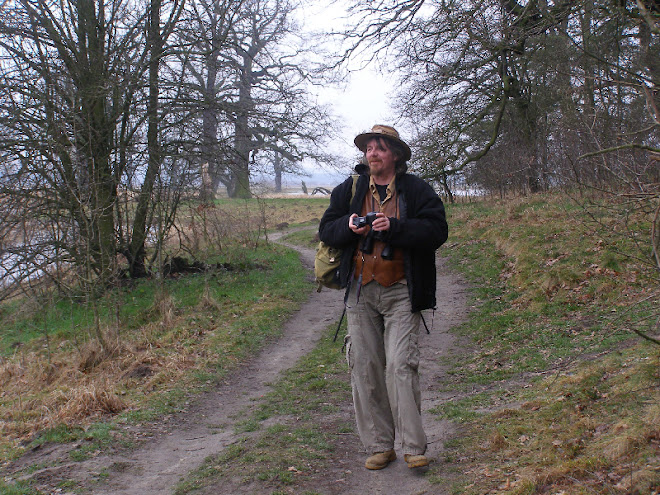
This is me

This is me
At the end of another Norfolk Coastal footpath walk. 47 miles, 3 days 99 species of bird. September 2009

Caley Wood view

Caley Wood view
sunshine through the canopy 29.05.08

A walk along the Warta Valley, Poznan, Poland. Feb 2007

A walk along the Warta Valley, Poznan, Poland. Feb 2007
Best birds on this walk: black and middle spotted woodpecker and short toed treecreeper

About Me

My photo
A primary school teacher for 30 years, I retired from teaching in July 2009 to set up my own science enhancement and communication company. The Primary Works offers science clubs, workshops and staged science shows nationwide. I have always been interested in bird watching since my early years. Apparently my first tick was after inquiring about a chaffinch and then receiving the Observer book of birds. By the age of 9 I had moved on to Tory Peterson's collins guide and was now involved on YOC birding holidays to Northumbria, Essex coast, Slimbridge and Yorkshire. My twitching rule is that I will willingly travel 1km for each gram the bird weighs. However, I have had many rarities just by being in the right place. I have travelled widely throughout Europe and also visited Australia and Sri Lanka. In 2016 I spent time at Portland Bird Obs and two trips to Aviero, Portugal. 2017 found me back in Sri Lanka in Feb/March, then July and back for New Year's Eve celebrations in December. Also returned to The Camargue in May for a 4 day trip. Few plans for 2018, but nothing yet booked apart from a trip to the IOW.

Grey heron

Grey heron
Over the allotment 28.09.08

Southern Hawker

Southern Hawker
Ridge footpath 27.08.08

Juvenile green woodpecker (17.08.08)

Juvenile green woodpecker (17.08.08)
Note the stripes, denoting a bird fledged this year.

common blue

common blue
Ash Valley G.C. 15.08.08

Indian balsam (impatiens glandulifera)

Indian balsam (impatiens glandulifera)
River Ash

azure damselfly

azure damselfly
River Ash 28.07.08

marbled white

marbled white
Discovered at Westland Green 22.07.08

ruddy darter

ruddy darter
Bush Wood 21.07.08

honeysuckle 19.07.08

honeysuckle 19.07.08
growing in hedgerow in Chapel Lane

cinnabar moth caterpillar

cinnabar moth caterpillar
Photographed on ragwort 19.07.08

Bittersweet

Bittersweet
Study of petals 11.06.08

male yellowhammer

male yellowhammer
08.06.08

common blue butterfly

common blue butterfly
06.06.08

River Ash

River Ash
looking south from the bridge at Hadham Ford

Common poppy (papaver rhoeas)

Common poppy (papaver rhoeas)
in rape field 29.05.08

Caley Wood sunshine

Caley Wood sunshine
29.05.08

Millenium Wood fox

Millenium Wood fox
24.05.08

common comfrey (symphytum officinale)

common comfrey (symphytum officinale)
06.05.08 banks of the River Ash

Garlic Mustard or Jack by the Hedge,(Alliara petiolata)

Garlic Mustard or Jack by the Hedge,(Alliara petiolata)
flowers, leaves and fruit edible . Good in salad and pesto

April showers

April showers
Double rainbow 30.04.08

Caley Wood bluebells

Caley Wood bluebells
22.04.08

Yellow Archangel

Yellow Archangel
Chapel Lane (20.04.08)

sunlight 16.04.08

sunlight 16.04.08
looking south west from Bush Wood

snowy buds

snowy buds
06.04.08 in Bush Wood

Looking north west

Looking north west
05.04.08 evening shower approaching

Back Garden

Back Garden
Easter Sunday (23.03.08)

Brick Kiln Hill

Brick Kiln Hill
Looking east (23.03.08)

No play today

No play today
The 2nd hole at Ash Valley golf course

Teasel head

Teasel head
Bush Wood (21.03.08)

Reflections

Reflections
daffodils at Bush Wood pond (21.03.08)

Swollen River Ash

Swollen River Ash
The river at the bottom of Winding Hill 16.03.08

Daybreak over the chapel

Daybreak over the chapel
Thursday 13th March

Wild daffodils (narcissus pseudonarcissus)

Wild daffodils (narcissus pseudonarcissus)
growing in Bush Wood

January snowdrops

January snowdrops
Banks of River Ash, north of Much Hadham

Good Moon

Good Moon
From garden 24.01.08

Village Green

Village Green
Looking east towards Acremore Street

Looking south before Hadham Ford

Looking south before Hadham Ford
rare January blue sky

Useful sites

The following are some useful websites that may interest readers of this blog.
Firstly, Bishop's Stortford Natural History Society http://bsnhs.webplus.net/

Fellow birder, Gary Whelan's blog. Gives reports from our trips out together plus reports from his trips abroad. http://hairybirders.blogspot.co.uk
http://www.hertsbirdclub.org.uk/ The official herts bird club website. Frequently updated, listing bird sightings around the county. Offers links to many other websites. Both of these sites also offer links to yahoo discussion groups.
http://www.birdforum.net/ An international site. You can enter as a guest but become a member( free) to post comments, bird sightings and just about anything to do with wild birds. Good news updates, classified section for binoculars, cameras etc.
http://www.guidedbirdwatching.com/ A new site set up where you can contact people worldwide who will help you find good birds in their country. UK section being set up presently.
http://www.britainsbirder.co.uk/
Fellow birders blog. Strtford resident, Graeme Smith regulary birds the area south of Stortford as well as around Spellbrook and the River Stort from Spellbrook to Twyford Locks. Some superb bird photography: Graeme uses a digital camera attached to his powerful telescope to get detailled images of the birds he sees. Well worth a browse.
Two local sites that may be of interest can be found at
http://www.thehadhams.com/ www.thepelhams.net/content/section/12/139/

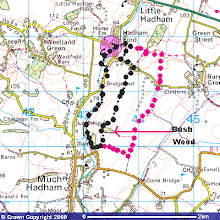
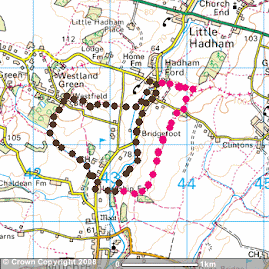
South Easterly walk

South Easterly walk
black, normal, red extended walk

South Westerly route.

South Westerly route.
Black usual, red extended

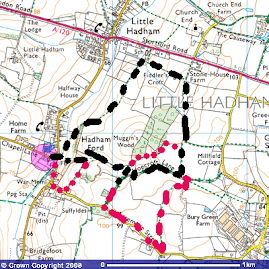
North Easterly walk

North Easterly walk
black short, walk. Red, extended

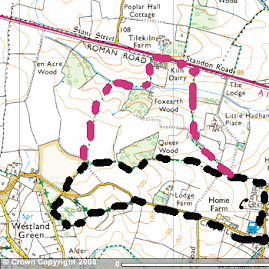
North West Patch

North West Patch
black route regular. Red route the extended wander