Wednesday, 1 September 2021

August Mothing: An overview

 End of month review of the moths taken to my 125MV Skinner trap set in my small rural garden in Little Hadham, East Herts.

August gave up 1976 moths in total making the year count so far 6001 moths made up of 373 species in total. This total shows 220 macro species and 153 micro species. All these totals are considerably lower than most years and certainly well down on 2020.

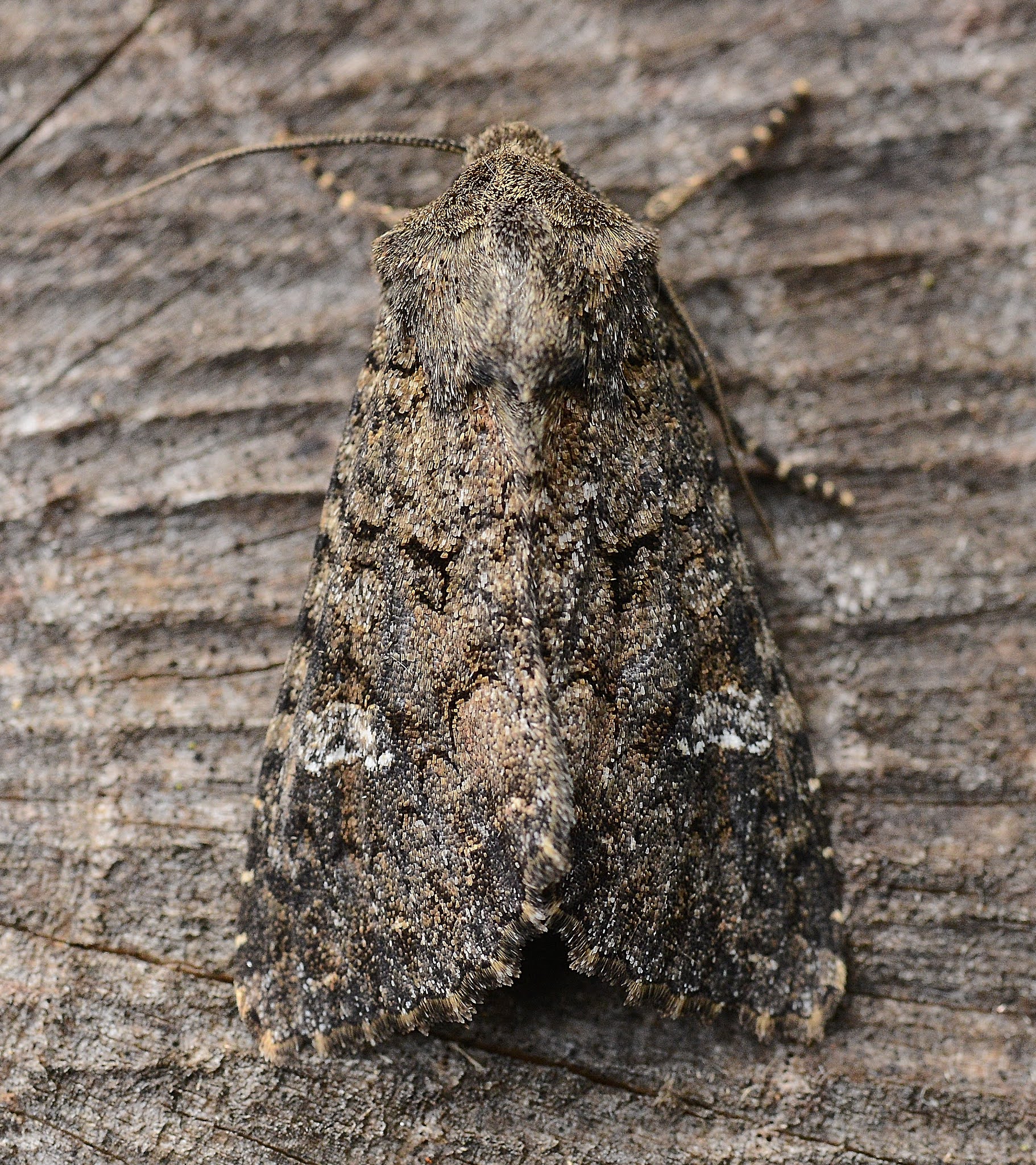
One new macro was recorded for the parish, just a few miles west of Bishop's Stortford. This was a Tawny-barred angle taken on 25.viii.21.

Tawny-barred angle

In all, 26 new species of macro were added for the year with Cabbage (15th,) Tree Lichen Beauty (17th) and Turnip (31st) being moths I don't record on a regular basis.

Numbers were supplied by the usual suspects: Setaceous hebrew character, Common wainscot and the yellow underwing brigade. However, no Broad bordered yellow underwing yet but 171 Lesser broad bordered yellow underwing as from the 20.vii.21.

Other good counts: Jersey tiger 23 as from 02.viii.21 and 39 Square spot rustics as from 08.viii.21.

A Bactra lancealana was new for parish records on 16.viii.21 whilst nothing else was unexpected. Numbers supplied by 95 Agriphila geniculea after the first one on 07.viii.21, 105 Cydalima perspectalis as from 10th.vii.21 up until 30.viii.21 and 257 Yponomeuta evonymella between 07.vii.21 and 27.viii.21.

Since beginning trapping in June 2011 I have now recorded 803 species within the parish of Little Hadham, made up of 380 macros and 423 micros. None too bad considering I only run my Skinner every night whilst also placing a 15W Actinic Heath type trap around woods and grasslands on favourable nights each month.


Jersey tiger

Bactra lancealana

Tree lichen beauty

Cabbage

Sunday, 1 August 2021

July Mothing, an overview

 Trapped every night bar three in July, running the Skinner 125 MV at the bottom of the garden where it has been for over 10 years. A good selection of moths including several new for Little Hadham parish records, a village a few miles west of Bishop's Stortford in East Herts.

New moths were:

Brown Scallop: 18.vii.21

Sycthropia crataegella: 10.vii.21

Rhyconia pinicolana: 18.vii.21

Eucosma conterminiana: 19.vii.21

Exoteleia dodecella: 19.vii.21

Caloptilia honoratella: 29.vii.21 gen det completed. This moth became the 800th species for my parish records. Also, a good county record for Hertfordshire. this was the 6th county record and only 2nd site record. All previous 5 taken from a garden in Stevenage, 1 in 2020 and 4 this year. All spring records. 

Sitochroa verticalis: 31.vii.21

A faded Brown scallop

Scythropia crataegella

Caloptilia honoratella


In total, 135 new species were recorded throughout July, made up of 62 macro species and 73 micros. Apart from those above, macro highlights were:

Leopard: 4th garden record 02.vii.21

Scarce silver lines: 1st garden record, 2nd parish record 04.vii.21

Blackneck: 3rd garden record

Eyed hawkmoth: 1st for 4 years, 05.vii.21 and again on the 11th

Waved black: few each year, only one so far this year on 21.vii.21

Magpie: 1st for 3 years 27.vii.21 and 2 more since

Rosy rustic: a reasonably early emergence 29.vii.21.

Rosy rustic

Magpie

Eyed hawkmoth

Scarce silver lines

Leopard.


Micro moths that were noteworthy included:

Chilo phragmitella: 10.vii.21. Not an annual to the garden trap.

Yposlopha dentella: 17.vii.21 Again not an annual capture.

Grapholita janthinana: 18.vii.21 2nd garden record.

Chilo phragmitella

Grapholita janthinana

Numbers were inevitably supplied by Common footman (385,) Rustic (75,) Dingy footman (50,) Least carpet (33) and Ruby tiger at 21 since 21.vii.21.

Invariably micro numbers were heightened by Yponomeuta evonymella (180 since 07.vii.21,) Cydalima perspectalis (69 since 10.vii.21) and Pleuroptya ruralis with 25 so far since 18.vii.21)

The running totals for the year were, on 31.vii.21 193 macro species and 138 micro species, giving a total moth species of 331. Not the best year by a long chalk. Often over 400 species for the end of July and many 1st generation species were missed completely in April and May. Early and Purple thorn only taken on 2nd gen examples this year.

On the 28 days of trapping I recorded, in total, 3004 moths for July with the best night being the 27.vii.21 where 180 moths were recorded of 56 species. Not the best species count, which  the 19.vii.21 with a record 65 species. Busy times. Obviously, the earlier I get to the trap in the morning, preferably at sunrise, the better the total as there will still be plenty of micros on the perspex and adjacent fence. These will have invariably flown by 7am.

Hopefully, the numbers and new species will continue into August.


Saturday, 17 July 2021

Guiding in North Norfolk

Painted Lady near Kelling Water meadows.

 Last Tuesday (13th July) Wendy and I set off for a couple of nights staying at the Kings Arms, Blakeney, returning Thursday afternoon. A relatively early night as the following morning I was booked to pick up American birder Moez from his accommodation in Sheringham, so I was heading back up the M11 at 5.30am ready for a meet at 7.30.
Superb Yellowhammer at Blakeney Esker

I arrived a few minutes late courtesy of some farm traffic  and we set off for Sheringham Esplanade for a sea watch: gulls, terns and gannets got on to the day list before we headed towards Kelling Heath, hopefully for Dartford warbler. This, after a good search was neither seen nor heard but several warblers made the list as I pointed out several tree and plant species. Once back at the car park, time for a good wander down to Kelling Water Meadow and Kelling Quags where more warbler species were noted along with several finch species. A quick check on the sea before returning to Kelling Tea Rooms where the car was.

We popped into Weybourne beach car park and down Salthouse Beach Road but nothing of note so we moved along, stopping for coffee at Cley NWT Visitors' Centre and then another sea watch from Cley beach. Nothing to add and a check on the Eye field  gave up one sedge warbler so time for a longer walk.

Sedge warbler


Parked at Stiffkey campsite car park and headed east to Stiffkey Fen. This was a lovely walk with linnets everywhere. Spoonbills and Shelduck flew east whilst at Stiffkey Fen Black tailed godwits, gulls and wildfowl. I hadn't carried my scope due to the increasing heat, meaning Moez (from the Arizona desert) was taking off layers of clothing as he had felt the cold earlier when it was only 18C.

Time for a change of habitat so parking in an incredibly busy Lady Anne's Drive we walked to the lake in Holkham Woods. Goldcrests and coal tits along with a good array of the more common butterflies and a few dragonflies.

From here, a drive into Holkham Hall estate to view the deer herd before popping on to the car park at Brancaster Staithe for oystercatchers and then up to Choseley Barns, which are now not a patch on what they used to be so off for another wander at Holme NWT. As we drove over the narrow bridge before the car park 2 turtle doves upon wires. A 2nd record for Moez and the first of the year for me, indeed, first since 2019. Once parked we wandered towards the Visitors' Centre before dropping down on to the track and working our way back to the car park by the golf course. Stonechats everywhere.

Our final stop was Blakeney Esker where many years ago I recorded 3 nightingale. It was now gone 7pm but no nightingales. A splendid yellowhammer, a pair of bullfinches and several Purple hairstreak butterflies. A good conclusion to a super day.

Purple hairstreak at Blakeney Esker


Dropped Moez back in Sheringham, turned around, headed home, stopping for a meal on the way and, due to endless A14 and A11 roadworks meaning reduced speed, I eventually got home at 11.10pm. Covered over 300 miles in the car and walked 14 miles in total.

A brilliant day out. Glass of red wine and bed for a good night's sleep.

A selection of photos below with, unfortunately, heat haze being an issue and meaning birds that were a little more distant were not photographable. One or two pleasing ones in what became quite harsh light in the afternoon.

Moez had spent the previous day at both Cley NWT Reserve and then Titchwell RSPB Reserve, hence the reason we headed elsewhere. His combined list for the 2 days should make for a good list for North Norfolk in mid July. 

Bird species:

  1. Gannet
  2. Cormorant
  3. Little egret
  4. Grey heron (over road at Egham on way home)
  5. Spoonbill
  6. Mute swan
  7. Greylag goose
  8. Shelduck
  9. Egyptian goose
  10. Mallard
  11. Teal
  12. Red kite
  13. Marsh harrier
  14. Common buzzard
  15. Sparrowhawk
  16. Kestrel
  17. Red legged partridge
  18. Pheasant
  19. Moorhen
  20. Coot
  21. Oystercatcher
  22. Avocet
  23. Golden plover
  24. Lapwing
  25. Sanderling
  26. Black tailed godwit
  27. Curlew
  28. Black headed gull
  29. Herring gull
  30. Lesser black backed gull
  31. Common gull
  32. Sandwich tern
  33. Common tern
  34. Stock dove
  35. Wood pigeon
  36. Turtle dove
  37. Collared dove
  38. Barn owl (over road near Castle Acre on way home)
  39. Swift
  40. Great spotted woodpecker
  41. Skylark
  42. Sand martin
  43. House martin
  44. Swallow
  45. Meadow pipit
  46. Pied wagtail
  47. Wren
  48. Dunnock
  49. Robin
  50. Stonechat
  51. Song thrush
  52. Blackbird
  53. Blackcap
  54. Whitethroat
  55. Sedge warbler
  56. Cetti's warbler
  57. Reed warbler
  58. Chiffchaff
  59. Goldcrest
  60. Great tit
  61. Blue tit
  62. Coal tit
  63. Magpie
  64. Jackdaw
  65. Jay
  66. Rook
  67. Carrion crow
  68. Starling
  69. House sparrow
  70. Chaffinch
  71. Linnet
  72. Goldfinch
  73. Greenfinch
  74. Bullfinch
  75. Reed bunting
  76. Yellowhammer
    Fine male yellowhammer having a doze.

Butterflies.

  1. Painted Lady
  2. Small tortoiseshell
  3. Small white
  4. Red admiral
  5. Comma
  6. Speckled Wood
  7. Gatekeeper
  8. Meadow brown
  9. Purple haistreak
  10. Small skipper
  11. Large skipper
Common buzzard Kelling Heath

Same bird

Female linnet, Kelling Water Meadows

Male Linnet, Kelling Water Meadows

Reed bunting, male, Kelling Quags

Painted lady, Kelling Water Meadows

Comma, Kelling Water Meadows

Small tortoiseshell, Kelling Water Meadows

Common tern, Stiffkey Fen

Oystercatcher, Warham Greens

Non breeding plumage Black Headed gull, Stiffkey Greens

Black headed gull, breeding plumage, Stiffkey Greens

Stonechat, Stiffkey Greens

Male linnet, Stiffkey campsite

Distant and heat hazed wing tagged Marsh harrier

Red admiral, Holkham Pines

Turtle dove, one of a pair, Holme, just before car park


Stonechat, Holme dunes

Common buzzard being mobbed by Black headed gull, Holme NWT

Buzzard has had enough

Female House sparrow, Holme NWT

Male goldfinch, Holme NWT

Another Common buzzard overhead.


Friday, 2 July 2021

Moth review of the 1st 6 months of 2021

 The first 6 months of 2021 will go down as one of the poorest mothing years in living memory. 22 nights of frost in April and a very wet May, interspersed with a few hot and dry days really meant several common and expected moth species were not seen. It is possible they didn't emerge due to the low temperatures and it will now be a wait and see game. Will they remain in pupation until next year or just perish? If the latter is the case then certain moths will be hard to come by for a few years to come. Wonder if those that are bivoltine will emerge at the correct time as 2nd generation? Not sure we will ever prove that apart from where 1st and 2nd generations differ in colouration or size. 

Moths such as Purple thorn and Early thorn, regular visitors to the 125 MV Skinner trap were not seen at all, whilst others were counted in very small numbers. No moths were trapped at all between 28.iv.21 and 02.v.21 whilst my latest ever date for an empty trap occured on 25.v.21, a particularly cold night for the end of May

By mid June things began to pick up with several warmer, overcast nights, with the 28.vi.21 being the best night for species, where 43 different species were recorded. The night that offered the most moths was 16.vi.21 where 91 moths were taken, made up of 40 species. This was a very wet night, where my MV bulb blew but still functioned. Presumably a brighter light without the shaded glass surround. According to Jon Clifton, it was also likely to be emitting more UV light, hence the good haul for that night.

A few new records for Little Hadham were made during this period, as follows:

01.iii.21: Calybites phasianpennella

31.iii.21: Lead coloured drab

03.vi.21: Dichroampha acumintana

14.vi.21: Aethes beatricella

16.vi.21: Epinotia bilunana

17.vi.21: Netted pug

26..vi.21: Miller

By the last day of June, the totals were 133 species of macro moth and 65 micro species. Overall, 1515 moths were trapped.

The most numerous moths were: 

Large nutmeg: 134 

Treble lines: 115

Heart and dart: 86

Small quaker: 85

Common swift: 48

Common wainscot: 42

The most common micro was Celypha striana with a count of 22 specimens. Appears to be having a good year.

Not too many suprises in emergence times apart from a brief spell between 14.vi.21 and 18. vi.21 where 7 Common rustic aggs were taken. Not unheard of but a tad early. None since the final date. 

By 30.vi.21 the overall records for Little Hadham parish, including the garden at TL435218 stand at 378 macro species and 416 micro species, giving a total of 794 species since I began recording in June 2011, exactly 10 years ago. There are still many gaps and hopefully, it will be possible to pass 800 species by the end of this year.

Moths with particulary low numbers this period, ones that I normally expect to make 3 figures were Hebrew character (32) and Common quaker (38) whilst others are typically seen on more than 30 occasions were Double striped pug (4,) Nut tree tussock (1,) Green carpet (19) and Oak tree pug (1.)

Hopefully, July through to mid September should see a better haul and possibly a few more new records for my parish list.

Epinotia bilunana

Miller

Netted pug, female that started egg laying in the tube so immediately released.

A very worn Lead coloured drab that was gen detted to confirm

Small elephant hawkmoth continues to increase in number locally. None between 2011 and 2018, 1 in 2019, 4 in 2020 and already 6 for 2021.


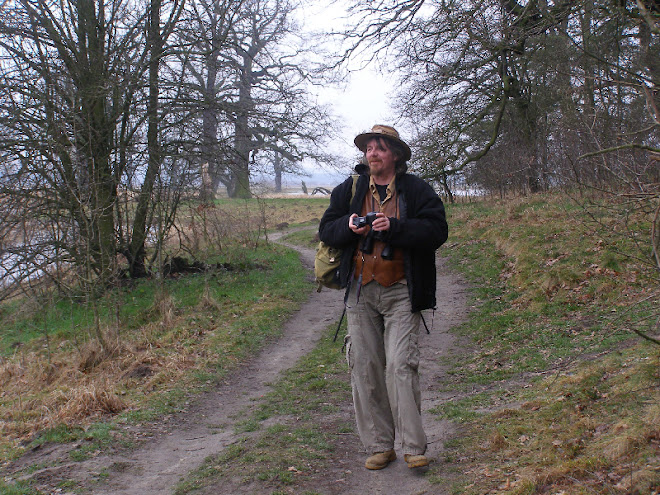
This is me

This is me
At the end of another Norfolk Coastal footpath walk. 47 miles, 3 days 99 species of bird. September 2009

Caley Wood view

Caley Wood view
sunshine through the canopy 29.05.08

A walk along the Warta Valley, Poznan, Poland. Feb 2007

A walk along the Warta Valley, Poznan, Poland. Feb 2007
Best birds on this walk: black and middle spotted woodpecker and short toed treecreeper

About Me

My photo
A primary school teacher for 30 years, I retired from teaching in July 2009 to set up my own science enhancement and communication company. The Primary Works offers science clubs, workshops and staged science shows nationwide. I have always been interested in bird watching since my early years. Apparently my first tick was after inquiring about a chaffinch and then receiving the Observer book of birds. By the age of 9 I had moved on to Tory Peterson's collins guide and was now involved on YOC birding holidays to Northumbria, Essex coast, Slimbridge and Yorkshire. My twitching rule is that I will willingly travel 1km for each gram the bird weighs. However, I have had many rarities just by being in the right place. I have travelled widely throughout Europe and also visited Australia and Sri Lanka. In 2016 I spent time at Portland Bird Obs and two trips to Aviero, Portugal. 2017 found me back in Sri Lanka in Feb/March, then July and back for New Year's Eve celebrations in December. Also returned to The Camargue in May for a 4 day trip. Few plans for 2018, but nothing yet booked apart from a trip to the IOW.

Grey heron

Grey heron
Over the allotment 28.09.08

Southern Hawker

Southern Hawker
Ridge footpath 27.08.08

Juvenile green woodpecker (17.08.08)

Juvenile green woodpecker (17.08.08)
Note the stripes, denoting a bird fledged this year.

common blue

common blue
Ash Valley G.C. 15.08.08

Indian balsam (impatiens glandulifera)

Indian balsam (impatiens glandulifera)
River Ash

azure damselfly

azure damselfly
River Ash 28.07.08

marbled white

marbled white
Discovered at Westland Green 22.07.08

ruddy darter

ruddy darter
Bush Wood 21.07.08

honeysuckle 19.07.08

honeysuckle 19.07.08
growing in hedgerow in Chapel Lane

cinnabar moth caterpillar

cinnabar moth caterpillar
Photographed on ragwort 19.07.08

Bittersweet

Bittersweet
Study of petals 11.06.08

male yellowhammer

male yellowhammer
08.06.08

common blue butterfly

common blue butterfly
06.06.08

River Ash

River Ash
looking south from the bridge at Hadham Ford

Common poppy (papaver rhoeas)

Common poppy (papaver rhoeas)
in rape field 29.05.08

Caley Wood sunshine

Caley Wood sunshine
29.05.08

Millenium Wood fox

Millenium Wood fox
24.05.08

common comfrey (symphytum officinale)

common comfrey (symphytum officinale)
06.05.08 banks of the River Ash

Garlic Mustard or Jack by the Hedge,(Alliara petiolata)

Garlic Mustard or Jack by the Hedge,(Alliara petiolata)
flowers, leaves and fruit edible . Good in salad and pesto

April showers

April showers
Double rainbow 30.04.08

Caley Wood bluebells

Caley Wood bluebells
22.04.08

Yellow Archangel

Yellow Archangel
Chapel Lane (20.04.08)

sunlight 16.04.08

sunlight 16.04.08
looking south west from Bush Wood

snowy buds

snowy buds
06.04.08 in Bush Wood

Looking north west

Looking north west
05.04.08 evening shower approaching

Back Garden

Back Garden
Easter Sunday (23.03.08)

Brick Kiln Hill

Brick Kiln Hill
Looking east (23.03.08)

No play today

No play today
The 2nd hole at Ash Valley golf course

Teasel head

Teasel head
Bush Wood (21.03.08)

Reflections

Reflections
daffodils at Bush Wood pond (21.03.08)

Swollen River Ash

Swollen River Ash
The river at the bottom of Winding Hill 16.03.08

Daybreak over the chapel

Daybreak over the chapel
Thursday 13th March

Wild daffodils (narcissus pseudonarcissus)

Wild daffodils (narcissus pseudonarcissus)
growing in Bush Wood

January snowdrops

January snowdrops
Banks of River Ash, north of Much Hadham

Good Moon

Good Moon
From garden 24.01.08

Village Green

Village Green
Looking east towards Acremore Street

Looking south before Hadham Ford

Looking south before Hadham Ford
rare January blue sky

Useful sites

The following are some useful websites that may interest readers of this blog.
Firstly, Bishop's Stortford Natural History Society http://bsnhs.webplus.net/

Fellow birder, Gary Whelan's blog. Gives reports from our trips out together plus reports from his trips abroad. http://hairybirders.blogspot.co.uk
http://www.hertsbirdclub.org.uk/ The official herts bird club website. Frequently updated, listing bird sightings around the county. Offers links to many other websites. Both of these sites also offer links to yahoo discussion groups.
http://www.birdforum.net/ An international site. You can enter as a guest but become a member( free) to post comments, bird sightings and just about anything to do with wild birds. Good news updates, classified section for binoculars, cameras etc.
http://www.guidedbirdwatching.com/ A new site set up where you can contact people worldwide who will help you find good birds in their country. UK section being set up presently.
http://www.britainsbirder.co.uk/
Fellow birders blog. Strtford resident, Graeme Smith regulary birds the area south of Stortford as well as around Spellbrook and the River Stort from Spellbrook to Twyford Locks. Some superb bird photography: Graeme uses a digital camera attached to his powerful telescope to get detailled images of the birds he sees. Well worth a browse.
Two local sites that may be of interest can be found at
http://www.thehadhams.com/ www.thepelhams.net/content/section/12/139/

South Easterly walk

South Easterly walk
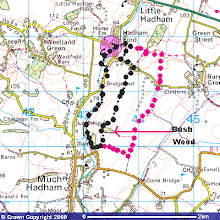
black, normal, red extended walk

South Westerly route.

South Westerly route.
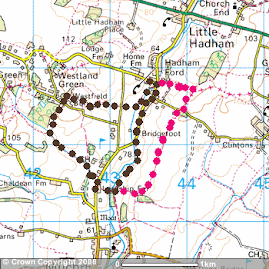
Black usual, red extended

North Easterly walk

North Easterly walk
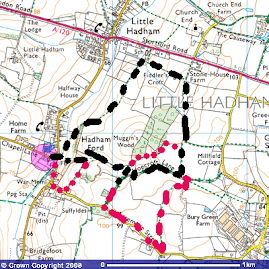
black short, walk. Red, extended

North West Patch

North West Patch
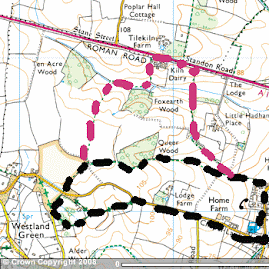
black route regular. Red route the extended wander