Sunday, 2 April 2017

Dawn chorus Walk


Sent from my iPhoneUp before 5 and a meeting with Davey, my intrepid companion for the 2 hour, 3.5 mile wander. We met in the village at 5.15 and headed uphill towards Millennium Wood. At the polo fields the chorus was just beginning, with pheasant, red legged partridge, skylark and carrion crow.
As we headed along Millfield Lane blackbirds, robins and song thrushes joined in and wren and blue tit were added in the wood.
From here, as it was getting lighter, we went through Bury Green noting mallard on the pond, many more of birds already heard as well as wood pigeon and collared dove. The first chiffchaff was heard at Clintons, one of at least 5 along with great tit, overhead herring and lesser black backed gulls and a very brief glimpse of a common buzzard.
At Acremans footpath, two foxes along a footpath that has mysteriously been ploughed and the first yellowhammer and coal tits. Back down the hill where a blackcap, my first in the parish this year and nuthatch made the list. A list that eventually totalled 30 species. Back home just after 7, lovely wander with good company.
Next one 23rd April where we should hear and see many more migrants including wheatear and an outside chance of ring ouzel

Moth report, Little Hadham Parish Jan - March

A first quarter report of moths within the parish in Little Hadham. At home, I run a 125MV Skinner trap every night I am home. Within the first quarter I missed 12 nights due to holiday at the end of Feb-beginning of March. Consequently, run all night on 78 occasions.
Away from home I use a 15W heath trap which I have used 32 times in this period in 12 sites, with Millennium Wood being visited the most, on 9 nights.
In total, a record of 393 moths were recorded, made up of 29 macro species and 9 micro species. There have been 2 new for parish records: small brindled beauty on 19.ii.17 from Westland Green and Caloptilia semifascia from Valley Fields on 30.iii.17.

Caloptilia semifascia

Small brindled beauty
 The year began very quietly, with just numbers being supplied by winter moth, most notably on on 07.i.17 when I netted 33 in Millennium Wood. Between 16.i.17 and 31.i.17 I recorded precisely 3 moths, an Early moth on the 20th, winter moth (28th) and another Early moth (30th) In total, January gave up 5 macro species: Mottled umber, winter moth, Chestnut, Satellite and Early moth.
 February didn't really improve things, with just Dotted border (6th) Pale brindled beauty (13th) Spring Usher (16th) March moth (19th) Small brindled beauty (19th) and dark chestnut (20th) along with the first micros of the year: Agonopterix heracliana (6th) Tortricodes alternella (14th) Acleris ferrugana (15th) Acleris cristana (17th) and Emmelina monodactyla (20th) February concluded, for me on the 21st as off to Sri Lanka and by this time the running total was 141 moths made up of 11 macros and 5 micros.
Returning on the 7th March and back to trapping, immediately scoring with species I probably have taken earlier had I been running the traps: Macro species were:
Common quaker (8th) Shoulder stripe (8th) Oak Beauty (8th) Hebrew character (8th) Clouded drab (9th) Double striped pug (10th) Engrailed (10th) Small quaker (16th) Early thorn (19th) Early grey (19th) Streamer (24th) Brindled pug (24th) Twin spotted quaker (24th) Water carpet (29th) Lunar marbled brown (30th) Purple thorn (30th) V pug (30th) and nut tree tussock (31st)
V pug

Lunar marbled brown

Water carpet

Micros during March were: Diurnea fagella (10th) Caloptilia semifascia (30th) Eriocrania subpurpurella (30th) and Acleris literana (31st)


As can be noted, the warmer last week of March provided a few better moths, showing that they are probably always there, just need temperatures in excess of 12C to get them to fly to the trap.
Notables on this list, apart from the 2 new for parish records were my 2nd, 3rd, and 4th Water carpet, 2nd Lunar marbled brown and 2nd Acleris literana.
All in all, a pleasing first quarter that compares favourably to 2016 where I took 276 moths of 20 macros and 7 micros.
Oak beauty
Spring Usher

Saturday, 1 April 2017

Moth Update.

With the amazing temperatures that have been experienced over the last week, it was expected that some new for year species would be trapped. I ran the portable heath trap somewhere in the parish each night last week, scoring with 5 new for year macros and 3 micros. Most pleasing.
On 29th a water carpet in Suffyldes Wood was only my 2nd ever record, as was a Lunar marbled brown from Valley Fields on the 30th. That night also saw my first purple thorn of the year along with a V pug to the garden Skinner trap.
Last night, the heath trap ran near Clinton's Farm on the footpath. Unfortunately, the cloud cover disappeared at dusk and the temp dropped to around 6C. Nevertheless, a nut tree tussock was new and 2 more water carpet were most pleasing.
Micro wise, 2 new for year species from Valley Fields on 30th, Caloptilia semifascia and Eriocrania subpurperella, whilst a garden Acleris literana was only my 2nd ever. Unfortunately, it was difficultly placed between 2 slats of the lap larch fence adjacent to the trap and slipped through the gap when I attempted to pot it. A good moth to record.
Nut tree tussock

V pug

Purple thorn

Rainham Visit 31.03.17

A trip to Rainham Marsh RSPB Reserve yesterday in what looked to be good light. However, upon arrival the clouds darkened and a few drops of rain as I left the car. After a breakfast in their good cafe on to the circular walk, that includes 4 hides and plenty of vantage points. From the Purfleet Hide a jack snipe and immaculately plumaged drake pintail along with the regular lapwings, redshanks, canada geese and greylags. Teals, mallards, gadwall and shoveler were in good number, too.
lapwing mobbing a pheasant

A very tufted duck in breezy conditions

mute swan
My attention was caught by a kerfuffle of lapwings mobbing something on the ground. This transpired to be a male pheasant that had clearly wandered into their nesting territory. Behind this, a cattle egret and more of the same wildfowl. The Butts Hide often offers the best opportunity for birds, but, apart from several drake pochard and tufted duck, nothing new until 2 sand martin flew past, my first of the year. A single yellow wagtail, brilliant yellow, emerged from the undergrowth for a few seconds before disappearing from view. Further along the north trail, 2 ringed plover and a reed bunting. A sedge warbler sang and many cetti's warbler called, but just mute swan, greylag and mallard from the last hide. Into the willow area where chiffchaffs sang before returning to the Visitors' Centre for a coffee and the journey home.
A lovely 3 hour wander, even though the hoped for migrants were low in numbers. The grey skies persisted for the whole walk, consequently, no photos of any merit, just a few here as illustrations. Many birds are frequently distant at Rainham so not the best reserve for photography.
Little grebe

chiffchaff

chiffchaff

Saturday, 25 March 2017

Moth night


Sent from my iPhone5 enthusiastic children and 11 adults met in Millennium Wood for the 1st village moth night of the year. We set up 7 traps and trapped over 60 moths of 14 species:
Diurnea fagella
Agonopterix heracliana
Streamer
Twin spotted quaker
Common Quaker
Hebrew character
Small quaker
Engrailed
Early thorn
March moth
Clouded drab
Brindled pug
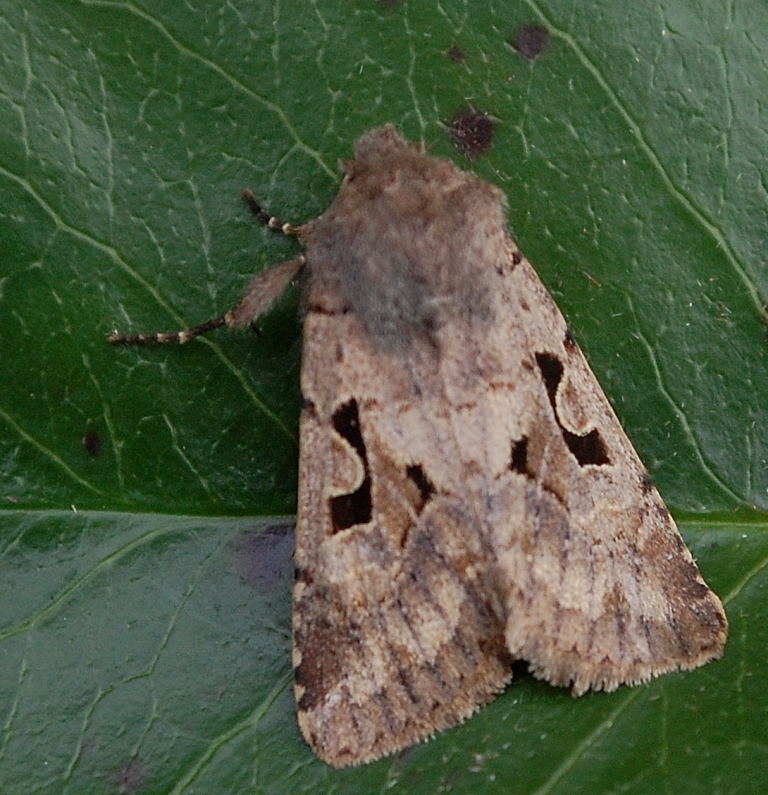
Shoulder stripe
As we were emptying one trap both the Engrailed landed on Ella's wellies.
Totals for the year now passed 300 moths of 24 macros and 6 micros

Monday, 13 March 2017

Moth Update

Since our return, I have run both traps, the garden Skinner 125W each night as usual and the 15W Heath trap just close to the house. Disappointing results so far, with Common quaker, Shoulder stripe, Oak Beauty, Hebrew character, Clouded drab, Double striped pug and Engrailed being added to the macro list and just Diurnea fagella to the micro list. Not so much the species count, just the overall totals per night seem to be very low for what has been a warm spring week.
Oak beauty

Hebrew character

Clouded drab


Wednesday, 8 March 2017

Sri Lanka trip

We flew from Heathrow on the overnight flight to Colombo on Wed 22nd Feb, arriving at our first hotel, Jetwing Blue in Negombo at 5pm Thursday. Colombo airport is undergoing refurbishment of the runway and is closed between 8.00am and 4.30pm. Consequently, we had to sit on the plane at Male in The Maldives for over an hour and then circle Colombo for 30 minutes before landing. In total, the flight lasted 13 hours.
Negombo has some good hotels and a lovely beach, but in our mind, is not Sri Lanka. It has adapted well to the tourist trade and offers a variety of eateries including a fish and chip shop! It is, however, only 20 minutes from the airport and so good for recuperating for a couple of days after the flight.
Birding was incidental to the overall holiday, but I did manage to get out most days for a wander. In Negombo there is a small vegetable garden opposite the hotel and I checked out the 2 ponds here along with the trees for local birds. Also, the sea offered views of tern species and a huge evening roost of house crows. About 200 crows pass the hotel, along the beach, per minute for 2 hours all heading for the local fish market, the largest in Sri Lanka
In the garden I started the list with common birds such as common mynah, Indian pond heron, red wattled lapwing, purple rumped sunbird, Indian cormorant and white breasted waterhen. A yellow bittern had been reported but was not seen on the 3 occasions I checked.
Blue tailed bee eater

Common mynah having a wash in the swimming pool

Common tailorbird

Indian cormorant

Purple rumped sunbirds

Tawny coster butterfly
After 2 nights at the Jetwing, we met our driver and off for the 2.5 hour drive to Koggala, on the south coast and a 7 night stay at the stunning Fortress Hotel, some 25 minutes drive east of Galle. Here, I could sea watch, wander local lanes, meet locals who didn't all want to offer me a tuk tuk ride when I was out birding, have a beer in a bar and get a boat trip around the expansive Koggala Lake.
Walking the well vegetated tracks around a small industrial complex gave up loads of bird photo opportunities with black hooded orioles, white breasted kingfishers, scaley breasted and white rumped munias, chestnut headed bee eaters, white browed and red vented bulbuls seen on a daily basis. Overhead, Brahminy kites and an occasional white bellied sea eagle.
Juvenile Asian koel

female Asian koel

Chestnut headed bee eater through dense foliage

White browed bulbul

Gull billed tern

Red vented bulbul

Sri Lankan drongo
On the Monday I took a tuk tuk to Koggala Lake for a 2 hour trip around the huge lake. There are several islands within the lake and plenty of standard vegetation everywhere. Striated heron was the first bird of the trip, followed by common, whiskered and gull billed terns, Little and Indian cormorants, little, cattle and great egrets whilst overhead swallows and Asian palm swifts. White breasted and stork billed kingfishers were noted regularly.
On the water in front of us, a large crocodile whilst in the trees plenty of black monkeys. Green Imperial pigeons got on to the trip list as did the ubiquitous spotted dove.
Our evening was rocked when we took a phone call from the cattery where we had left our wonderful cat, Colin. He had escaped and disappeared. We were mortified and sadly, the rest of the holiday was not what we wanted. Constant worry and concern for the cat we adore. We rallied some fantastic friends who covered miles in all types of weather but to no avail. Traps were set that caught a variety of cats, but not Colin. As the days went by in a bit of a haze I certainly thought of coming home, but really this wouldn't have achieved anything that wasn't already being done. Wendy spent time trying to read and I would wander off to bird watch, but our minds were elsewhere! We were checking our phones constantly, racking up an impressive roaming data bill. With Sri Lanka being 5.5hours ahead we would be waking during the night to check for good news and then be tired and sleepy during the day.
On the Wednesday we had booked to go to Mirissa to whale watch and, hopefully note a few seabirds. An early start found us with 23 other folk on a boat that headed out to the horizon at 6.30a.m. The weather became increasingly poor, with the boat being tossed all over the place. Folk were calling to head back, crying and feeling sick but on we ploughed, into even worse conditions. Eventually the captain took a vote and the majority opted for a return after 2 hours of being bounced around.We would have not had good views of any whales of dolphins, never mind birds as the passenger deck was surrounded in plastic sheeting in a poor attempt to keep us dry from the waves that were now breaking over the top of the boat. We returned in pouring rain, with the only consolation being we got a full refund of our 15,000 rupees, about £70.00
Our minibus returned us to the hotel and I wandered off for another walk in grey but warm conditions. Chestnut headed bee eaters and purple rumped sunbirds a plenty, along with white browed bulbuls, a brown headed barbet and more of what had already been seen. However, a clamorous reed warbler was a new Sri Lankan bird for me and a Plain prinia was a new trip lister.


Clamorous reed warbler

Partially submerged crocodile

Black monkey

Black monkey

Fruit bat colony

Fruit bats

Little egret on the beach

Oriental magpie robin

Another chestnut headed bee eater through vegetation

Stork billed kingfisher
 On the Friday we got the train to see friends in Galle. Raja and family live in Mahamodora just west of Galle City near the superb Jetwing Lighthouse. We also met up with Anoma, the resident naturalist at the Lighthouse to discuss a language/wildlife project he is planning that I wish to be involved with. We also met Raja's brother, Nilantha who runs a turtle hatchery on the beach adjacent to the hotel. Lovely to see all of them after 2 years. Raja drove us back to Koggala in the tuk tuk we raised money for several years ago, which he now uses to make money to support his wife and 4 children.
I spent Saturday trying to photograph the greater crested terns from the beach. A few shots here.
Just emerging, fishless


Green Imperial pigeon

Indian Jezebel

Loten's sunbird

Purple rumped sunbird, female

Looking east from The Fortress lawn

Beach west of The Fortress

After a week at The Fortress and some great times at Siri's restaurant (email:niroshanmadushanka91@gmail.com) where we drank wine and arrak with him on our last night, we were heading back to Negombo for 2 nights and a transfer to the airport at 4.00am on Monday 6th.
We had time to thank Dimuthu who had been our tuk tuk driver for the week If anyone is travelling to the south coast of the isalnd I can highly recommend Ranasingha Ranawalage Dimuthu Tours. Check the Facebook Page. Also, do use Kotawana Fisherman Seafood Restaurant, run by Siri. It is on the main road, 400 yards east of The Fortress at the top of the lane to the station. Great curry at a superb price. Very friendly, too.
Back in Negombo I headed back to the garden but still no yellow bittern. The following morning I had a 6.30 start to visit Mutharajwela Marshes, with the resident naturalist at the Jetwing Hotels in Negombo, Hermantha.
A superb boat trip along canals and onto the lagoon. Birds a plenty, with a common kingfisher being a new bird for my Sri Lankan list. The 2 hour trip was one of constant birdwatching, in great light. More stunning white breasted and stork billed kingfishers, white bellied sea eagle, brahminy kites, terns, purple herons, brown headed barbets, a water monitor lizard, darter, and plain prinia were all noted. A trip I strongly recommend. This was my 2nd visit with Hermantha, good to see him too.
African monarch butterfly

Brahminy Kite

Brahminy kite, juvenile

Brown headed barbet

Female Common kingfisher (not common in Sri Lanka, though)

Crimson rose butterfly

Darter, a strange hunting technique, swimming mostly submerged

Great white egret

Distant grey heron

Rose ringed parakett

Rose ringed parakeet that has lost a lot of feathers, probably due to a mite.

Stork billed kingfisher

Striated heron

Water monitor

White bellied sea eagle nest

White bellied sea eagle returning with a fish

White breasted kingfisher

White breasted kingfisher


Our flight home seemed much faster than the outward flight and we were in the car by 4.00pm. Due to a broken down vehicle on the M25 we stayed on A roads that were also congested. Took over 2 hours to get home, a quick change and out to look for Colin. We spent an hour or so searching and calling, saw a cat that could have been him before returning home and getting to bed some 24 hours after getting up. I was up early the next morning for a walk along lanes to try and find places he would be hiding. 2 areas seemed Colin territory and, fingers crossed, we might trap him at one of these. We have received reports of him near a local pub but now can eliminate that area from our inquiries as we trapped 2 cats that, from a distance may be thought to be ours. However, doing a leaflet drop at every house today a lady said she had seen Colin in her garden, so she is putting out food and we hope he feeds and gains her trust over the next week or so. We miss him very much.

Finally, a big thank you to Simon Gemmell at Designer Travel for putting our trip together. As before, Simon made great suggestions and everything went smoothly. www.designertravel.co uk for website and simon@designertravel.co.uk for contact. It anyone is thinking of Sri Lanka as a holiday destination, or for birding/butterfly trip do contact both me for advice (I've visited 4 times in 3 years) and Simon for help with your travel plans.
Overall, 64 species were noted, not bad for a non birding holiday.

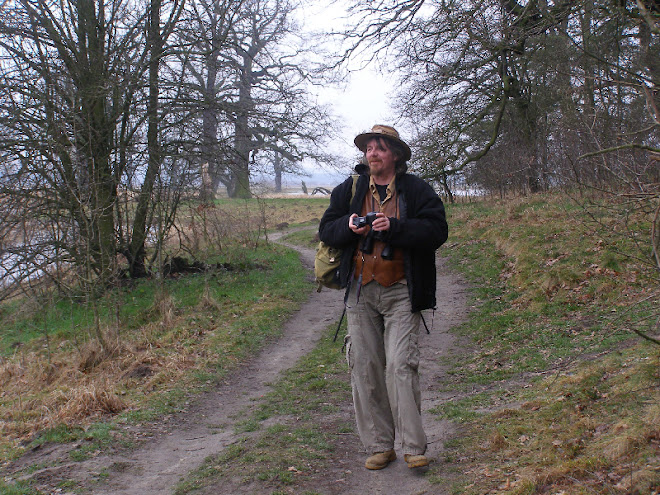
This is me

This is me
At the end of another Norfolk Coastal footpath walk. 47 miles, 3 days 99 species of bird. September 2009

Caley Wood view

Caley Wood view
sunshine through the canopy 29.05.08

A walk along the Warta Valley, Poznan, Poland. Feb 2007

A walk along the Warta Valley, Poznan, Poland. Feb 2007
Best birds on this walk: black and middle spotted woodpecker and short toed treecreeper

About Me

My photo
A primary school teacher for 30 years, I retired from teaching in July 2009 to set up my own science enhancement and communication company. The Primary Works offers science clubs, workshops and staged science shows nationwide. I have always been interested in bird watching since my early years. Apparently my first tick was after inquiring about a chaffinch and then receiving the Observer book of birds. By the age of 9 I had moved on to Tory Peterson's collins guide and was now involved on YOC birding holidays to Northumbria, Essex coast, Slimbridge and Yorkshire. My twitching rule is that I will willingly travel 1km for each gram the bird weighs. However, I have had many rarities just by being in the right place. I have travelled widely throughout Europe and also visited Australia and Sri Lanka. In 2016 I spent time at Portland Bird Obs and two trips to Aviero, Portugal. 2017 found me back in Sri Lanka in Feb/March, then July and back for New Year's Eve celebrations in December. Also returned to The Camargue in May for a 4 day trip. Few plans for 2018, but nothing yet booked apart from a trip to the IOW.

Grey heron

Grey heron
Over the allotment 28.09.08

Southern Hawker

Southern Hawker
Ridge footpath 27.08.08

Juvenile green woodpecker (17.08.08)

Juvenile green woodpecker (17.08.08)
Note the stripes, denoting a bird fledged this year.

common blue

common blue
Ash Valley G.C. 15.08.08

Indian balsam (impatiens glandulifera)

Indian balsam (impatiens glandulifera)
River Ash

azure damselfly

azure damselfly
River Ash 28.07.08

marbled white

marbled white
Discovered at Westland Green 22.07.08

ruddy darter

ruddy darter
Bush Wood 21.07.08

honeysuckle 19.07.08

honeysuckle 19.07.08
growing in hedgerow in Chapel Lane

cinnabar moth caterpillar

cinnabar moth caterpillar
Photographed on ragwort 19.07.08

Bittersweet

Bittersweet
Study of petals 11.06.08

male yellowhammer

male yellowhammer
08.06.08

common blue butterfly

common blue butterfly
06.06.08

River Ash

River Ash
looking south from the bridge at Hadham Ford

Common poppy (papaver rhoeas)

Common poppy (papaver rhoeas)
in rape field 29.05.08

Caley Wood sunshine

Caley Wood sunshine
29.05.08

Millenium Wood fox

Millenium Wood fox
24.05.08

common comfrey (symphytum officinale)

common comfrey (symphytum officinale)
06.05.08 banks of the River Ash

Garlic Mustard or Jack by the Hedge,(Alliara petiolata)

Garlic Mustard or Jack by the Hedge,(Alliara petiolata)
flowers, leaves and fruit edible . Good in salad and pesto

April showers

April showers
Double rainbow 30.04.08

Caley Wood bluebells

Caley Wood bluebells
22.04.08

Yellow Archangel

Yellow Archangel
Chapel Lane (20.04.08)

sunlight 16.04.08

sunlight 16.04.08
looking south west from Bush Wood

snowy buds

snowy buds
06.04.08 in Bush Wood

Looking north west

Looking north west
05.04.08 evening shower approaching

Back Garden

Back Garden
Easter Sunday (23.03.08)

Brick Kiln Hill

Brick Kiln Hill
Looking east (23.03.08)

No play today

No play today
The 2nd hole at Ash Valley golf course

Teasel head

Teasel head
Bush Wood (21.03.08)

Reflections

Reflections
daffodils at Bush Wood pond (21.03.08)

Swollen River Ash

Swollen River Ash
The river at the bottom of Winding Hill 16.03.08

Daybreak over the chapel

Daybreak over the chapel
Thursday 13th March

Wild daffodils (narcissus pseudonarcissus)

Wild daffodils (narcissus pseudonarcissus)
growing in Bush Wood

January snowdrops

January snowdrops
Banks of River Ash, north of Much Hadham

Good Moon

Good Moon
From garden 24.01.08

Village Green

Village Green
Looking east towards Acremore Street

Looking south before Hadham Ford

Looking south before Hadham Ford
rare January blue sky

Useful sites

The following are some useful websites that may interest readers of this blog.
Firstly, Bishop's Stortford Natural History Society http://bsnhs.webplus.net/

Fellow birder, Gary Whelan's blog. Gives reports from our trips out together plus reports from his trips abroad. http://hairybirders.blogspot.co.uk
http://www.hertsbirdclub.org.uk/ The official herts bird club website. Frequently updated, listing bird sightings around the county. Offers links to many other websites. Both of these sites also offer links to yahoo discussion groups.
http://www.birdforum.net/ An international site. You can enter as a guest but become a member( free) to post comments, bird sightings and just about anything to do with wild birds. Good news updates, classified section for binoculars, cameras etc.
http://www.guidedbirdwatching.com/ A new site set up where you can contact people worldwide who will help you find good birds in their country. UK section being set up presently.
http://www.britainsbirder.co.uk/
Fellow birders blog. Strtford resident, Graeme Smith regulary birds the area south of Stortford as well as around Spellbrook and the River Stort from Spellbrook to Twyford Locks. Some superb bird photography: Graeme uses a digital camera attached to his powerful telescope to get detailled images of the birds he sees. Well worth a browse.
Two local sites that may be of interest can be found at
http://www.thehadhams.com/ www.thepelhams.net/content/section/12/139/

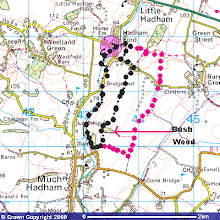
South Easterly walk

South Easterly walk
black, normal, red extended walk

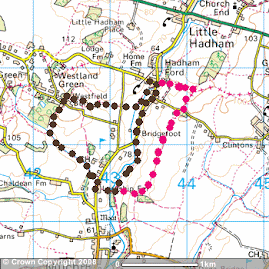
South Westerly route.

South Westerly route.
Black usual, red extended

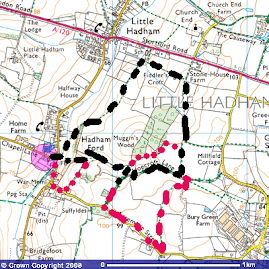
North Easterly walk

North Easterly walk
black short, walk. Red, extended

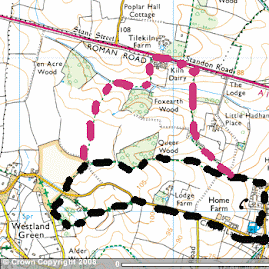
North West Patch

North West Patch
black route regular. Red route the extended wander