Friday, 8 July 2016

Serious lepidoptera day: Mothing marathon

I started the day with an early afternoon trip to Stocking Wood near Bury Green. Last year at this time I recorded many butterflies, including new for parish records of silver washed fritillary and white letter hairstreak. These constituted the 28th and 29th butterfly species for the parish. Also present last year were several purple hairstreak. However, this year, nothing so exotic so far. A fine comma, many meadow brown, ringlets, large skipper and large whites were all that were recorded

Having walked back home,I decided to have a serious moth night as the temperatures remained high, good cloud cover and just a hint of a breeze. Basically, perfect July conditions.
 Out with the Heath Trap at 9pm to leave this on the side of a beech and oak lined green lane with horse grazing fields eitherside. Having done this I then headed to a footpath in Pigs Green, the far west of the parish to try netting with a head torch. Very little was about which surprised me, but then again, it was early and only recently dark, being 10.15pm. Eventually I had a selection of 9 moths: Yellowshell, Agriphila straminella, Brimstone, Beautiful hooktip, clouded bordered brindle (NFY) Aphomia sociella, 2 common emeralds and Endrosis sarcitrella (NFY)
It was still early, so a quick, 15 minute check on the grass area that is Westland Green. Plenty of common wainscot as I netted 8 more in the short time present:
3 common wainscot (probably 25+ on the wing,) Pandemis cerasana, Paraswammerdamia nebulella (await confirmation) Scoparia ambigualis, Blastodacna hellerella and best of all, a new for parish record of a yet to be confirmed Syncapacma species. Only 2 pssibilities but dissection required.

From here, I returned with the confirmation moths potted and labelled to Valley Fields bridleway. It was immediately clear I was going to be some time! Moths everywhere, on the sheet, in and on the trap and generally all around the bulb. I collected all my pots and started on the sheet. The more I potted the more came so I closed and switched off the trap. My headtorch still attracted some and I reckon I probably only potted 75% of those present. Many fluttered and didn't land and netting them would have meant I would have been there all night.
By 12.45 I was finished and heading home with bags bursting with pots. I eventually just potted everything and returned to the moth shed at home to begin listing. I had completed this, with all identifications bar a few for gen det by 2.15 and then began potting from the garden skinner perspex and adjacent fence. I eventually enjoyed a glass of wine before bed.
From the heath trap, an all time record of 106 moths of 36 species with: peppered moth, Eucosma obumbratana, Hedya salicella, Epagoge grotiana all new for year, apart from H. salicella which is new for parish records. I had now passed 600 moth species for Little Hadham parish. Roll on 700.
As Wendy was off to work early (4.45am) I too got up and identified those potted from the skinner earlier and released them so I had enough pots. This was done some way away from the trap so not to count them twice. The trap was heaving as I listed and potted. Back to the moth shed with piles of pots and a large mug of black coffee (strong!) By 7.45 I had identified and listed all I could, with just 1 taht I just can't fathom and with several that I need confirming, some by dissection and some by more expert eyes than mine.
In all: 160 moths of 72 species taken at the skinner. New for parish records were:
Eudonia pallida and suspected Epinotia signatana with several Cnephasia sp awaiting dissection.May well be C. stevensiana judging by the dark markings.
New for year were: small yellow wave, Notocelia trimaculana, Archips rosana, Pandemis corylana, Fan foot, Privet hawkmoth, Broad bordered yellow underwing, Yponomeuta evonymella, Brown tail, Phycitodes binavella, Teleiodes vulgella, Gypsonoma dealbana and Acrobasis suavella.

In total for the night: 284 moths of at least 97 species. Thorough check needed to see if it was more than 100, but not presently!!

This takes the totals to 2005 moths for 2016, made up of 124 micro species and 151 macros. The parish total moves to a probable 604 species. All records typed up and recorded by 2pm and I now need to go and lie down in a dark room until Monday. However, shall just run the Skinner tonight, or then again, it maybe overcast and warm!!


The List; Bold indicates new for year,

Pigs Green: head torch and net:

  1. yellowshell
  2. Agriphila straminella
  3. Brimstone
  4. Beautiful hooktip
  5. Clouded bordered brindle
  6. Aphomia sociella
  7.  Common emerald 2
  8. Endrosis sarcitrella
Westland Green head torch and net

  9. Common wainscot 3
10. Pandemis cerasana
11. Syncopacma sp  TBC
12. Paraswammerdamia nebulella
13. Scoparia ambigualis
14. Blastodacna hellerella

Valley Fields 15W heath trap

15. Short cloaked minor
16. Brimstone 3
17. Chrysoteuchia culmella 40+
18. Aphomia sociella 5
19. Common wainscot 5
20. Treble brown spot
21. Celypha striana
22. Anthrophila fabricana
23. Mottled beauty
24. Small emerald
25. Eucosma cana 3
26. Timothy tortrix 2
27. Pandemis cerasana
28. Light emerald
29. Green pug 6
30. Yellowshell
31. July highflier 4
32. Agapeta hamana 4
33. Double square spot 3
34. Scoparia subfusca 2
35. Riband wave 4
36. Epiblema uddmanniana
37. Swallowtail
38. Blastobasis adustella
39. Peppered moth
40. Carcina quercana
41. Willow beauty
42. Clouded silver
43. Grey pug
44. Eudonai lacustrata
45. Eucosma obumbratana
46. Hedya salicella
47. Epinotia grotiana
48. Double striped pug
49. Swammerdamia caesiella
50. Hedya pruniana

Garden 125W Skinner trap

51. Riband Wave 17
52. Buff ermine 4
53. Clouded border 3
54. Emmelina monodactyla 5
55. Scoparia subfusca
56. Green pug 4
57. Agriphila straminella 8
58. Carcina quercana 3
59. Common footman 5
60. Clepsis consimilana 5
61. Celypha lacunana 4
62. Least carpet 2
63. Chrysoteuchia culmella 5
64. Paraswammerdamia nebulella
65. Scoparia ambigualis
66. Dwarf cream wave
67. Common emerald
68. Small yellow wave
69. July Highflier 2
70. Celypha rosaceana 2
71. Celypha striana 3
72. Pandemis cerasana 2
73. Notocelia trimaculana 3
74. Willow beauty 3
75. Endotricha flammealis
76. Large yellow underwing 2
77. Ditula angustiorana
78. Udea prunalis
79. Rustic 2
80. Archips rosana 2
81. Spectacle
82. Buff tip 2
83. Pandemis corylana
84. Eucosma cana 2
85. Elephant hawkmoth 2
86. Anania hortulata 2
88. Fan foot 2
89. Beautiful hooktip 2
90. Heart and dart 5
91. Dark arches
92. Privet hawkmoth
93. Double square spot
94. Common wainscot
95. Brimstone
96. Swallowtail
97. Broad bordered yellow underwing
98. Phoenix
99. Treble brown spot 8
100. Yponomeuta evonymella
101. Eudonia mercurella 2
102. Single dotted wave 2
103. Archips xylosteana
104. Notocelia uddmanniana
105. Browntail
106. Heart and club 3
107. Uncertain
108. Snout
109. Eudonia lacustrata
110. Udea olivalis
111. Clouded silver
112. Phycitodes binavella
113. Cydia pomonella
114. Garden carpet
115. Mottled rustic 2
116. Eudonia pallida
117. Epinotia signatana TBC
118. Teleiodes vulgella
119. Gypsonoma dealbana
120. Acrobasis suavella TBC
121. Cnephasia sp TBC


ringlet

large skipper

large skippper
comma


Wednesday, 6 July 2016

Butterflies at Westland Green, Little Hadham

A trip this lunchtime to Westland Green to check on the marbled white butterfly colony that first established itself in 2009. Pleased to find in excess of 30 insects flying and feeding on red clover and, occasionally, bird's foot trefoil. Also on the wing were 100+ meadow browns and a few large and small skippers. No Essex skippers noted.
However, it was mainly the marbled whites that I wished to photograph and this can p[rove tricky as they are relatively flighty butterflies. Making sure not to cast my shadow over them was the first rule as I fired off some distant shots with a 400mm lens. Easy enough to get a record shot, such as these:
The distance with a 55mm lens. Need to get closer


Another distant shot with 400mm lens

Another 400mm shot that loses clarity and sharpness

400mm shot showing upperwing pattern.
These were good enough record shots, but to improve meant either stalking them and hoping to get close by stealth or just sitting next to a nectar plant and waiting for one to come to feed. The former can be most frustrating as just as you're about to take a photo, the insect flies off. The latter just requires patience and was the approach I chose. After 15 minutes or so, I got lucky as one decided to aligth on a clover next to me.
With a 55mm lens

same insect.
Finally, success and not before I had recorded a Silver Y moth flitting through the long grass as well.

Friday, 24 June 2016

Busy Mothing period: Recent update

The list of moths for the year has now reached 199 species within the Little Hadham Parish. On the 21st June I set a new for year garden record of 58 moths of 36 species and this was almost beaten on the 22nd. Last night saw the bar move a little higher with 63 moths of 40 species. Still a long way to go to beat last years record of 210 moths of 82 species. Maybe a warm July night will get me close.
New for the year moths are daily at this time of the year and over the last 3 nights have been:
Micros:
Gypsonoma dealbana
Celypha roseceana
Agriphila straminella
Prays fraxinella (NFM, species number 596 for the parish records)
Pseudargyrotoza conwagana
Eudonia mercurella
Rhopobota naevana
(1 more TBC)

Macros:
Riband Wave
Rufous minor
Fern
Common footman
Common emerald
Elephant hawkmoth
Double square spot
Phoenix

Prays fraxinella

Common emerald


Phoenix

Flame

Elophila nympheata


Hackney Mothing

Small dusty wave
Aphomia sociella (Bee moth)
Ephestia parasitella unicolrella
Blastobasis lacticolella
Bright line brown eye
Prays fraxinella
Haworth's pug
Enarmonia formosana
Graeme Smith and I had been invited to run several moth traps at east Bank West Bank NR in Stamford Hill, Hackney. This reserve is a thin strip of land several hundred yards long on either side of the railway line out of Liverpool Street. Only 3 yards wide and heavily vegetated. Plenty of privet, sycamore and plane.
Traps set by 9.30 and we began netting. Mainly micros with a few small fan foots and small dusty wave.
By 10.45 the sky blackened and an electric storm brought a rapid end to the event. We were packed by 11.45 with a list of 65 moths of 28 species, including Prays fraxinella, 3 Ephestia unicolorella, Enarmonia formosana and Acentria ephemerella. Pretty good micros.
All photo credits: Graeme J. Smith who also carried out necessary dissections.
Full List:
Classification
Vernacular
Latin
Number taken
Micro 


216
Cork Moth
Nemapogon cloacella
1
228

Monopsis weaverella
1
449
Ash bud moth
Prays fraxinella
1
464
Diamond back moth
Plutella xylostella
2
644

Borkhausenia fuscecens
1
647
Brown house moth
Hoffmannophila pseudospretella
1
819

Scrobipalpa costella
1
874

Blastobasis lacticolella
3
994

Clepsis consimilana
10
998
Light brown apple moth
Epiphyas postvitanna
8
1011

Pseudargyrotoza conwagana
2
1216
Cherry bark moth
Prays fraxinella
1
1301

Crambus lathionellus
3
1331
Water veneer
Acentria ephemerella
1
1361
Mint moth
Pyrauta aurata
3
1376
Small magpie
Anania hortulata
2
1428
Bee moth
Aphomia sociella
6
1474

Ephestia parasitella unicolorella
3
Macros 


0017
Common swift
Hepialis lupilinus
6
1702
Small fan-footed wave
Idaea biselata
1
1707
Small dusty wave
Idaea seriata
4
1711
Treble brown spot
Idaea trigimenata
1
1713
Riband wave
Idaea aversata
1
1742
Yellow Shell
Camptogramma bilineata
1
1813
Haworth’s pug
Eupithecia haworthiata
1
2089
Heart and Dart
Agrotis exclamationis
1
2160
Bright line brown eye
Lacanobia oleracea
1
2473
Beautiful hooktip
Laspeyria flexula
1

Thursday, 16 June 2016

New moths recently

Blood vein
Now getting to the time of year when new for year moths are almost a daily occurence. Over the last few days added:
Chrysoteuchia culmella
Celypha striana
Small waved umber
Blood vein
common wainscot
Pale oak beauty
Heart and club
small waved umber

Celypha striana


Common wainscot

Heart and Club


Sunday, 12 June 2016

New Moth for Parish records

A reasonable haul in the garden moth trap this morning, with new for the year records of Common Wave and burnished brass
Burnished brass

Burnished brass


Common wave
However, a small very plain brown micro with a yellow head caught my attention as unusual and so it proved, a Achroia grisella (Lesser wax moth.) This is a pest to bee keepers as it lays its eggs in bee hives and the young caterpillars can cause damage to the hive by munching through everything and anything that is in there.
In all 18 moths of 16 species.
Achroia grisella (Lesser wax moth)
These records take the number of moths trapped this year in the parish to 1115 made up of 58 micro species and 102 macro species and, in total 594 species for the parish.

Friday, 10 June 2016

Moth Night: Millennium Wood

3 of us set up 5 traps within the wood as from 8.45 and immediately began netting moths found on plants and bushes, many from nettle patches.
Quickly, our total for the night rose, with large numbers of silver-ground carpet and common swift. The temperature dropped around 11.15 and it became quite damp and dewy which appeared to stop moths flying. Consequently, we began emptying the traps, listing the contents and saving those that required further work for identification.
In total 159 moths of 38 species were identified with 5 new macros for the parish year list and 9 micros one of which, Coptotriche marginea was new for parish records.
This means my totals for the year with Little Hadham presently stand at 99 macro moths and 54 micro moths, taking the total species count for the parish to a reasonably impressive 593 species since 2011. The champagne is now on ice for when I catch my 600th moth species for the parish.
The list in total:
Macros: New for year records in bold

  1. 30 silver -ground carpet
  2. angle shades
  3. 6 common marbled carpet
  4. 25 common swift
  5. 4 snout
  6. 2 yellowshell
  7. 3 brimstone
  8. 3 flame shoulder
  9. 3 light emerald
  10. 3 garden carpet
  11. 5 clouded silver
  12. 2 common pug
  13. 2 scorched wing
  14. 5 mottled pug
  15. 2 green carpet
  16. 2 marbled minor
  17. setaceous hebrew character
  18. 2 tawny marbled minor
  19. brindled pug
Micro moths: new for parish in red, new for year in bold
  1. 20 Plutella xylostella
  2. Yponomeuta cagnagella
  3. Anthophilia fabricana
  4. 3Hedya pruniana
  5. Nemapogon cloacella
  6. 2 Celypha lacunana
  7. 9 Scoparia ambigualis
  8. 5 Blastobasis lacticolella
  9. Nemaphora degeerella
  10. Monopsis weaverella
  11. Udea olivalis
  12. Tortrix viridana
  13. aphomia sociella
  14. Anania hortulata
  15. Tinea semifulvella
  16. Eulia ministrana
  17. Nematopogon swammerdamella
  18. Parapoynx striatata
  19. Coptotriche marginae

  1. yellowshell

    Anthophilia fabricana

    Yponomeuta cagnagella

    Nemophora degeerella
Scorched wing

Tortrix viridana

Tinea semifulvella

Angle shades

Clouded silver

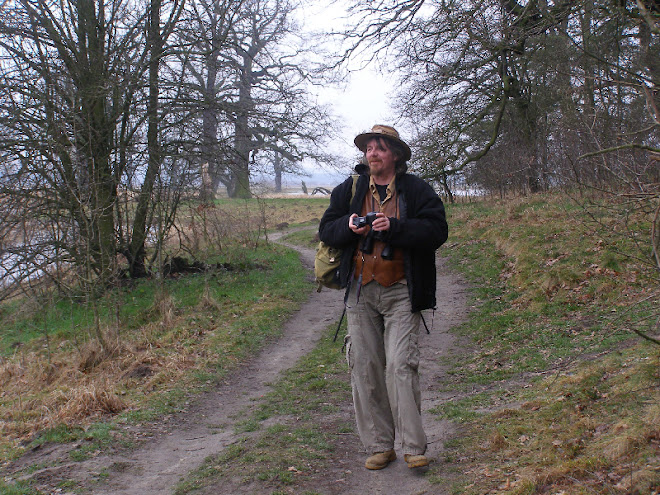
This is me

This is me
At the end of another Norfolk Coastal footpath walk. 47 miles, 3 days 99 species of bird. September 2009

Caley Wood view

Caley Wood view
sunshine through the canopy 29.05.08

A walk along the Warta Valley, Poznan, Poland. Feb 2007

A walk along the Warta Valley, Poznan, Poland. Feb 2007
Best birds on this walk: black and middle spotted woodpecker and short toed treecreeper

About Me

My photo
A primary school teacher for 30 years, I retired from teaching in July 2009 to set up my own science enhancement and communication company. The Primary Works offers science clubs, workshops and staged science shows nationwide. I have always been interested in bird watching since my early years. Apparently my first tick was after inquiring about a chaffinch and then receiving the Observer book of birds. By the age of 9 I had moved on to Tory Peterson's collins guide and was now involved on YOC birding holidays to Northumbria, Essex coast, Slimbridge and Yorkshire. My twitching rule is that I will willingly travel 1km for each gram the bird weighs. However, I have had many rarities just by being in the right place. I have travelled widely throughout Europe and also visited Australia and Sri Lanka. In 2016 I spent time at Portland Bird Obs and two trips to Aviero, Portugal. 2017 found me back in Sri Lanka in Feb/March, then July and back for New Year's Eve celebrations in December. Also returned to The Camargue in May for a 4 day trip. Few plans for 2018, but nothing yet booked apart from a trip to the IOW.

Grey heron

Grey heron
Over the allotment 28.09.08

Southern Hawker

Southern Hawker
Ridge footpath 27.08.08

Juvenile green woodpecker (17.08.08)

Juvenile green woodpecker (17.08.08)
Note the stripes, denoting a bird fledged this year.

common blue

common blue
Ash Valley G.C. 15.08.08

Indian balsam (impatiens glandulifera)

Indian balsam (impatiens glandulifera)
River Ash

azure damselfly

azure damselfly
River Ash 28.07.08

marbled white

marbled white
Discovered at Westland Green 22.07.08

ruddy darter

ruddy darter
Bush Wood 21.07.08

honeysuckle 19.07.08

honeysuckle 19.07.08
growing in hedgerow in Chapel Lane

cinnabar moth caterpillar

cinnabar moth caterpillar
Photographed on ragwort 19.07.08

Bittersweet

Bittersweet
Study of petals 11.06.08

male yellowhammer

male yellowhammer
08.06.08

common blue butterfly

common blue butterfly
06.06.08

River Ash

River Ash
looking south from the bridge at Hadham Ford

Common poppy (papaver rhoeas)

Common poppy (papaver rhoeas)
in rape field 29.05.08

Caley Wood sunshine

Caley Wood sunshine
29.05.08

Millenium Wood fox

Millenium Wood fox
24.05.08

common comfrey (symphytum officinale)

common comfrey (symphytum officinale)
06.05.08 banks of the River Ash

Garlic Mustard or Jack by the Hedge,(Alliara petiolata)

Garlic Mustard or Jack by the Hedge,(Alliara petiolata)
flowers, leaves and fruit edible . Good in salad and pesto

April showers

April showers
Double rainbow 30.04.08

Caley Wood bluebells

Caley Wood bluebells
22.04.08

Yellow Archangel

Yellow Archangel
Chapel Lane (20.04.08)

sunlight 16.04.08

sunlight 16.04.08
looking south west from Bush Wood

snowy buds

snowy buds
06.04.08 in Bush Wood

Looking north west

Looking north west
05.04.08 evening shower approaching

Back Garden

Back Garden
Easter Sunday (23.03.08)

Brick Kiln Hill

Brick Kiln Hill
Looking east (23.03.08)

No play today

No play today
The 2nd hole at Ash Valley golf course

Teasel head

Teasel head
Bush Wood (21.03.08)

Reflections

Reflections
daffodils at Bush Wood pond (21.03.08)

Swollen River Ash

Swollen River Ash
The river at the bottom of Winding Hill 16.03.08

Daybreak over the chapel

Daybreak over the chapel
Thursday 13th March

Wild daffodils (narcissus pseudonarcissus)

Wild daffodils (narcissus pseudonarcissus)
growing in Bush Wood

January snowdrops

January snowdrops
Banks of River Ash, north of Much Hadham

Good Moon

Good Moon
From garden 24.01.08

Village Green

Village Green
Looking east towards Acremore Street

Looking south before Hadham Ford

Looking south before Hadham Ford
rare January blue sky

Useful sites

The following are some useful websites that may interest readers of this blog.
Firstly, Bishop's Stortford Natural History Society http://bsnhs.webplus.net/

Fellow birder, Gary Whelan's blog. Gives reports from our trips out together plus reports from his trips abroad. http://hairybirders.blogspot.co.uk
http://www.hertsbirdclub.org.uk/ The official herts bird club website. Frequently updated, listing bird sightings around the county. Offers links to many other websites. Both of these sites also offer links to yahoo discussion groups.
http://www.birdforum.net/ An international site. You can enter as a guest but become a member( free) to post comments, bird sightings and just about anything to do with wild birds. Good news updates, classified section for binoculars, cameras etc.
http://www.guidedbirdwatching.com/ A new site set up where you can contact people worldwide who will help you find good birds in their country. UK section being set up presently.
http://www.britainsbirder.co.uk/
Fellow birders blog. Strtford resident, Graeme Smith regulary birds the area south of Stortford as well as around Spellbrook and the River Stort from Spellbrook to Twyford Locks. Some superb bird photography: Graeme uses a digital camera attached to his powerful telescope to get detailled images of the birds he sees. Well worth a browse.
Two local sites that may be of interest can be found at
http://www.thehadhams.com/ www.thepelhams.net/content/section/12/139/

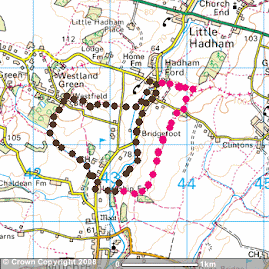
South Easterly walk

South Easterly walk
black, normal, red extended walk

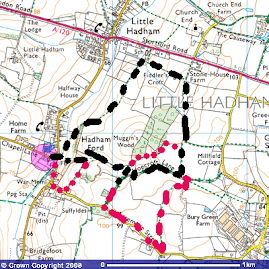
South Westerly route.

South Westerly route.
Black usual, red extended

North Easterly walk

North Easterly walk
black short, walk. Red, extended

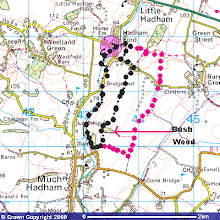
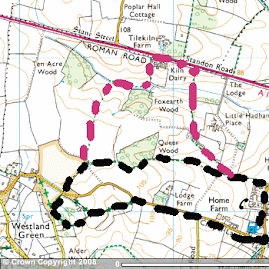
North West Patch

North West Patch
black route regular. Red route the extended wander