Tuesday, 11 August 2015

Extinct moth

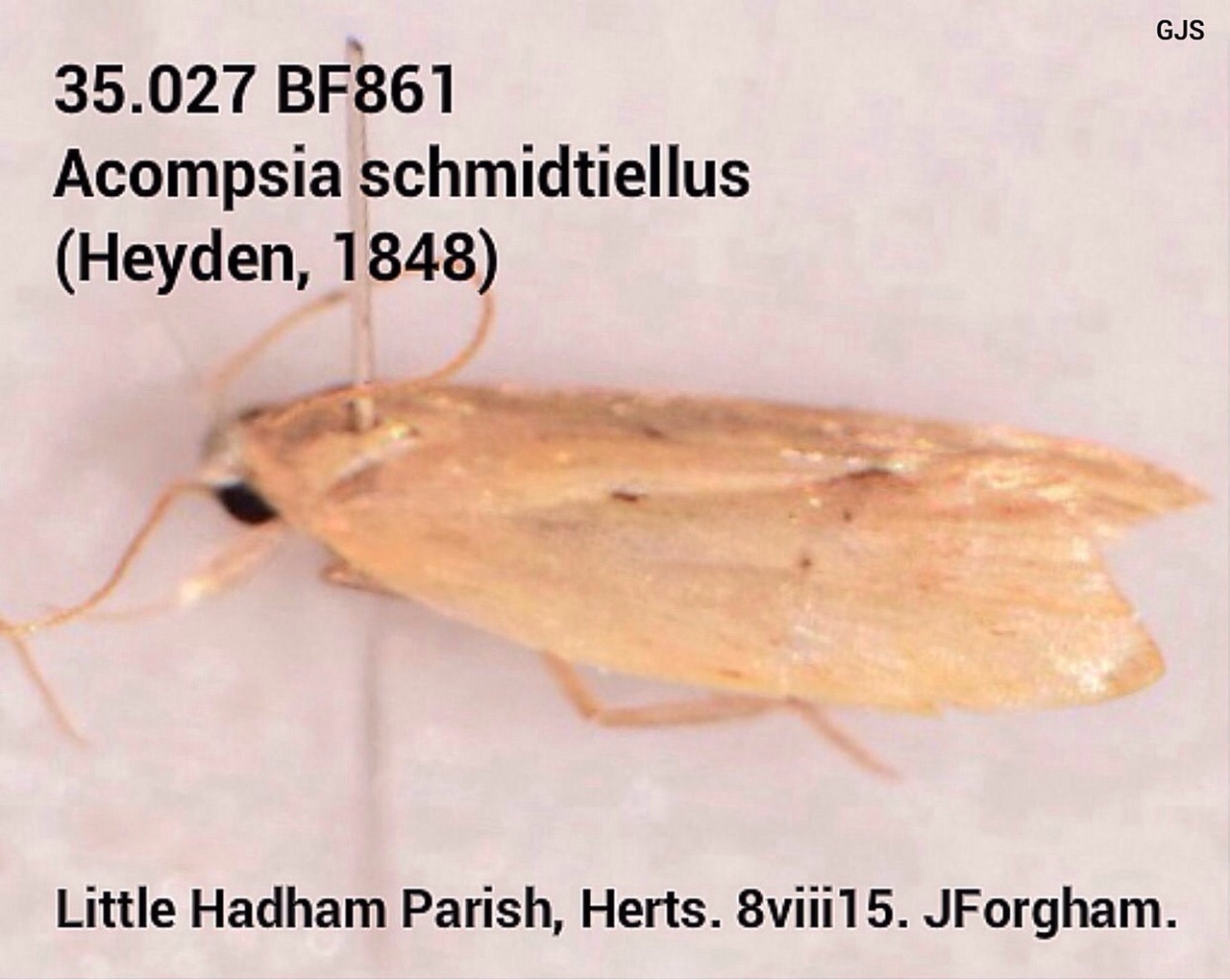
Last Saturday night I spent a while out with head torch and moth net. New Road of Chapel Lane gave 43 moths, mainly Pleuropyta ruralis and Agrophila straminella. Also: magpie, dusky sallow, angle shades and Chinese character along with other regulars. One micro caught my eye, was potted and taken round to Graeme's for identification.
Glad I did, Acompsia schmidtiellus, a moth last recorded in Herts in 1953 and classified as Herts extinct. My 2nd extinct moth of 2015. Good stuff! Its larval foodplant is wild majoram and this flourishes 100 yards away on the banks of the River Ash from where I netted it. Need to get down to the river and see if there are more about.
As always, thanks to Graeme for the gen det and accompanying slides.

Monday, 10 August 2015

Amazing butterfly wander

As usual, left Costa coffee for a walk back home. Today, I planned on spending more time at Stocking Wood, checking for butterfly species. As I wandered past East Wood, just inside the parish boundary, a small grey butterfly flew past and alighted in the grass. A purple hairstreak. A new site and a great start. I managed to get down flat on the ground and fire off some shots with the 55mm lens.
Purple hairstreak

Uncommon open wing shot of purple hairstreak

showing the feint hairstreak and small eye spot on underside of wing.
Not too much as I headed off to Stocking Wood; a few chiffchaffs calling and first year buzzards mewing overhead.
As I arrived, in overcast yet warm conditions, there were not a lot of butterflies to be seen on the meadowsweet, common knapweed, vetch and bird's foot trefoil that all grow in this ride between the 2 woods, Stocking on the left and Stocking Woods plantation on the right.
Viewing the butterfly site from footpath to the south of the woods
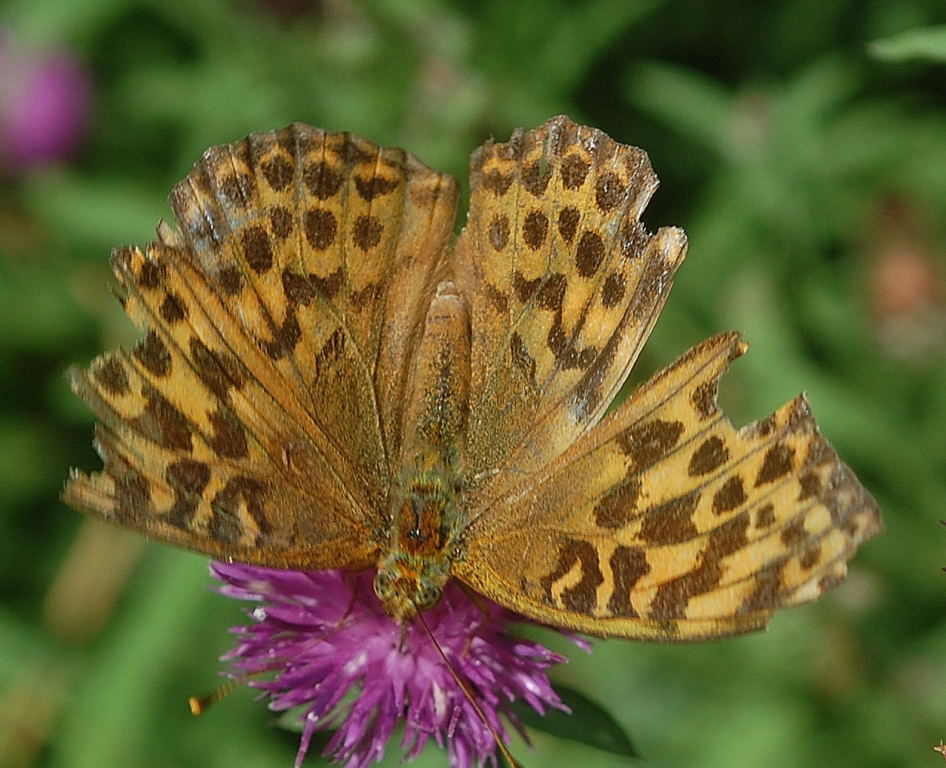
However, after a little searching, peacock and green veined white appeared, if not in the numbers seen yesterday when the sun was bright. After 10 minutes the sun emerged and the place immediately filled with creatures: 5 peacocks, 15 green veined white, 2 white letter hairstreaks, 3 purple hairstreaks, 1 silver washed fritillary, 6 gatekeepers, 1 ringlet, 2 speckled wood, 1 comma, 2 brimstone, 15+ meadow browns and even a sliver Y moth as well as countless Agriphila straminella micro moths. Certainly  a superb site.
rather battered silver washed fritillary


Poor record shot of white letter hairstreak

Poor record shot of white letter hairstreak

ringlet

silver Y

Managed to get close enough to use 55mm lens again
As well as all this lepidoptera activity, overhead, more buzzards, a sparrowhawk whilst in the woods nuthatches and green woodpeckers called.
 Also perched on the vegetation, several common darter dragonflies.
common buzzard

sparrowhawk at considerable height

much paler juvenile common buzzard

common darter

another common darter, this, a female

 I moved on, amazingly coming across another grounded purple hairstreak near Millennium Wood before heading downhill towards Hadham Ford. On the track in front of me, seen at the very last minute, a small copper. Only the 4th parish record of this uncommon butterfly for Little Hadham. Unfortunately, it flew into the hayfield and then off before I could manage even a record shot. The ensuing light shower meant it headed straight for the safety of the hawthorn hedge.
Back home, I sorted out the moths from the trap last night, with straw underwing, Yponomeuta plumbella and Agriphila geniculea all being new for the year.
Superbly marked straw underwing

Agriphila straminella

Sunday, 9 August 2015

What's next?

After 3 new parish records this week: small red eyed damselfly, white letter hairstreak and the unexpected silver washed fritillary, I began thinking what may well be out there for me to find.
Basically, I appreciate there are plenty of insects and plants as yet undiscovered, especially hoverflies and grasshopper species, so a special effort with those next year, but what about the rest?
Bird wise, with 106 species already recorded within the parish, the list can be both very limited, or extremely broad, depending upon how optimistic I am, but the following are all possible;
Certainly, I would anticipate these to be noted one day:
waxwing, brambling, common tern, peregrine falcon, firecrest, black redstart

Probably be seen within the parish:
lesser spotted woodpecker, yellow legged gull, curlew, pochard, gadwall, shoveler, great grey shrike, reed warbler, nightingale, water pipit, tree pipit, little ringed plover

Feint chance of connecting:
osprey, various waders such as oystercatcher, black tailed godwit, redshank plus hawfinch, water rail, marsh harrier, rough legged buzzard.

In the butterfly department, I suspect it is at the high realms of possibility that white admiral and purple emperor would be found, but with planned development of Millennium Wood and purple emperor being seen 1 mile south of the parish and half a mile to the north east this year, it may not be so much of a pipedream. Otherwise, I think the 29 species recorded is a fairly complete list and very good for a small East Herts parish, .

Moths; the list now exceeds 520 species and I envisage this stretching to around 600 in the next 2 years as I continue to identify each and every micro moth that is trapped or netted. With over 80 micro species added for 2015, I can only imagine another 50 species are highly likely. Macro wise, maybe adding 5 - 10 species per year, but plenty still possible. Secret will be to get out and run traps in a variety of habitats as well as visit these sites for daytime and night time netting, the latter with a head torch. This year has thrown up a fair few totally unexpected moths, such as the previously extinct Dichrorampha sequana, so many things are possible.

Odonata species are more tricky, as selective searching will be required, but certainly red eyed damselfly will be within the parish boundary. Also, likely: emerald damselfly,

Mammals; most voles, excluding water and a selection of shrews are undoubtedly within the parish as I have found skeletal remains in barn owl pellets at several sites locally. However, this does not prove they are all present within the confines of the study area and therefore can't be added to the list. Again, to see these, really just chance encounters and a few early morning forays to check winter snowfall for footprints.

So, all in all, plenty to keep me going well into 2018! Photos here from an early migrant check around Hadham Hall. Here is the largest amount of standing water within the parish so the willows on the banks attract good migrants. 2013: pied flycatcher and redstart both observed within half an hour of each other after a particular heavy easterly.
patrolling emperor

resident grey heron

azure damselfly female


common blue damselfly

More landmark numbers

An hour spent with head torch and net in local lanes last night was fruitful, with a selection of common moths netted. Pleuropyta ruralis and Agriphila straminella were in good numbers, but, more surprisingly, 3 magpies, one abberant, a dusky sallow, chinese character and angle shades were all good to record. In all, 43 moths in an hour.
The trap this morning was fairly busy with just Flame carpet being new for the year. This was the 350th moth species captured for 2015, so 400 species is definitely on the cards this year. Last year my total was 331 species.
Later on in the count, a rustic was my 4000th moth of the year, with the total now increased to 4010, a large increase on the 3331 moths for 2014. Again, with some luck, 5000 moths is possible.
Other more unusual visitors last night were: waved black, a 2nd generation Celypha lacunana, brown line bright eye, 2 more magpie and a setaceous hebrew character. The latter will continue to increase in numbers throughout the month, becoming the most regular visitor to the trap.
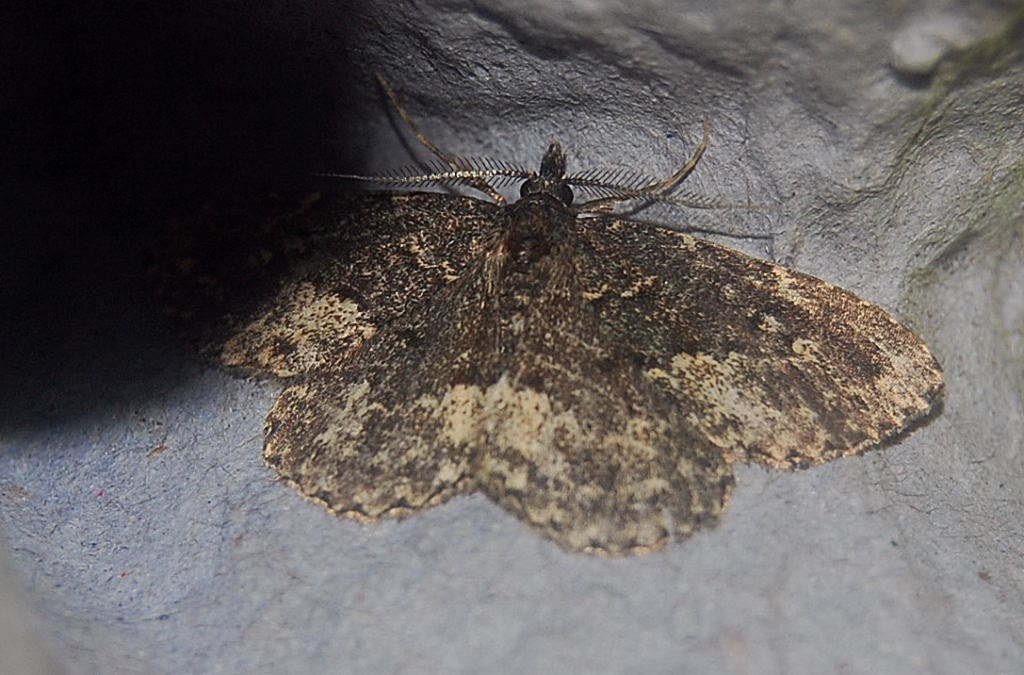
Flame carpet

flame carpet

waved black


Saturday, 8 August 2015

Another butterfly watch

I headed back to Stocking Wood this afternoon at the hottest point of the day. In the ride which proved so successful yesterday, I came across the regular species: comma (2) peacock (15+) green veined white (3) small white (8) large white (2) speckled wood (1) brimstone (2) white letter hairstreak (1) gatekeeper (5)and meadow brown(10)
The hairstreak was again, not worth photographing, found high in a tree but other species lent themselves to a photo in sunny conditions. A common dater, female, was a first for the year, shown below.
I have a good feeling about this area and intend to pay a longer visit on Monday morning, trying to catch the hairstreaks as they come down in the morning to nectar on the knapweed etc. I think the vegetation here is good for a white admiral, too, so well worth a few hours. However, long trousers and socks required as there are too many low growing brambles in the undergrowth and these are very adept at wrapping around my sockless ankles!
female brimstone

female common darter

immaculate peacock

Friday, 7 August 2015

New Parish records

Just when I begin thinking there can't be too much left to find in the parish, something turns up to make me think again. I knew finding the white letter hairstreak butterfly in local woods would just be a matter of time and searching local elms at the correct time but today, I recieved a phone call from David in Bury Green. He told of a place where he had come across a white letter hairstreak colony so off I wandered to Stocking Wood. At the correct place were a variety of flowers including bird's foot trefoil and common knapweed with plenty of whites (large, small and green veined) and peacocks. Several commas and a single brimstone, so indeed a good butterfly spot. High in the elm I noted serveral white letter hairstreaks, with one flying by but not alighting for a photo. New butterfly for my records. Shortly after, a large orange butterfly was noted, flitting around the knapweed some 20 yards away: a silver washed fritillary. This was totally unexpected for the parish and a great find.
I managed a few record shots, headed home after stopping off to thank David for the tip off before returning, briefly in better sunshine in the afternoon. Same creatures about apart from the fritillary but again, high in the trees, a purple hairstreak, too obscured by leaves for a worthwhile photo. What a spot and one certainly worth monitoring this August and then from June onwards next year.
So: in 3 days, 3 new records: small red eyed damselfly and the 2 butterflies. What's next, I wonder?
peacock

green veined white

silver washed fritillary

silver washed fritillary

brimstone

comma

Thursday, 6 August 2015

Moth round up

A few moths worth reporting over the last few days. On the 3rd, a haul of 86 moths made up of 46 species, with notables including Monopsis weaverella, Cameraria ohridella and Monochroa palustrellus, Cnephasia gentilana and 2 Blastobais adustella, all new for the year. Also, a 2nd record for the year of Coleophora trifolli.
Highlights were 2 new for parish records in the shape of Elasticha cannapennella and Depressaria chaerophylli, both dissected by Graeme. Many thanks. On the macro front, a square spot rustic was new for the year. This takes the parish annual totals to:
Macros 171
Micros 177
This morning, after heavy rain last night, as expected, a very empty trap with nothing but regular common moths in the count of 14 of 10 species
Coleophora trifolii

Depressaria chaerophylli

Monochroa palustrellus

Monopsis weaverella

Wednesday, 5 August 2015

Depressaria chaerophylli

Slides from the uncommon Herts moth, taken 03.08.15.

Another good wander 05.08.15

Again, leaving Tescos and this time heading north of the A120 I wandered through Hadham Lodge, Hadham Hall and then through Stonewall Farm back to The Ford.
2 good highlights of the walk: both at the same site. I stopped off at the lagoon east of Hadham Hall, but very little of note apart from the expected common blue and azure blue damselflies in warm but overcast conditions. I moved on to check the ponds around Hadham Hall and flushed a common sandpiper, white wing bars apparent as it flew off to hide in the vegetation adjacent to the mud on the periphery of the pond. As I waited I thought I would check, through binoculars, the lily pads and glad I did: small red eyed damselfly, a new record for my parish records. At least 5 specimens flying and ovipositing in the pond.
Small Red eyed damselfly

Common blue damselfly

Further into the wander, along the River Ash, I heard the familiar call of goldcrests. I watched and failed brillinatly to get a photo of them as they hovered, insect picking. Did manage this one photo, though.
Post breeding moult goldcrest; The Ford

Butterfly wise; no small coppers that I have recorded along this footpath and no hoped for painted lady or clouded yellow; consequently, regulars: meadow brown, small and large white, peacock, gatekeeper, ringlet and small tortoiseshell.
ringlet

meadow brown

gatekeeper

speckled wood

Monday, 3 August 2015

Long morning wander

Been quite a while since I took a walk back from town to home, so this morning I was dropped off at Tescos and wandered, at a leisurely pace, back home via Green Street, Millfield Lane, Muggin's Wood and The Ford.
Main aim was to get some data for the big butterfly count. This I did in warm, but overcast conditions, with the following totals being forwarded.
peacock 11
small white: at least 78 and probably 150+
gatekeeper 19
meadow brown 22
large white 7
small skipper 4
common blue 3
The numbers of small white were high due to counting 66 over one rape field in Green Street. These were ones in the air, so suspect the actual number present was far higher.
Near Muggin's Wood are 3 old straw bales left for the pheasant shot. As I lent on one to complete some notes I became aware of one or two hornets about. I then noticed a whole squadron of them taxiing, ready for lift off from a hole in the bale. Obviously a busy nest and one that will be worth keeping an eye on over the next few months. Not a place to set a moth trap as they would be attracted to the light! I had enough wasps in the trap this morning, but irate hornets are an altogether different matter.
I only had my 55mm lens with me as the camera body for the 400mm had a flat battery, so no bird photos.
In all, I registered 25 species, with pleasing numbers of yellowhammer noted (12) 2 bullfinches, a garden warbler, treecreeper and 3 chiffchaff. Not too bad for the first week in August. Need to keep an eye to the sky at dawn and dusk for migrating waders, although their migration route is usually some 40 miles west of the village, encompassing Tring reservoirs.
gatekeeper hiding in the pasture

wasp's nest dug out by, perhaps, a badger

small skipper on knapweed

hornet leaving the nest.

As close as I was happy to get.

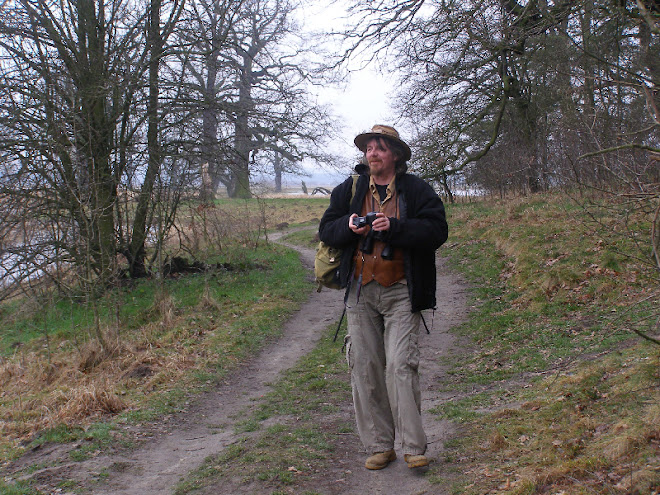
This is me

This is me
At the end of another Norfolk Coastal footpath walk. 47 miles, 3 days 99 species of bird. September 2009

Caley Wood view

Caley Wood view
sunshine through the canopy 29.05.08

A walk along the Warta Valley, Poznan, Poland. Feb 2007

A walk along the Warta Valley, Poznan, Poland. Feb 2007
Best birds on this walk: black and middle spotted woodpecker and short toed treecreeper

About Me

My photo
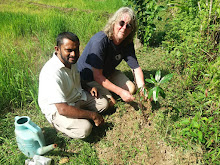
A primary school teacher for 30 years, I retired from teaching in July 2009 to set up my own science enhancement and communication company. The Primary Works offers science clubs, workshops and staged science shows nationwide. I have always been interested in bird watching since my early years. Apparently my first tick was after inquiring about a chaffinch and then receiving the Observer book of birds. By the age of 9 I had moved on to Tory Peterson's collins guide and was now involved on YOC birding holidays to Northumbria, Essex coast, Slimbridge and Yorkshire. My twitching rule is that I will willingly travel 1km for each gram the bird weighs. However, I have had many rarities just by being in the right place. I have travelled widely throughout Europe and also visited Australia and Sri Lanka. In 2016 I spent time at Portland Bird Obs and two trips to Aviero, Portugal. 2017 found me back in Sri Lanka in Feb/March, then July and back for New Year's Eve celebrations in December. Also returned to The Camargue in May for a 4 day trip. Few plans for 2018, but nothing yet booked apart from a trip to the IOW.

Grey heron

Grey heron
Over the allotment 28.09.08

Southern Hawker

Southern Hawker
Ridge footpath 27.08.08

Juvenile green woodpecker (17.08.08)

Juvenile green woodpecker (17.08.08)
Note the stripes, denoting a bird fledged this year.

common blue

common blue
Ash Valley G.C. 15.08.08

Indian balsam (impatiens glandulifera)

Indian balsam (impatiens glandulifera)
River Ash

azure damselfly

azure damselfly
River Ash 28.07.08

marbled white

marbled white
Discovered at Westland Green 22.07.08

ruddy darter

ruddy darter
Bush Wood 21.07.08

honeysuckle 19.07.08

honeysuckle 19.07.08
growing in hedgerow in Chapel Lane

cinnabar moth caterpillar

cinnabar moth caterpillar
Photographed on ragwort 19.07.08

Bittersweet

Bittersweet
Study of petals 11.06.08

male yellowhammer

male yellowhammer
08.06.08

common blue butterfly

common blue butterfly
06.06.08

River Ash

River Ash
looking south from the bridge at Hadham Ford

Common poppy (papaver rhoeas)

Common poppy (papaver rhoeas)
in rape field 29.05.08

Caley Wood sunshine

Caley Wood sunshine
29.05.08

Millenium Wood fox

Millenium Wood fox
24.05.08

common comfrey (symphytum officinale)

common comfrey (symphytum officinale)
06.05.08 banks of the River Ash

Garlic Mustard or Jack by the Hedge,(Alliara petiolata)

Garlic Mustard or Jack by the Hedge,(Alliara petiolata)
flowers, leaves and fruit edible . Good in salad and pesto

April showers

April showers
Double rainbow 30.04.08

Caley Wood bluebells

Caley Wood bluebells
22.04.08

Yellow Archangel

Yellow Archangel
Chapel Lane (20.04.08)

sunlight 16.04.08

sunlight 16.04.08
looking south west from Bush Wood

snowy buds

snowy buds
06.04.08 in Bush Wood

Looking north west

Looking north west
05.04.08 evening shower approaching

Back Garden

Back Garden
Easter Sunday (23.03.08)

Brick Kiln Hill

Brick Kiln Hill
Looking east (23.03.08)

No play today

No play today
The 2nd hole at Ash Valley golf course

Teasel head

Teasel head
Bush Wood (21.03.08)

Reflections

Reflections
daffodils at Bush Wood pond (21.03.08)

Swollen River Ash

Swollen River Ash
The river at the bottom of Winding Hill 16.03.08

Daybreak over the chapel

Daybreak over the chapel
Thursday 13th March

Wild daffodils (narcissus pseudonarcissus)

Wild daffodils (narcissus pseudonarcissus)
growing in Bush Wood

January snowdrops

January snowdrops
Banks of River Ash, north of Much Hadham

Good Moon

Good Moon
From garden 24.01.08

Village Green

Village Green
Looking east towards Acremore Street

Looking south before Hadham Ford

Looking south before Hadham Ford
rare January blue sky

Useful sites

The following are some useful websites that may interest readers of this blog.
Firstly, Bishop's Stortford Natural History Society http://bsnhs.webplus.net/

Fellow birder, Gary Whelan's blog. Gives reports from our trips out together plus reports from his trips abroad. http://hairybirders.blogspot.co.uk
http://www.hertsbirdclub.org.uk/ The official herts bird club website. Frequently updated, listing bird sightings around the county. Offers links to many other websites. Both of these sites also offer links to yahoo discussion groups.
http://www.birdforum.net/ An international site. You can enter as a guest but become a member( free) to post comments, bird sightings and just about anything to do with wild birds. Good news updates, classified section for binoculars, cameras etc.
http://www.guidedbirdwatching.com/ A new site set up where you can contact people worldwide who will help you find good birds in their country. UK section being set up presently.
http://www.britainsbirder.co.uk/
Fellow birders blog. Strtford resident, Graeme Smith regulary birds the area south of Stortford as well as around Spellbrook and the River Stort from Spellbrook to Twyford Locks. Some superb bird photography: Graeme uses a digital camera attached to his powerful telescope to get detailled images of the birds he sees. Well worth a browse.
Two local sites that may be of interest can be found at
http://www.thehadhams.com/ www.thepelhams.net/content/section/12/139/

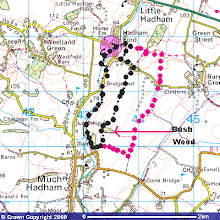
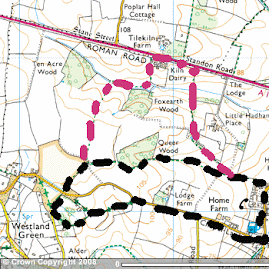
South Easterly walk

South Easterly walk
black, normal, red extended walk

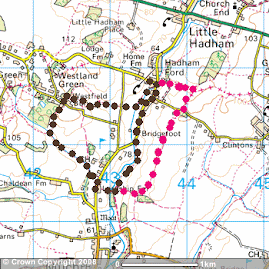
South Westerly route.

South Westerly route.
Black usual, red extended

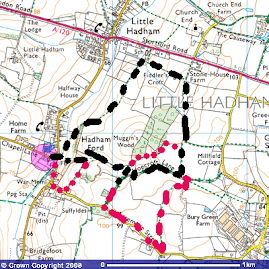
North Easterly walk

North Easterly walk
black short, walk. Red, extended

North West Patch

North West Patch
black route regular. Red route the extended wander