Saturday, 12 December 2020

Beginners Guide to Waders. Part 6: The Unmistakables.

 Fortunately for those new to wader spotting, or those baffled by the whole group of them there are a fair few that are easy to identify, so let's have a look at these. 

Another top tip for watching waders is not to be over powered by the sheer number that may be in front of you. Break them into smaller groups and just concentrate on this bunch, noting the dunlin and godwits as well as the easier ones and then there may be a few left that present more of a challenge. In reality, the vast majority of what is before you will fall into the categories above. In the UK unlikely to get 100's of sandpiper species together, just Dunlin, Lapwing, godwits and Knot. In there though may be a Little stint, a Curlew sandpiper or something even more challenging and exciting such as an American vagrant. This is where field notes are essential as mentioned in a previous part of this brief series. A reminder, make notes on plumage that stands out: tail pattern, wing bars in flight, eye stripes if present as well as leg colouration and bill shape, size and colour. Make comparisons to nearby waders that you know eg, smaller than Dunlin or longer and darker bill than an oystercatcher. When in a hide studying waders don't be afraid to point one out that is tricky to another birder. They may not have looked at this group yet and unaware of its presence. Give good details or, if in your scope, ask them to have a look. All good field skills to get the most from a session wader watching.


Titchwell Fresh Marsh from the Parrinder Hide. All very daunting to a beginner but just look at the group directly in front. Lapwings clearly visible and with them a group of mainly roosting smaller waders showing white underparts and a browny head and wing: Dunlin. Then scan through to see if anything else stands out. 

Oystercatcher:

Large black and white wader showing bright orange bill and legs. Can be quite noisy with a typical piping call. Can't really be mistaken for anything else.


Avocet:

Another black and white wader but so different in shape and size to the above. Upturned bill obvious, very aggressive during breeding season to anything that gets too near nest, eggs or young. Saw an avocet actually land on a Marsh Harrier once, looked like it was surfing on it. Not the unusual blue legs.


Turnstone:

Busy bird of beach and pools. Flicks over sea weed and beach litter in search of invertebrates. Any gravel will be flicked about. Mainly seen in the UK in non breeding plumage as shown here. 


In the final photo above, note size and shape compared to the Dunlin shown here. Note the straight cut off point from the dark breast to the white belly.  Short, stubby and dark bill, orange legs. 

Purple Sandpiper:

Not a regular bird for South East England but does show up, invariably on rocks where waves are breaking. Amazing ability to hold on to the rocks as water washes all around it. Very unlikely to find another bird behaving like this, nor actually found in such a habitat.


A very rotund wader with long toes that are orange and a slightly decurved bill that is dark at the tip and orange at the base. Has a vague purpleness to it but overall impression is a grey/brown bird. Note the visible white eye ring.

Snipe:

Whilst not overlooking similarities with Woodcock and Jack snipe, almost all snipe like birds seen will be........Snipe. Excellent camouflage and a liking for not giving up its position until a birder is just about to tread on it (similar to Woodcock) means most views of snipe are when they are out on mud or soft grassy fields probing with their ludicrously long bill. Note the head pattern of black and gold striped heading from the crown. A woodcock has them going across the crown. If the snipe is constantly bobbing up and down then it will be the slightly smaller and shorter billed Jack snipe.


Curlew:

Only similar bird is the less common, migratory whimbrel so the latter only about during April/May and late August/early October. Can be ruled out at all other times therefore making curlew easy to identify. A larger wader, long legged with huge decurved bill. Pay attention to the head pattern again especially the crown as shown here.


Not too much detail on the head pattern, just a series of streaks. The smaller whimbrel shows a clear head stripe upon the crown as shown below. Note also the much shorter decurved bill. Beware: 1st year curlews have shorter bills as they're not fully grown but the head pattern will immediately sort this confusion out. Whimbrel photo from The Camargue, the only one I have ever seen there in way over 10 trips in the last 20 years. A special place, love it there.


Common sandpiper:

Perhaps this shouldn't in the unmistakable section due to possible mix up with Green sandpiper but there is one diagnostic feature that renders this a relatively easy bird to id, even from a distance. In both these photos (Amwell and Portugal) the white patch extending upwards towards the neck is very prominent and defines Common sandpiper. Invariably lands and bobs about loads. In flight, broad white wing bars also tell it apart from the all brown wings of Green sandpiper.


Compare the plumage on this Green sandpiper to note differences. Also, in winter, Green sandpiper almost 100% by fresh water and Common sandpiper, being a summer visitor will have returned south so can be ruled out after October and before April. 


The lack of the white "shoulder" here is very clear showing this indeed to be a Green sandpiper.

Little Stint:

Again, Little stints shouldn't really be in this section as their plumage is similar to many other waders, especially Curlew sandpiper and Dunlin but just their diminutive size gives them away when seen feeding with other species, such as dunlin. See photo below showing a Black tailed godwit, 2 Golden plover, a feeding Dunlin and then the tiny Little stint. Same size as a Great tit!!


Here another view of the same bird. This taken at the fantastic Oare Marshes, near Faversham. A great wader watching place where you can watch from the comfort of your own car! From back to front: Black tailed godwit, Golden plover, Dunlin and Little stint. Note straight bill compared to the usual decurved bill of the Dunlin.


First year Little stints can be identified by what are known as tramlines. These are 2 distinct white lines running down the back of the bird as illustrated here. These from Titchwell, North Norfolk.


No tramlines here so adult bird. Note the 4th photo shows a Little stint either moulting from or into breeding plumage. Compare with first two snaps where full non breeding plumage is shown.


Just one final comment. If you see a Little stint with yellow/light coloured legs you have a rare Temminck's stint! Only ever seen 3 in the UK in over 50 years of birding so don't worry about it too much!

Underwing of Little stint but such a fast flyer very rare to get a good glimpse.


To conclude this brief intro to waders I include a favourite photo from many years ago on Titchwell beach. Just love the amount of species and the photo does not include all the other waders on the beach along with gulls and sea duck out to sea. Fantastic place.


Here Curlew heading left, redshank, 5 Oystercatchers, Grey plover in breeding plumage, Black headed gull in non breeding plumage, and 3 Black tailed godwit.

Hope this mini-guide has been of use and give folk a little knowledge to help with a tricky group of birds. 

Thursday, 10 December 2020

Beginners Guide to Waders: Part 5: Plovers

 Five species of plover covered here and all rather straight forward once you have got a good look at the bird. Green plover, better known as Lapwing, Golden plover, Grey Plover, Ringed plover and Little Ringed plover.

Lapwing:

An unmistakeable bird, usually seen in large numbers. Green with a crest, showing broad rounded black and white wings in flight. A little time at Amwell studying these and it will become a familiar and easy bird to recognise.


Grey Plover:

A bird, again unmistakeable in summer plumage. A stunning bird showing a silver grey back and jet black belly whilst in summer plumage. This bird migrates from North Africa to the Arctic regions to breed. It has been noted that it does the Spring journey north in one go whilst its return journey is frequently interrupted with fuelling stops on salt marshes and beaches. A common bird for North Norfolk in September where a late moulting bird maybe found, still supporting the breeding plumage. These two examples are just starting to moult. First from Titchwell, second one from Dungeness, Kent


Note their long legs which are also apparent in their duller non breeding plumage. This is a strikingly larger bird than the next species, the Golden plover. Rarely seen in large flocks and frequently solitary in its nature. Note the legs still appear long and the overall feel for the bird is a grey and white bird sporting a black bill with dark legs. First photo here, a distant one on Cley beach, the second one taken from the platform of Faro station, Portugal overlooking the salt creeks next to the station. 

Grey plover: dark bill, longish dark legs, grey plumage and a rounded, dumpy bird. As can be seen be these terrible photos, the dark eye stands out from the pale face and cheeks


Golden Plover:

A bird that can be found in its 1000's in many areas of the UK. I used to watch these flocking on Frodsham Marshes, Cheshire where I cut my ornithological teeth aged 7-11. Basically, in summer plumage, a golden version of the Grey plover, only smaller and shorter legged. Again, likely to be seen in moult in August and September upon returning from breeding grounds before it takes on its familiar golden flecked non breeding plumage. Below, 5 recent returnees to Norfolk, still showing the black belly and the flecked golden wings and back. Again, a dark eye and dark legs. Second photo shows part of a huge flock that can be witnessed at Titchwell. Note the solitary large bird showing rounded black and white plumage; a Lapwing.

Top Tip: When watching waders it is not uncommon for the whole lot to take to the air at the same time, spooking gulls as well to take off. When this happens it is invariably a bird of prey that has spooked them: Marsh harrier, Peregrine, Hen harrier etc. Look to the sky to see what it has caused the commotion. 


In winter plumage the Golden plover stands out when roosting upon a mud scrape. Usually in big numbers but always worth checking through for a different bird. Here, several self explanatory shots of Golden plover in non breeding plumage. Compare leg length with Grey plover. In overall comparison a smaller, daintier bird and one that any visitor to places such as RSPB Titchwell will become familiar with very rapidly. These photos: 1 Aviero, Portugal 2. Titchwell beach and 3. Cley Norfolk Wildlife Reserve.


Ringed Plover:

The Ringed plover and the smaller Little Ringed plover are a tad more tricky to sort out, but there are some easy diagnostic features to aid id. Firstly, the Little Ringed plover is a bird that moves north to the UK to breed from Africa, a summer migrant so it can be ruled out after September and before mid March. 

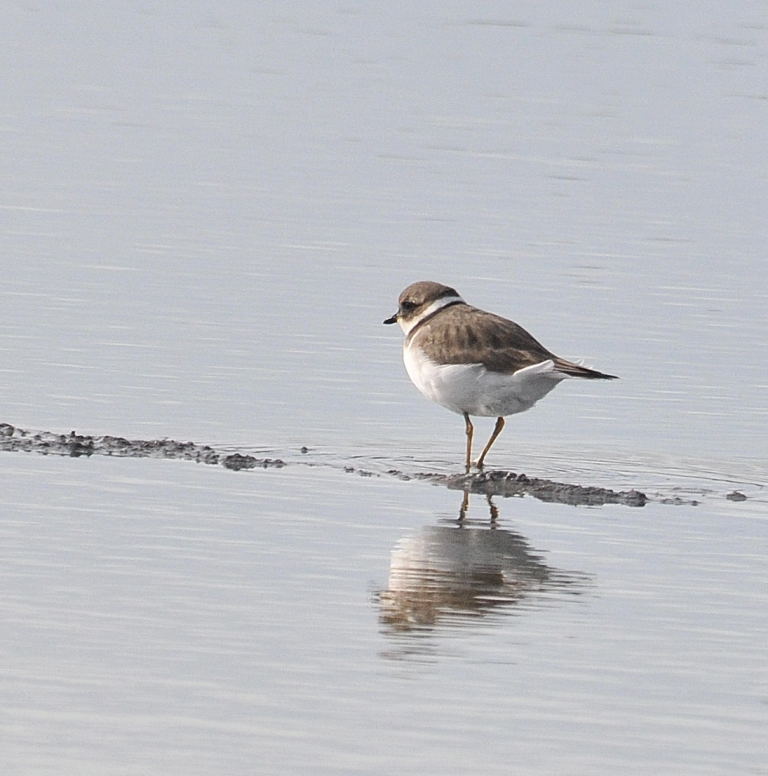
let's look at the resident Ringed plover. In breeding plumage a bright orange bill and orange legs. It shows a black stripe, thick around the eye, thinning around the base of the bill. White forehead followed by another black stripe across the front of the crown. A wide black band across the breast. Wings a light brown/faun colour. An example here from Tavira in Portugal whilst the second photo of Ringed plover and Dunlin is from Aviero, mid Portugal. Note the similarity in size to the Dunlin. Size is all important when making field notes on waders. Compare it in size to a bird that you know that is close by.


In non breeding plumage it becomes a much paler version of the breeding plumage. The bill becomes dark, the brightness loses its lustre and the legs become a much less bright orange. Note the white collar all around the back of the neck and the dark patch around the eye. As a resident it will be likely this bird can be encountered at any time of the year in Norfolk.
If still in doubt about the bird you're watching being Ringed or Little ringed wait until it flies. Ringed plover shows an obvious wing bar whereas LRP has an all dark wing.


Little Ringed Plover:

As stated, a summer migrant to our shores, the first ever LRP to breed was indeed in Hertfordshire at Tring reservoirs in, I think without checking, 1955. Therefore, it is most likely to be encountered in breeding plumage where the stand out feature is a spectacular yellow eye ring, never present on Ringed plover, as shown below. A much thinner bird than the rounded Ringed Plover.


To differentiate from Ringed plover, note the extra white stipe across the top of the head, the dark bill and darker legs. It is also a smaller bird but for that to be useful it really requires both species to be seen together. However, LRP is a much slimmer bird than the rounded Ringed plover. The yellow eye ring really does stand out. Photos here from Amwell Reserve.

The LRP does hang on until quiet late in the year and will be seen in non breeding plumage, again a less colourful version of the breeding plumage.


Note the much finer bill on LRP and the thin black collar bordering the white ring over the back of the head. Also, the LRP shows a patch of white above the base of the bill and its legs become a fleshy shade of pinky/yellow. Finally, no white wing bar on LRP. Photos from North Norfolk and Amwell. A habit of LRP during breeding season is to spend a lot of time running around over sandbanks and mud scrapes in an attempt to catch flies that land upon the damp mud. Rye Meads RSPB near Broxbourne normally hosts them, seen often from the Draper Hide.

Wednesday, 9 December 2020

Identifying waders. Part 4: Redshanks, Greenshanks and Ruff

 These species can cause confusion with beginners to wader watching but certain features make it not too difficult to sort out. 

Ruff 

Breeding male:

These arrive on our shores as from August and are unmistakable as they are totally individual in colouration and state of moult. They can range from golden yellow to jet back and all points between.


The middle bird in these distant shots of ruff coming out of breeding plumage is the same bird in the 2nd snap. Note longish legs and a slight decurve on the bill which again, can be red, orange or black. As can be seen in all these, huge variety and not likely to be confused with anything else.

Non breeding male

These are a brown bird, sometimes still with a red/orange bill, slightly decurved and invariably show orange/red legs which is where the confusion can set in. The ruff and reeve (female) are a strange, somewhat pot bellied shape with a humped back. 


This male in non breeding plumage at first glance does resemble a redshank but the shape is wrong, the bill thicker and shorter and there is much more white edging on the wing feathers whilst the belly is unmarked white. A slight tinge of brown on the chest. If this is a more peachey colour that will probably indicate a first year/juvenile bird. The latter stop off on our shores in huge numbers as from late August. The one above shows a dark tip to the bill only as it is covered in mud!

Juvenile:

Resembles the non breeding male in many ways but has a dark bill. Two juveniles shown here showing the slight decurve on the dark bill and dark legs but remember, this colour can always be mud, not the true leg tone. The light colouration on the breast is much more than the non breeding male whilst the belly is still white.


The reeve is similar to both the non breeding male and juvenile and to go into all possibilities of this relatively easy bird to identify but tricky to pinpoint age and sex is note required here. Below a selection of ruff shots to indicate the range, bearing in mind most seen in the UK will be in non breeding plumage.


Very difficult to say for sure but possibly top 2 are juvenile, 3rd is non breeding reeve and last one non breeding male. Enough here to be able to spot a ruff. 

In flight, a ruff has a barely perceptible white wing bar, a tapering tail edged white with a central brown bar. The white is plain, not marked. Usually a silent bird.

Conclusion: Medium length bill, thick at base and tapering, red/orange or dark. Legs variable but the pot belly look, humped back and white edging to the feathers as shown in these photos should be good enough to say ruff confidently.


Redshank

After Dunlin probably the most common of wader, so another good one to become familiar with to eliminate from your inquiries.


Typical redshank here, longer bill than ruff and more delicate, a darker, richer brown and, always helpful, frequently a white eye ring as shown here. Fortunately, not too much change for breeding plumage, just finer markings and a lighter colour but still a redshank. Note the bill changes from orange through to a dark tip.

In flight easy to identify as the trailing edge of the wing  from body to near the point is a broad white bar whilst it will also show a cigar shaped white area above the narrowly barred tail from which a good length of red/orange leg and feet protrude. Photo below shows all those features clearly. Upon take off and landing the Redshank can be very vocal with loud teeeyuu calls, usually uttered with a visibly open bill. A good call to learn for mud bank and marsh bird watching


Breeding plumage.


As can be seen, not big change, still orange legs and thin bill of medium length, straight and the white eye ring still present, albeit less obvious. Below, a few more redshank photos, almost all from North Norfolk as the breeding plumaged one above is. This successfully raised 2 juveniles just outside a hide upon Cley Reserve. The 3rd photo from The Camargue as there is also a Black Winged Stilt in the shot. However, the other bird is a Spotted redshank. See below for more details.


Spotted Redshank

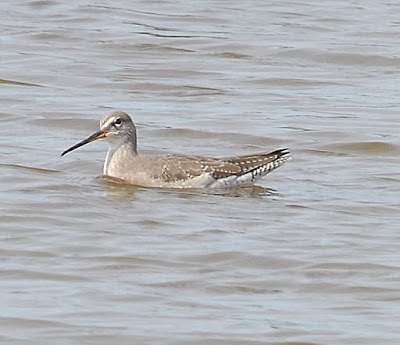
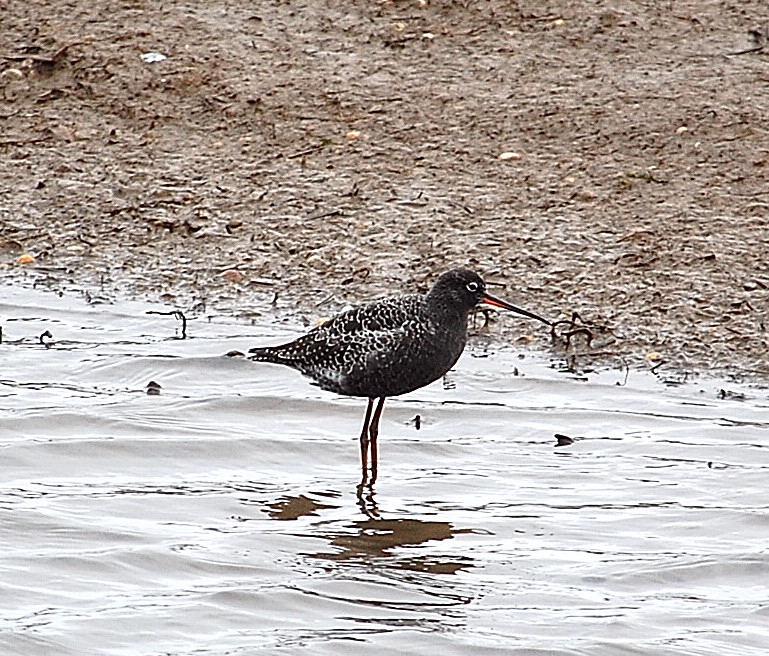
This can be a confusion species with Common redshanks but again, many features differ. Firstly it has a far longer bill which is almost entirely dark apart from a red section near the base. Also, sounds minute but it is apparent through binoculars, the very tip of the bill is clearly downturned, sometimes looking like it is actually snapped. The legs of Spot Shank are orange red but much longer than Common redshank. Plumage in non breeding stages is similar, usually lighter whereas in breeding plumage it is unmistakeable: Jet black. In flight the Spotted redshank shows the white cigar shape but the wings are brown with no white on the secondaries. 

Spotted redshanks can be found at typical wadering grounds on migration, particularly in September where they may still show signs of the black breeding plumage but most will be as shown below. Note the salient points of colouration, bill tip and the final feature, a clear white supercilium (eye stripe) beginning at the base of the bill and reaching the eye. These photos from The Camargue, Southern France.


In picture 3 the bird, like godwits, is actually swimming, something I have never seen a Common redshank do. The penultimate photo shows 4 Spotted redshanks, a Little ringed plover and a Common sandpiper. (Later for the latter two.) The final picture shows the huge plumage change into breeding gear. No mistaking this one.

Greenshank

As the name implies, the legs of this bird are yellowy green and that is usually enough to identify it but if wading they will not be visible. The next diagnostic feature is that the bill has a clear upturn to it. Not as pronounced as an avocet but more so than a Bar tailed godwit. The bill of greenshank can be a yellowy/green through to a darkish blue tinge and is stronger and thicker than the redshank and Spotted redshank. Again, a migratory bird with them being a rare but annual visitor to Stansted Airport lagoons. These photos taken both in The Camargue and North Norfolk. 

Again, no huge change in the plumage throughout the year.


2nd photo is a distant shot from The Algarve, but in reality, this is how they are frequently observed. The upcurve on the bill is noticeable in both photo1 and 2, whilst the 3rd photo from Pont de Gau, The Camargue shows the clear white belly, light brown feathering on the throat and breast and obvious leg colouration. To the right is a Spotted redshank

The bird that most resembles the Greenshank is the rare to our shores, Marsh sandpiper. If you were to encounter one of these on your day out, rest assured, you would not be alone. There would be birders and photographers everywhere. Just for comparison here is one from The Camargue and one from Yala, Sri Lanka from 6 years ago. Note the needle thin bill which this bird uses to delicately pick insects off the surface of the water, whilst the stouter Greenshank bill is for probing mud. Also, a dark bill.


This is me

This is me
At the end of another Norfolk Coastal footpath walk. 47 miles, 3 days 99 species of bird. September 2009

Caley Wood view

Caley Wood view
sunshine through the canopy 29.05.08

A walk along the Warta Valley, Poznan, Poland. Feb 2007

A walk along the Warta Valley, Poznan, Poland. Feb 2007
Best birds on this walk: black and middle spotted woodpecker and short toed treecreeper

About Me

My photo
A primary school teacher for 30 years, I retired from teaching in July 2009 to set up my own science enhancement and communication company. The Primary Works offers science clubs, workshops and staged science shows nationwide. I have always been interested in bird watching since my early years. Apparently my first tick was after inquiring about a chaffinch and then receiving the Observer book of birds. By the age of 9 I had moved on to Tory Peterson's collins guide and was now involved on YOC birding holidays to Northumbria, Essex coast, Slimbridge and Yorkshire. My twitching rule is that I will willingly travel 1km for each gram the bird weighs. However, I have had many rarities just by being in the right place. I have travelled widely throughout Europe and also visited Australia and Sri Lanka. In 2016 I spent time at Portland Bird Obs and two trips to Aviero, Portugal. 2017 found me back in Sri Lanka in Feb/March, then July and back for New Year's Eve celebrations in December. Also returned to The Camargue in May for a 4 day trip. Few plans for 2018, but nothing yet booked apart from a trip to the IOW.

Grey heron

Grey heron
Over the allotment 28.09.08

Southern Hawker

Southern Hawker
Ridge footpath 27.08.08

Juvenile green woodpecker (17.08.08)

Juvenile green woodpecker (17.08.08)
Note the stripes, denoting a bird fledged this year.

common blue

common blue
Ash Valley G.C. 15.08.08

Indian balsam (impatiens glandulifera)

Indian balsam (impatiens glandulifera)
River Ash

azure damselfly

azure damselfly
River Ash 28.07.08

marbled white

marbled white
Discovered at Westland Green 22.07.08

ruddy darter

ruddy darter
Bush Wood 21.07.08

honeysuckle 19.07.08

honeysuckle 19.07.08
growing in hedgerow in Chapel Lane

cinnabar moth caterpillar

cinnabar moth caterpillar
Photographed on ragwort 19.07.08

Bittersweet

Bittersweet
Study of petals 11.06.08

male yellowhammer

male yellowhammer
08.06.08

common blue butterfly

common blue butterfly
06.06.08

River Ash

River Ash
looking south from the bridge at Hadham Ford

Common poppy (papaver rhoeas)

Common poppy (papaver rhoeas)
in rape field 29.05.08

Caley Wood sunshine

Caley Wood sunshine
29.05.08

Millenium Wood fox

Millenium Wood fox
24.05.08

common comfrey (symphytum officinale)

common comfrey (symphytum officinale)
06.05.08 banks of the River Ash

Garlic Mustard or Jack by the Hedge,(Alliara petiolata)

Garlic Mustard or Jack by the Hedge,(Alliara petiolata)
flowers, leaves and fruit edible . Good in salad and pesto

April showers

April showers
Double rainbow 30.04.08

Caley Wood bluebells

Caley Wood bluebells
22.04.08

Yellow Archangel

Yellow Archangel
Chapel Lane (20.04.08)

sunlight 16.04.08

sunlight 16.04.08
looking south west from Bush Wood

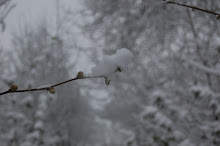
snowy buds

snowy buds
06.04.08 in Bush Wood

Looking north west

Looking north west
05.04.08 evening shower approaching

Back Garden

Back Garden
Easter Sunday (23.03.08)

Brick Kiln Hill

Brick Kiln Hill
Looking east (23.03.08)

No play today

No play today
The 2nd hole at Ash Valley golf course

Teasel head

Teasel head
Bush Wood (21.03.08)

Reflections

Reflections
daffodils at Bush Wood pond (21.03.08)

Swollen River Ash

Swollen River Ash
The river at the bottom of Winding Hill 16.03.08

Daybreak over the chapel

Daybreak over the chapel
Thursday 13th March

Wild daffodils (narcissus pseudonarcissus)

Wild daffodils (narcissus pseudonarcissus)
growing in Bush Wood

January snowdrops

January snowdrops
Banks of River Ash, north of Much Hadham

Good Moon

Good Moon
From garden 24.01.08

Village Green

Village Green
Looking east towards Acremore Street

Looking south before Hadham Ford

Looking south before Hadham Ford
rare January blue sky

Useful sites

The following are some useful websites that may interest readers of this blog.
Firstly, Bishop's Stortford Natural History Society http://bsnhs.webplus.net/

Fellow birder, Gary Whelan's blog. Gives reports from our trips out together plus reports from his trips abroad. http://hairybirders.blogspot.co.uk
http://www.hertsbirdclub.org.uk/ The official herts bird club website. Frequently updated, listing bird sightings around the county. Offers links to many other websites. Both of these sites also offer links to yahoo discussion groups.
http://www.birdforum.net/ An international site. You can enter as a guest but become a member( free) to post comments, bird sightings and just about anything to do with wild birds. Good news updates, classified section for binoculars, cameras etc.
http://www.guidedbirdwatching.com/ A new site set up where you can contact people worldwide who will help you find good birds in their country. UK section being set up presently.
http://www.britainsbirder.co.uk/
Fellow birders blog. Strtford resident, Graeme Smith regulary birds the area south of Stortford as well as around Spellbrook and the River Stort from Spellbrook to Twyford Locks. Some superb bird photography: Graeme uses a digital camera attached to his powerful telescope to get detailled images of the birds he sees. Well worth a browse.
Two local sites that may be of interest can be found at
http://www.thehadhams.com/ www.thepelhams.net/content/section/12/139/

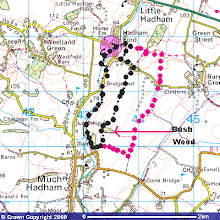
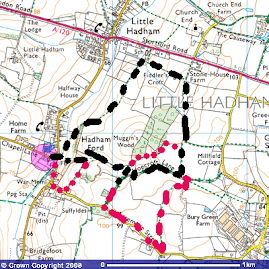
South Easterly walk

South Easterly walk
black, normal, red extended walk

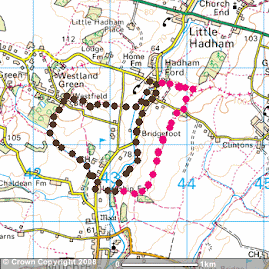
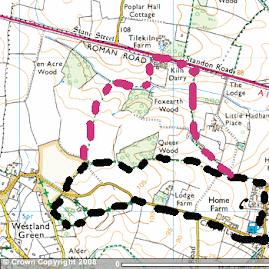
South Westerly route.

South Westerly route.
Black usual, red extended

North Easterly walk

North Easterly walk
black short, walk. Red, extended

North West Patch

North West Patch
black route regular. Red route the extended wander