Thursday, 26 March 2020

Today's suggestions for finding nature in your garden

Good morning,
Please do see the previous post where I have mentioned things that local folk found and the photographs that I received. All great to see.
It doesn't matter how much or how little knowledge you have of identifying creatures to be involved in this and I know so many children that love hunting for bugs, beetles, butterflies etc. If you do get a photo, I am very happy to receive it and make suggestions, if not, send me a description: size, colours, where it was. e.g. Beetle type insect larger than a ladybird that was on the soil, shiny black with ridges on its back. Although there are 2350 beetle species in Hertfordshire alone, just that little bit of info would inform me that it was probably a ground beetle and that it could be a Black clock beetle. Give it a go.

Today is about birds. We all know what a robin looks like, a wood pigeon and a crow or jackdaw. Some of you know the difference between a great tit and a blue tit. So what would be good today would be to get outside for half an hour at a time, perhaps morning and afternoon and just look around for birds. If you don't know what it is, a phone photo may help or just a description of colour, or, of course, just enjoy seeing them and counting different types. Almost all gardens, with some careful watching will give up at least 10 species and don't forget to look in the sky for birds of prey and other species flying over.
Here are a few you may find:
Goldfinch: note red/white/black face and bright gold/yellow on wing when it flies

Chaffinch: grey and pink head, white on wing when it flies

Collared dove: usually in pairs. Fawn colour with black ring on neck

Jackdaw: bright blue eye, all black and noisy. Usually in groups

Long tailed tit: pink/black white with long tail. Usually in pairs or more. Small

Red kite: large, reddy brown and look for the special forked tail. Maybe flying high over your garden, often in a circling pattern and being chased by crows

Goldcrest: Very small and often found in conifer trees and hedges. Usually in pairs at this time of the year

Great tit: yellow tummy with black stripe down the middle

Chiffchaff: small and green. Probably hear it rather than see it. Has a distinct call zip zap zip zap or chiff chaff chiff chaff repeated for a minute or so.

Wood pigeon. Large, grey and with white bar on the wings. Coo Coo call

Blue tit. yellow and blue, no black stripe on tummy

So now, you can be outside, counting birds and seeing if you can identify them, whilst also looking for bees, flies, ladybirds, and butterflies. Plenty to keep you outside on what is going to be another fantastic day. Finally, if you have any yogurt type pots, please keep them for several activities in the future, we'll be making beetle traps. Also, if you have an old piece of carpet, an old doormat or just a brick or stone, put it somewhere in your garden on soil or grass. Do remember, not on your prize lawn, it will kill the grass underneath very quickly. This we shall come back to on another day. 
Remember to send me notes and photos to jforgham"at"hotmail.com or just leave a comment underneath in the comments box. Have a wonderful day and looking forward to hearing about your discoveries. keep sharing these ideas. Take care, Jono.

Yesterday's results

Good Day to all,
Yesterday I was even busier, with 77 people looking at my suggestion, great stuff, keep sharing with folk on Facebook if you like and do remember to send me anything you find, even if it is not part of the daily idea.
I received several messages and photographs from people so thought I would share these first and then add today's suggestion in a separate post.
I received a photo of a comma butterfly from Renee that landed in her garden.
Comma butterfly in Bishop's Stortford
Fellow nature watcher and first class photographer Richard sent me loads from his garden. Here are just a few of his excellent captures using a macro lens for close up work.
7 spot ladybird

Dark edged bee-fly

Click on this Gwynne's mining bee to admire the detail captured here
Another Stortford resident, Graeme sent in a selection from his small garden. Here are a selection.
Green shieldbug

Red Kite over Thorley

A spider species yet to be identified. A job for later this morning

Another Dark edged bee-fly

I had other reports of butterflies, with a Brimstone seen in Bury Green, a flyby orange species, either Comma or Small tortoiseshell in Ware and a Small tortoiseshell over my garden at about 2pm
Thank you for sending these in. Please keep them coming and we will be able to build up a good back catalogue of regular creatures found in gardens so others can use the photos to help identify what they have found.
Me? I got a reasonable selection from my very small garden: 25 yards long 5 yards wide.
Goldfinch

Buff tailed bumble bee

First hoverfly of the year, Eristalis pertinax

March Moth


Thanks for sending these in.


Wednesday, 25 March 2020

Nature Activity Day 2

Good morning all,
Thank you for all the kind comments yesterday and glad to note that 44 people had a look at yesterday's activity suggestion. If you found any bees, well done. There were a few in my garden and I suspect more today with temperatures forecast to top 11C by early afternoon. Whilst the weather remains perfect for being outside I shall carry on with things to do in the garden. When it turns wet I have loads of indoor ideas, too.
I had an email and photo sent to me by Jen and her son. They found this creature and managed a great photo making identification easy.
Jen and her son found this Dark edged bee fly
These will be in many gardens today, look for the long, sharp proboscis which is just a glorified straw for drinking nectar. This fly lays its eggs by flicking them, whilst in flight near or into a bee nest, usually the nest of an Oak mining bee. The larvae hatch and crawl into the nest to feed upon the larvae of the bee. All clever stuff.
Here's a photo I got of one last year in our local Community Wood.

Today, I think, as well as searching for bee flies and other bees and flies it is possible that early butterflies will be flying. Sometime after noon will be best, up until 3.30pm when the temperature starts to drop.
So, today, how about getting into the garden and keeping an eye out for any butterflies. The 4 most likely species will be these.

Small tortoiseshell
Comma
Peacock
Brimstone.

Brimstone the only yellow or green butterfly you'll see

Comma, note the ragged edge to the wings

Peacock, note the large "eye spots" one on each wing

Small tortoiseshell, look for the blue markings on the edge of the hind wing
A good tip for getting a butterfly photo is to move slowly towards it as it sits on a leaf, flower or fence, usually in full sun. Make sure you do not cast a shadow over it as it will fly off immediately. Therefore, check where the sun is and where your shadow is before you stalk it. Not always easy but worth remembering

If no butterflies appear there is bound to be something and I will be very pleased to see your photos or, something for children and adults before it gets warm, a drawing, painting or felt tip picture of one of these butterflies. Just print off a photo and give it a go. Phone photo to jforgham"at"hotmail.com
Best of luck and share the link.
There is another nature suggestion in today's Bishop's Stortford Independent if you are shopping and see a copy. Out today and, no, I have not been paid to write that lol. I don't get paid for the article either!!

Tuesday, 24 March 2020

Activities for children in the garden: Day 1

Morning all,
Now that we are all at home and facing tough times indoors I thought I would start up a series of suggestions that folk may wish to become involved in doing outside in their garden. There is plenty about already as we are experiencing cold but beautifully sunny days. Consequently the insects are appearing. There are several bees that you may find. Look on any flowering plants for large buzzing bumble bee. This will be the buff tailed bumble bee queen who will be taking nectar and looking for a nest site.
Also at this time is the much smaller Gwynne's mining bee. You may find this on any flower but particularly primrose. Photos below. Look for its yellow hairy legs
Today's challenge.
In 45 minutes in your garden how many bees can you count? Can you see the different types. How many of each?
Try looking for flies as well. Maybe a blue one will be sitting on a leaf or a fence. This might be a Bluebottle. Wonder what else you may discover? spiders on wooden fences, perhaps. Get a photo
Why not try to get a photo on a phone if you don't have a camera? Post them to me at jforgham"at"hotmail.com I have written it this way to avoid web scrapers sending me piles of junk but I am sure you know what to do. I look forward to receiving them and send me any messages on here, too. Would be really happy to see your suggestions for other ideas. I'll try to get one out each day. Make the most of this beautiful day, forecast is for no rain for the rest of this week.
Good luck.
Bluebottle
Buff tailed bumble bee

Gwynne's Mining bee


Monday, 2 March 2020

A Day in North Norfolk

Leaving home around 6.30 meant, following an en route coffee break, I was at Lady Anne's drive in Holkham by 9 am. Plenty of brent geese, wigeon and lapwings along with Egyptian geese but no hoped for Rough Legged buzzard, just distant red kite and common buzzard to I headed off to Cley, checking waters around Wells and getting mallards, teal and little egrets.
I arrived at Cley beach and chatted to a birder I knew. He had been present since first light and had seen very little. This didn't inspire me to wander along the shingle to the North viewing screens so I just checked the sea; just gulls and cormorants. A quick scan over the Eye field revealed plenty of golden plover and more peewitting lapwings. Off to the NWT Centre to check for new books and another coffee before a short drive to Kelling Water meadows.
I wandered down a somewhat muddy path. Plenty of finches in the hedgerow, skylarks overhead and red legged partridge on the ploughed fields. On the water: gadwall, wigeon, Egyptian geese, black headed and herring gulls whilst a reed bunting popped up on some bush, but no hoped for stonechat. I walked as far as Muckleborough Hill before retracing my steps back to the village reading rooms where I had parked. A wren called and long tailed tits, blue tits and great tits got on to the day list.
Drake wigeon, Holkham

Female kestrel, Cley beach

Long tailed tit, Kelling Water Meadows

Red legged partridge, Kelling Water Meadows

Goldfinch, Kelling Water Meadows
From Kelling I drove to Salthouse beach but more of the same on the fields so I continued to Stiffkey and Warham Greens near High Sand Creel campsite. Out on the marsh were big numbers of brent geese, redshank, curlew and a pair of male Marsh harriers. Not too much so I decided against the walk to the Gibbert roundabout and headed off to buy some lunch. Once purchased, I ate it in the car at Brancaster harbour where more of the same was recorded with a black tailed godwit getting on to the list.
Marsh harrier, male, Warham Greens

same bird
From the harbour I thought a few hours at Titchwell would be good. The temp was pushing double figures and the sun was bright; good photography light. I checked the book of the days sightings. This confirmed that it was not a premium bird day for the area, as expected in early March but still worth a good walk to the beach and back and time in the hides. Following the rain, the FreshMarsh was full so no mud for waders, these were all on the Volunteer marsh. Numerous black headed gulls and in with them, several breeding plumaged Mediterranean gulls showing their jet black hood and bright blood red bill. Always good to see. I arrived at the beach and scanned the water with my telescope. One goldeneye flying into the Wash was my only reward but further along the beach plenty of waders at the surf's edge: sanderling, turnstone, knot, dunlin, black tailed godwit, oystercatcher and redshank. I then spent time in the Parrinder Hide but no sign of the reported water pipit before I, once again, trudged back to the car in rapidly fading light.
Distant Stonechat, male, Titchwell

Redshank, Titchwell

Oystercatcher, Titchwell

Drake teal, Titchwell

Redshank reflection, Titchwell

Little egret, Titchwell


2nd Little egret, Titchwell

Curlew, Titchwell

Black headed gull (with brown head!) and Mediterranean Gull, Titchwell

Avocets, Titchwell
Shelduck, Titchwell
Last stop was at Thornham Harbour. Upon arrival, usual waders in the creeks and a party of about a dozen twite flew over and settled in the sueda bushes, not to be seen again for a photo.
The weather had been a real change, probably the best day of the year, so far with sharp light, a very gentle breeze and temps up to 10C. Well worth the early start and really good to be back here. Like all birders, the next 8 weeks will offer plenty of opportunities in this area for some possible rare migrants coming off the North Sea, especially if the weather conditions are perfect for blowing birds to the shelter of the coast. I shall be returning once a fortnight over the next month or two and hopefully latch on to something a little more unusual than today's list
Curlew, Thornham Harbour


Species list
  1. cormorant
  2. little egret
  3. grey heron
  4. mute swan
  5. greylag goose
  6. pink footed goose
  7. canada goose
  8. brent goose
  9. shelduck
  10. egyptian goose
  11. mallard
  12. gadwall
  13. shoveler
  14. wigeon
  15. teal
  16. tufted duck
  17. goldeneye
  18. red kite
  19. marsh harrier
  20. common buzzard
  21. kestrel
  22. red legged partridge
  23. pheasant
  24. water rail (heard)
  25.  moorhen
  26. coot
  27. oystercatcher
  28. avocet
  29. grey plover
  30. golden plover
  31. lapwing
  32. knot
  33. sanderling
  34. turnstone
  35. dunlin
  36. redshank
  37. black tailed godwit
  38. curlew
  39. black headed gull
  40. Mediterranean gull
  41. herring gull
  42. lesser black backed gull
  43. wood pigeon
  44. collared dove
  45. kingfisher
  46. green woodpewcker
  47. skylark
  48. cetti's warbler
  49. meadow pipit
  50. pied wagtail
  51. wren
  52. dunnock
  53. robin
  54. stonechat
  55. song thrush
  56. mistle thrush
  57. blackbird
  58. goldcrest
  59. great tit
  60. blue tit
  61. long tailed tit
  62. bearded reedling (heard)
  63. treecreeper
  64. magpie
  65. jackdaw
  66. carrion crow
  67. rook
  68. starling
  69. house sparrow
  70. chaffinch
  71. linnet
  72. twite
  73. goldfinch
  74. greenfinch
  75. yellowhammer
  76. reed bunting

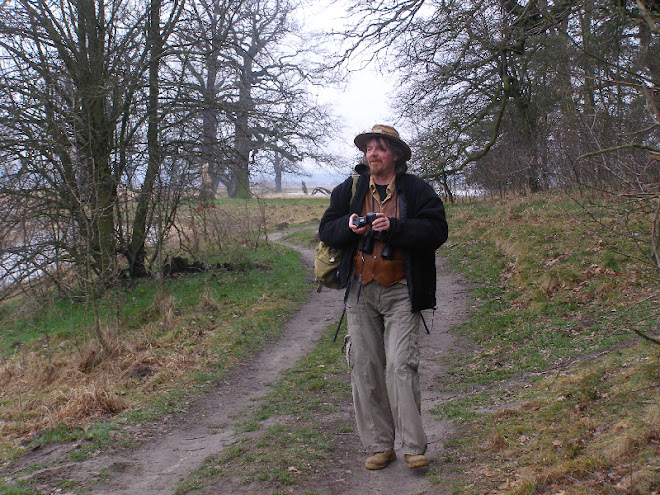
This is me

This is me
At the end of another Norfolk Coastal footpath walk. 47 miles, 3 days 99 species of bird. September 2009

Caley Wood view

Caley Wood view
sunshine through the canopy 29.05.08

A walk along the Warta Valley, Poznan, Poland. Feb 2007

A walk along the Warta Valley, Poznan, Poland. Feb 2007
Best birds on this walk: black and middle spotted woodpecker and short toed treecreeper

About Me

My photo
A primary school teacher for 30 years, I retired from teaching in July 2009 to set up my own science enhancement and communication company. The Primary Works offers science clubs, workshops and staged science shows nationwide. I have always been interested in bird watching since my early years. Apparently my first tick was after inquiring about a chaffinch and then receiving the Observer book of birds. By the age of 9 I had moved on to Tory Peterson's collins guide and was now involved on YOC birding holidays to Northumbria, Essex coast, Slimbridge and Yorkshire. My twitching rule is that I will willingly travel 1km for each gram the bird weighs. However, I have had many rarities just by being in the right place. I have travelled widely throughout Europe and also visited Australia and Sri Lanka. In 2016 I spent time at Portland Bird Obs and two trips to Aviero, Portugal. 2017 found me back in Sri Lanka in Feb/March, then July and back for New Year's Eve celebrations in December. Also returned to The Camargue in May for a 4 day trip. Few plans for 2018, but nothing yet booked apart from a trip to the IOW.

Grey heron

Grey heron
Over the allotment 28.09.08

Southern Hawker

Southern Hawker
Ridge footpath 27.08.08

Juvenile green woodpecker (17.08.08)

Juvenile green woodpecker (17.08.08)
Note the stripes, denoting a bird fledged this year.

common blue

common blue
Ash Valley G.C. 15.08.08

Indian balsam (impatiens glandulifera)

Indian balsam (impatiens glandulifera)
River Ash

azure damselfly

azure damselfly
River Ash 28.07.08

marbled white

marbled white
Discovered at Westland Green 22.07.08

ruddy darter

ruddy darter
Bush Wood 21.07.08

honeysuckle 19.07.08

honeysuckle 19.07.08
growing in hedgerow in Chapel Lane

cinnabar moth caterpillar

cinnabar moth caterpillar
Photographed on ragwort 19.07.08

Bittersweet

Bittersweet
Study of petals 11.06.08

male yellowhammer

male yellowhammer
08.06.08

common blue butterfly

common blue butterfly
06.06.08

River Ash

River Ash
looking south from the bridge at Hadham Ford

Common poppy (papaver rhoeas)

Common poppy (papaver rhoeas)
in rape field 29.05.08

Caley Wood sunshine

Caley Wood sunshine
29.05.08

Millenium Wood fox

Millenium Wood fox
24.05.08

common comfrey (symphytum officinale)

common comfrey (symphytum officinale)
06.05.08 banks of the River Ash

Garlic Mustard or Jack by the Hedge,(Alliara petiolata)

Garlic Mustard or Jack by the Hedge,(Alliara petiolata)
flowers, leaves and fruit edible . Good in salad and pesto

April showers

April showers
Double rainbow 30.04.08

Caley Wood bluebells

Caley Wood bluebells
22.04.08

Yellow Archangel

Yellow Archangel
Chapel Lane (20.04.08)

sunlight 16.04.08

sunlight 16.04.08
looking south west from Bush Wood

snowy buds

snowy buds
06.04.08 in Bush Wood

Looking north west

Looking north west
05.04.08 evening shower approaching

Back Garden

Back Garden
Easter Sunday (23.03.08)

Brick Kiln Hill

Brick Kiln Hill
Looking east (23.03.08)

No play today

No play today
The 2nd hole at Ash Valley golf course

Teasel head

Teasel head
Bush Wood (21.03.08)

Reflections

Reflections
daffodils at Bush Wood pond (21.03.08)

Swollen River Ash

Swollen River Ash
The river at the bottom of Winding Hill 16.03.08

Daybreak over the chapel

Daybreak over the chapel
Thursday 13th March

Wild daffodils (narcissus pseudonarcissus)

Wild daffodils (narcissus pseudonarcissus)
growing in Bush Wood

January snowdrops

January snowdrops
Banks of River Ash, north of Much Hadham

Good Moon

Good Moon
From garden 24.01.08

Village Green

Village Green
Looking east towards Acremore Street

Looking south before Hadham Ford

Looking south before Hadham Ford
rare January blue sky

Useful sites

The following are some useful websites that may interest readers of this blog.
Firstly, Bishop's Stortford Natural History Society http://bsnhs.webplus.net/

Fellow birder, Gary Whelan's blog. Gives reports from our trips out together plus reports from his trips abroad. http://hairybirders.blogspot.co.uk
http://www.hertsbirdclub.org.uk/ The official herts bird club website. Frequently updated, listing bird sightings around the county. Offers links to many other websites. Both of these sites also offer links to yahoo discussion groups.
http://www.birdforum.net/ An international site. You can enter as a guest but become a member( free) to post comments, bird sightings and just about anything to do with wild birds. Good news updates, classified section for binoculars, cameras etc.
http://www.guidedbirdwatching.com/ A new site set up where you can contact people worldwide who will help you find good birds in their country. UK section being set up presently.
http://www.britainsbirder.co.uk/
Fellow birders blog. Strtford resident, Graeme Smith regulary birds the area south of Stortford as well as around Spellbrook and the River Stort from Spellbrook to Twyford Locks. Some superb bird photography: Graeme uses a digital camera attached to his powerful telescope to get detailled images of the birds he sees. Well worth a browse.
Two local sites that may be of interest can be found at
http://www.thehadhams.com/ www.thepelhams.net/content/section/12/139/

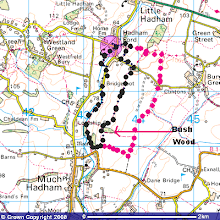
South Easterly walk

South Easterly walk
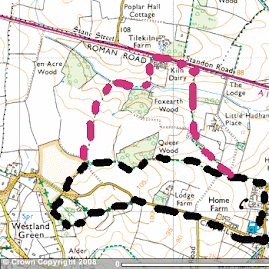
black, normal, red extended walk

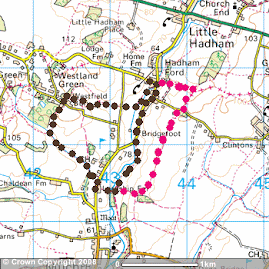
South Westerly route.

South Westerly route.
Black usual, red extended

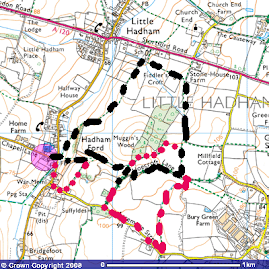
North Easterly walk

North Easterly walk
black short, walk. Red, extended

North West Patch

North West Patch
black route regular. Red route the extended wander