Wednesday, 14 June 2017

Amazing Moth Night

Last night, I switched the garden Skinner 125W on and set off for East Wood at TL463214. After carting the trap, net, sheet, pots, chair, bottle of beer and battery for half a mile, I set up next to a large clump of Bird's Foot trefoil in a small, sheltered pasture adjacent to the beech wood.
By 9.30pm the moths began flying with plenty of straw dot, Agapeta hamana and Tortrix viridana. When moths are in such number, I count the first 25 and then disregard those in flight, but do add any that are on the sheet or in the trap at the end of the evening.
Clouded silver

Ghost moths made an appearance as did several blood vein as I wandered through the pasture, netting as I went. Occasionally, I returned to the sheet, potted what was roosting and either put them aside to id at home or took them for a wander to release in a field far from the trap so as not to count them twice.
By midnight, I had a large collection of potted moths for home and a good list. I checked the trap, listing and potting and returned home at 1a.m to find the garden fence next to the trap and the perspex full of moths, which I then just potted to sort out in the morning. By 2.15 I had identified all but 12 of the East Wood moths and these were sorted in better natural light this morning.
In total: 231 moths of 51 species. Nothing new for parish records but a fair few to add to the year list.
13.06
6 Ghost moth
EW


34 Straw dot
EW


40 Agapeta hamana
EW


7 Crambus lathoniellus
EW


4 Common swift
EW


Aphelia paleana
EW
78th micro

6 Snout
EW


Angle shades
EW


5 Blood vein
EW


30 Tortrix viridana
EW


2 Middle barred minor
EW


Riband wave
EW


37 Chrysoteuchia culmella
EW


Silver ground carpet
EW


2 Clouded silver
EW


2 Udea olivalis
EW


Common wainscot
EW


Marbled minor
EW


Barred yellow
EW


Drinker
EW
144th macro

2 Mottled beauty
EW


2 Celypha lacunana
EW


Hofmannophilia pseudospretella
EW


Setaceous Hebrew character
EW


Pterophorus pentadactyla
EW


Light emerald
EW


Treble brown spot
EW


Heart and dart
EW


2 Brown silver line
EW


Foxglove pug
EW


Pseudargyrotza conwagana
EW
79th micro

Pandemis corylana
EW
80th micro

Acleris forsskaleana
EW
81st micro

Archips podana
EW


Aliemma loefligiana
EW
82nd micro

Apotomis turbidana
EW
83rd micro

Notocelia trimaculana
EW


5 Archips xylosteana
EW


Eucosma cana
EW
84th micro

2 Hedya pruniana
EW


Scoparia subfusca
EW


Pandemis cerasana
EW


Blastobasis lacticolella
EW


Single dotted wave
EW
145th macro

Wormwood pug
EW


Brimstone
EW


Aethes smeathmannianna
EW
85th micro

2 Paraswammerdammia albicapitella
EW


Epinotia nisella
EW
86th micro

Ingrailed clay
EW


Anthophila fabricana
EW


This morning, I emptied the Skinner and started identifying all, including those from last night. Incredibly, 2 new for parish records:
Pretty chalk carpet
Grapholita janthinana

Sadly, rather worn, but a Pretty Chalk Carpet. About as unexpected in my trap as the 2012 Jersey Tiger!!

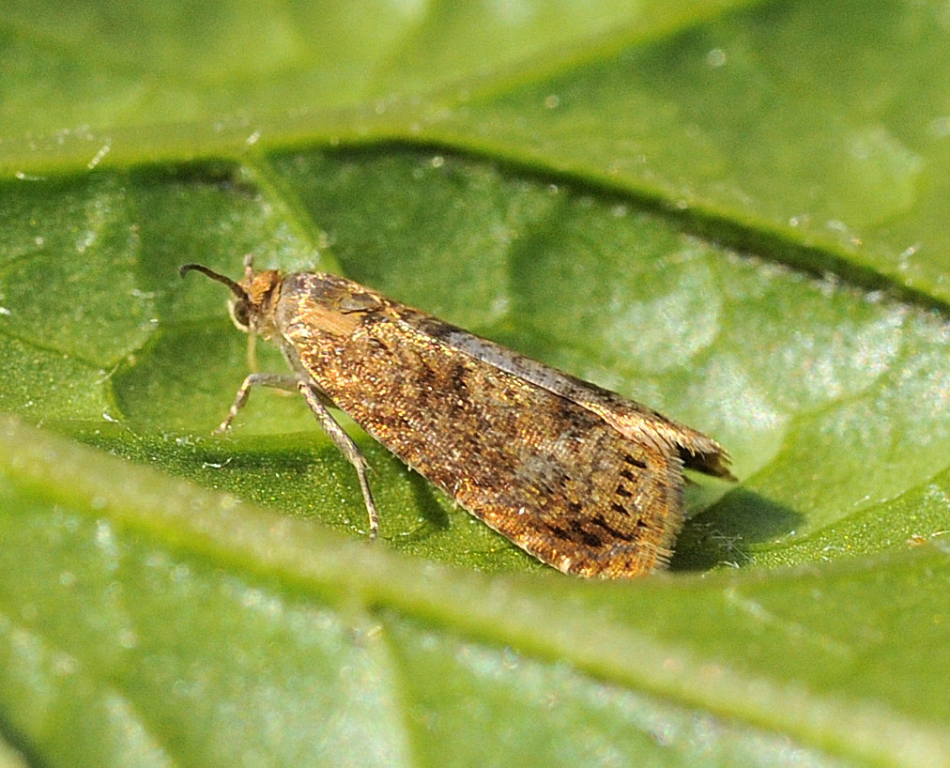
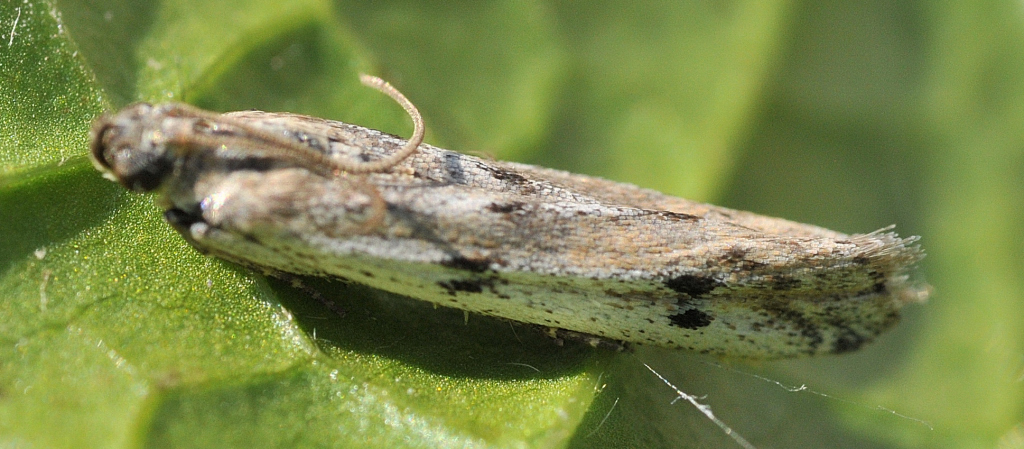
Grapholita janthinana, another new for parish records

Grapholita janthinana


As well as these, 6 new for year records, as noted here:

In total, 86 moths of 51 species. So, 317 moths in total with plenty to add to the year lists that now stand at 2349 moths: 149 macros and 91 micros. This year continues to impress and tonight looks like another busy night. I, however, will just be running the garden trap as long walk planned for tomorrow to record all aspects of the local natural history by walking the entire parish boundary, some 18 miles, beginning near East Wood.
Clouded brindle

Nephopterix angustella

Blue bordered carpet

Phycitodes binaevella


Photos of some of the species to follow this evening.


7 Heart and dart
G


Agapeta hamana
G


Beautiful golden Y
G


2 Flame
G


3 Marbled minor
G


4 Buff ermine
G


2 Dark arches
G


Straw dot
G


Nutmeg
G


Small fan footed wave
G
146th macro

Mottled beauty
G


Silver ground carpet
G


Clouded brindle
G

NFM
Pretty chalk carpet
G
147th macro

Common wave
G


Blue bordered carpet
G
148th macro

Tawny marbled minor
G


Scoparia subfusca
G


2 Ingrailed clay
G


Rufous marbled minor
G


Flame shoulder
G


5 Riband wave
G


2 Common wainscot
G


2 Chrysoteuchia culmella
G


2 Treble brown spot
G


2 Clouded border
G


Privet hawkmoth
G
149th macro

2 Common footman
G


Large yellow underwing
G


Fern
G


2 Beautiful hooktip
G


5 Celypha lacunana
G


Brimstone
G


Emmelina monodactyla
G


2 Scorched wing
G


Udea olivalis
G


Anania hortulata
G


2 Large nutmeg
G


Double striped pug
G


3 Archips podana
G


2 Notocelia uddmanniana
G
88th micro

Rhodophea formosa
G
89th micro

Celypha rosaceana
G


Hedya nubiferana
G


Common pug
G


Nephopterix angustella
G

NFM
Grapholita janthinana
G
90th micro

Phycitodes binaevella
G
91st micro

Monday, 12 June 2017

Few more moth species

A wonderful week camping on the Isle of Wight meant a break from local mothing, so these records are from 31st May - 2nd June and then 10th - 11th June, where new species continue to arrive.

On the 31.v.17 I ran the Heath 15W actinic trap on a grassy footpath, adjacent to several horse fields.
A total of 52 moths of 14 species were taken in the 2 hours the trap was one.
New for year were:
Phtheochroa rugosana
Hedya pruniana

That night, the home Skinner 125W gave up a pleasing 49 of 29 species with year additions being:
Mottled rustic
Small dusty wave
Least black arches
shoulder striped wainscot
Beautiful golden Y

Beautiful golden Y

Small dusty wave

Least black arches

Shoulder striped wainscot
The Following night I switched on the garden trap and headed off with all my gear for a long wander out to Stocking Wood. A superb habitat with much potential, having already taken some new for parish records here. Trap set by dusk and off wandering, netting as I went.
By 12.45a.m. I had plenty of records and these increased upon opening the trap before setting off for home.
New for my parish records were:
Phyllonorycter leucographella
Elasticha maculicerusella
Bucculatrix ulmella

Whilst the following made it on to the 2017 list:
Parornix anglicella
Lozotaenia forsterana
Pandemis cerasana
Wormwood pug
Blood vein
Tortrix viridana
Archips podana
Tinea semifulvella
Scoparia basistrigalis
Paraswammerdamia albicapitella
Choristoneura hebenstreitella

In total, Stocking Wood gave up an impressive 130 moths of 41 species. Back home, another 36 of 21 species were recorded, including NFY:
Cinnabar
Barred yellow
Lobster moth

The night of the 2nd meant just a garden trap as we were off for the ferry from Southampton early. Additions were:
Ribande Wave
Elephant hawkmoth
Suspected

Parornix leucographella

Lobster moth

Wormwood pug


Tinea semifulvella

Cinnabar


Returning from the IOW, I once again just ran the garden trap on the 10th, taking NFY:
Green pug
Celypha rosaceana
Uncertain
Barred straw
Dark arches
Clepsis consimilana
Apotomis betuletana
Paraswammerdamia nebulella
Adela crosella
Adela crosella

Dark arches

Last night, the heath trap ran for no more than an hour in Millennium Wood whilst the garden trap was on as usual.
From the wood:
Small fan foot
Beautiful hooktip
Yellowshell
Archips xylosteana

whilst at home, new for year records were:
Clouded border
Burnished brass
Hofmannophila pseudospretella
Hedya nubiferana
eudonia angustea
Treble brown spot

Yellowshell

All these additions mean I have now recorded 1957 moths this year of 210 species: 139 macros and 71 micros.
This compares to last year where had recorded 1115 moths made up of 160 species: 102 macros and 57 micros.
Just to emphasise how much better this year is than last, in 2016 by this time I had been away and not trapped on 4 nights only, whilst birdwatching in Aviero, Portugal.
This compares to this year, where I have been away on 23 nights, having visited Sri Lanka, The Camargue and the Isle of Wight.


Wednesday, 31 May 2017

Moths keep arriving

The moth season is now in full swing, with new moths for the year records arriving everyday. Over the 3 nights of 28th, 29th and 30th May there have been several additions and 2 trips out with the Heath 15W actinic trap.

28th May I placed the trap on rough ground near a wheatfield margin along Millfield Lane off the A120. I had trapped here on 3 previous occasions and scored with 1 moth, a winter moth but Sunday night looked promising and an opportunity to raise the average moth per visit count.
I left the trap in long grass near elder trees and plenty of grass and nettles and returned at 11.15. The sheet was swarming with Common swift! In total 90 were counted but the actual number was far higher as I counted 78 in the trap alone.
New for year was Plutella xylostella (diamond back moth) with 8 species in total. Not great, but a start and an encouragement to run the trap again here, in June.
Plutella xylostella

On the 30th I placed the trap in Alder Wood, a mixed woodland, predominantly beech and conifer but with alders bordering the adjacent golf course. A sandy carpet was netted as I walked to the site.
Returning at 11.30, a good haul was taken including new for years:
small waved umber
mottled beauty
Scoparia ambigualis
Notocelia trimaculana
bryotropha sennectella
Notocelia trimaculana


Back home, a clouded brindle, foxglove pug, Scoparia subfusca, parapoynx stratiotata were NFY whilst Vitula biviella  was new for my parish records on the 28th
The following day, Lime speck pug, Pale oak beauty, Rufous minor, Morophaga chorogella, Celypha striana, Sloe pug and Flame were all new for the year and this was followed up last night with a Shears and Vine's rustic.
Lime speck pug

Shears

This takes the running totals to 1523 moths, made up of 115 macro species and 47 micro species.. A couple more nights trapping locally before a break.


Ghost moth

Pale oak beauty

Foxglove pug


Sunday, 28 May 2017

Latest moth news

A period of good mothing, 19th May to 27th May meant many additions to the year list and a new for parish records in the form of a Seraphim. Amazingly, the 1st, taken at Pig's Green on the 22nd was followed by one to the garden trap a few hours later. This constitutes my 670th moth species for the parish.
Away trips with the 15W heath actinic trap have been:
21st: Ash Valley Golf Course where Anthophilia fabricana was new for the year
22nd: Pig's Green where, apart from Seraphim, sandy carpet, small rivulet, clouded bordered brindle, red green carpet and Anania hortulata got on the year list.
24th: Valley Fields where I added pale prominent, Garden carpet, and Crambus lathionellus were added.
25th: East Wood, a new site within the parish for me that gave up Ghost moth, Brown silver lines, Yellow barred brindle, Scoparia pyralella and Elasticha canapennella.

At Home to the garden 125W skinner trap gave the following new for year records
20th: buff ermine, Common carpet, Setaceous hebrew character, chocolate tip. The latter being my 100th moth species for 2017.
21st: pale tussock, Common marbled carpet, Snout
22nd: straw dot, common wainscot, Esperia sulpherella
23rd: Cydia pomonella, Iron prominent and Scorched wing
24th: Swallow prominent, Celypha lacunana, Epiphyas postvittana, Ditula angustiorana, Notocelia cynosbatella, Agapeta hamana, Large nutmeg, Middle barred minor and small clouded brindle.
25th: Clouded silver (100th macro species for the year), White spotted pug and  Nephopterix angustella
26th: Buff tip, orange footman, tawny marbled minor and Nutmeg.

A good week or so with fine temperatures that looks set to continue. Totals so far:
1250 moths
105 macros
38 micros.
Swallow prominent

Small clouded brindle

rustic shoulder knot

pale prominent

Middle barred minor

Buff tip

Nutmeg

Orange footman

Sandy carpet

Glphipterix simpliciella


Thursday, 18 May 2017

Moth round up.

Trap set in Stocking Wood. Rain brought an early finish at just after midnight

Last 2 nights have seen the moths eventually arrive. Trapping in Stocking Wood with my portable 15W trap on Tuesday night realised 97 moths of 18 species whilst the home trap added another 22 moths of 16 species with many new for year records.
The highlight was a first for my parish records, a Sallow kitten shown here:
330th macro moth for the parish and 668th species in total.
New for year species were:
Stocking Wood 15.05.17
Micros:
Evergestis forficalis
Eulia ministrana
Nemapogon cloacella
Syndemis musculana

Macros:
Maiden's blush
Angle shades
Light emerald
Rivulet
Ingrailed clay
Mottled pug

Nemapogon cloacella

Rivulet
Garden New for Year 15.05.17
Micro
Ypsolopha mucronella

Macros
White ermine
Shuttle shaped dart
Spectacle
Chinese character
Treble lines

This morning, after perpetual rain all night, I was surprised to find 27 moths in the Skinner trap, including these new for year insects.
Garden New for year 16.05.17

Micro:
Tinea trinotella

Macros:
Lesser swallow prominent
Heart and dart
Large yellow underwing

Tinea trinotella

Lesser swallow prominent

Chinese character

Spectacle

In all, this takes the number for 2017 to:
69 macros
23 micros
Total of 722 moths. This is far ahead of last year and, even better when you think last year I had trapped every night except for 5 and this year I have already missed 16 nights due to work and holidays.


Monday, 15 May 2017

Bug Hunt: Millennium Wood Sunday 14th May

10 adults and 10 children met in Millennium Wood yesterday at 11a.m for a Big Bug Hunt. Using several techniques, knocking trees and observing what fell out on to a white sheet, netting flying insects over bramble and around oak, turning over log piles placed 2 years ago and generally checking leaves in sunny positions, we managed to create a good list of creatures, several new for parish records.
Without doubt, the highlight was finding 3 great crested newts under several logs. These were photographed and put back under the log. A superb find and one that has been reported to Natural England and Herts and Essex Wildlife Trust. With this find come several important rules for Millennium Wood but it must be noted that they were discovered in an area where we carried out improvement work in the winter of 2015/16. At that time I wished to improve the quality of the grassland by removing many poor and failing trees. By removing these, it meant light and rain could penetrate through the gaps in the woodland canopy and permit grasses and wild flowers to prosper. This work was further enhanced by the placement of many small log piles, under which, we discovered the newts. With the nearest pond some 400 yards away, it is now imperative that we find time and money to scrape out the original pond within the wood, add a quality liner and allow it to fill naturally with rain water. Once certain pond vegetation is added, this could be a superb opportunity to increase the newt population. Newts, as amphibians, only return to ponds to breed. The rest of the time they remain under log piles, hunting by night in grassy areas. Just the habitat we have provided, so all present were very excited by this excellent discovery.
The only other highlight was the flushing of a field mouse that scurried over several pairs of feet before hiding itself away. Another good record as their presence will encourage creatures towards the top of the food chain to move in, such as falcons, owls, foxes etc.
Creatures identified so far from the 2 hour search:

Butterflies: (Lepidoptera)

  • Speckled Wood
  • Brimstone (male)

Micro Moths: (Lepidoptera)
  • Nematopoon swammerdammella (longhorn moth species)
  • Agonopterix arenella
Macro moths: (Lepidoptera. Note these were trapped overnight and released back into the habitat once seen by the children)
  • Green carpet
  • silver ground carpet
  • Scorched carpet
  • common swift
  • nut tree tussock
  • small white wave
Green carpet

Flies:(Diptera)
  • Tipula lunata (cranefly)
  • Tipula maxima (cranefly)
  • Greenbottle (Lucilia sericata)
  • St Mark's Fly (Bibio marci)
  • Dark edged bee fly (Bombylius major)
Bugs: (Hemiptera)
  • Phytocoris tiliae
  • Scolopostethus thomsonii
  • Rhabdomiris striatellus
  • Aphis urtica (Dark green nettle aphid)
  • Common froghopper (Philaenus spumarius)
Nettle weevil


Beetle: (Coleoptera)
  • Violet ground beetle (Carabus violaceus)
  • Stomis pumicatus
  • Pterostichus elanarius
  • Pterostichus nigrata
  • Pterostichus madidus
  • Pollen beetle (Meligethes aeneus)
  • Green nettle weevil (Phyllobius pomaceus)
Violet ground beetle

Pterostichus melanarius

Crickets and Grasshopper: (Orthoptera)
  • Common groundhopper (Tetrix undulata)

Earwigs: (Dermaptera)
  • Common earwig (Forficula auricularia)
Centipedes and millipedes (Chilopoda)
  • Millipede (Cylindrolulus caeruleocinctus)
  • Common centipede (Lithobius forficatus)
Mammal: (Mammalia in this case Rodentia)
  • Field mouse
Birds: (Aves)
  • whitethroat
  • chiffchaff
  • blackcap
  • robin
  • blackbird
  • collared dove
  • blue tit
  • great tit
Blackcap

Amphibians :(Amphibia)

  • Great Crested newt  (Triturus cristatus)


As can be seen, the children did a great job of finding and potting creatures. We also tapped trees where we found caterpillars, mainly small green jobs from oak. Very difficult to identify these to specific species at this stage of their development. Consequently, I have potted them with plenty of leaf material and shall await their emergence as moths in high summer.

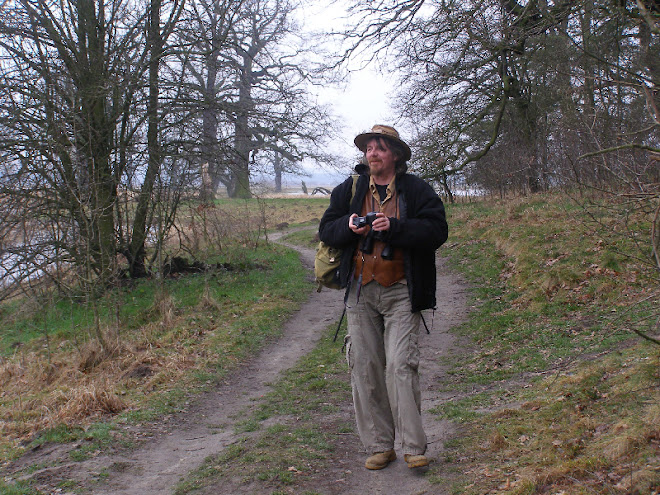
This is me

This is me
At the end of another Norfolk Coastal footpath walk. 47 miles, 3 days 99 species of bird. September 2009

Caley Wood view

Caley Wood view
sunshine through the canopy 29.05.08

A walk along the Warta Valley, Poznan, Poland. Feb 2007

A walk along the Warta Valley, Poznan, Poland. Feb 2007
Best birds on this walk: black and middle spotted woodpecker and short toed treecreeper

About Me

My photo
A primary school teacher for 30 years, I retired from teaching in July 2009 to set up my own science enhancement and communication company. The Primary Works offers science clubs, workshops and staged science shows nationwide. I have always been interested in bird watching since my early years. Apparently my first tick was after inquiring about a chaffinch and then receiving the Observer book of birds. By the age of 9 I had moved on to Tory Peterson's collins guide and was now involved on YOC birding holidays to Northumbria, Essex coast, Slimbridge and Yorkshire. My twitching rule is that I will willingly travel 1km for each gram the bird weighs. However, I have had many rarities just by being in the right place. I have travelled widely throughout Europe and also visited Australia and Sri Lanka. In 2016 I spent time at Portland Bird Obs and two trips to Aviero, Portugal. 2017 found me back in Sri Lanka in Feb/March, then July and back for New Year's Eve celebrations in December. Also returned to The Camargue in May for a 4 day trip. Few plans for 2018, but nothing yet booked apart from a trip to the IOW.

Grey heron

Grey heron
Over the allotment 28.09.08

Southern Hawker

Southern Hawker
Ridge footpath 27.08.08

Juvenile green woodpecker (17.08.08)

Juvenile green woodpecker (17.08.08)
Note the stripes, denoting a bird fledged this year.

common blue

common blue
Ash Valley G.C. 15.08.08

Indian balsam (impatiens glandulifera)

Indian balsam (impatiens glandulifera)
River Ash

azure damselfly

azure damselfly
River Ash 28.07.08

marbled white

marbled white
Discovered at Westland Green 22.07.08

ruddy darter

ruddy darter
Bush Wood 21.07.08

honeysuckle 19.07.08

honeysuckle 19.07.08
growing in hedgerow in Chapel Lane

cinnabar moth caterpillar

cinnabar moth caterpillar
Photographed on ragwort 19.07.08

Bittersweet

Bittersweet
Study of petals 11.06.08

male yellowhammer

male yellowhammer
08.06.08

common blue butterfly

common blue butterfly
06.06.08

River Ash

River Ash
looking south from the bridge at Hadham Ford

Common poppy (papaver rhoeas)

Common poppy (papaver rhoeas)
in rape field 29.05.08

Caley Wood sunshine

Caley Wood sunshine
29.05.08

Millenium Wood fox

Millenium Wood fox
24.05.08

common comfrey (symphytum officinale)

common comfrey (symphytum officinale)
06.05.08 banks of the River Ash

Garlic Mustard or Jack by the Hedge,(Alliara petiolata)

Garlic Mustard or Jack by the Hedge,(Alliara petiolata)
flowers, leaves and fruit edible . Good in salad and pesto

April showers

April showers
Double rainbow 30.04.08

Caley Wood bluebells

Caley Wood bluebells
22.04.08

Yellow Archangel

Yellow Archangel
Chapel Lane (20.04.08)

sunlight 16.04.08

sunlight 16.04.08
looking south west from Bush Wood

snowy buds

snowy buds
06.04.08 in Bush Wood

Looking north west

Looking north west
05.04.08 evening shower approaching

Back Garden

Back Garden
Easter Sunday (23.03.08)

Brick Kiln Hill

Brick Kiln Hill
Looking east (23.03.08)

No play today

No play today
The 2nd hole at Ash Valley golf course

Teasel head

Teasel head
Bush Wood (21.03.08)

Reflections

Reflections
daffodils at Bush Wood pond (21.03.08)

Swollen River Ash

Swollen River Ash
The river at the bottom of Winding Hill 16.03.08

Daybreak over the chapel

Daybreak over the chapel
Thursday 13th March

Wild daffodils (narcissus pseudonarcissus)

Wild daffodils (narcissus pseudonarcissus)
growing in Bush Wood

January snowdrops

January snowdrops
Banks of River Ash, north of Much Hadham

Good Moon

Good Moon
From garden 24.01.08

Village Green

Village Green
Looking east towards Acremore Street

Looking south before Hadham Ford

Looking south before Hadham Ford
rare January blue sky

Useful sites

The following are some useful websites that may interest readers of this blog.
Firstly, Bishop's Stortford Natural History Society http://bsnhs.webplus.net/

Fellow birder, Gary Whelan's blog. Gives reports from our trips out together plus reports from his trips abroad. http://hairybirders.blogspot.co.uk
http://www.hertsbirdclub.org.uk/ The official herts bird club website. Frequently updated, listing bird sightings around the county. Offers links to many other websites. Both of these sites also offer links to yahoo discussion groups.
http://www.birdforum.net/ An international site. You can enter as a guest but become a member( free) to post comments, bird sightings and just about anything to do with wild birds. Good news updates, classified section for binoculars, cameras etc.
http://www.guidedbirdwatching.com/ A new site set up where you can contact people worldwide who will help you find good birds in their country. UK section being set up presently.
http://www.britainsbirder.co.uk/
Fellow birders blog. Strtford resident, Graeme Smith regulary birds the area south of Stortford as well as around Spellbrook and the River Stort from Spellbrook to Twyford Locks. Some superb bird photography: Graeme uses a digital camera attached to his powerful telescope to get detailled images of the birds he sees. Well worth a browse.
Two local sites that may be of interest can be found at
http://www.thehadhams.com/ www.thepelhams.net/content/section/12/139/

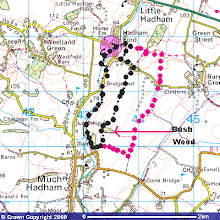
South Easterly walk

South Easterly walk
black, normal, red extended walk

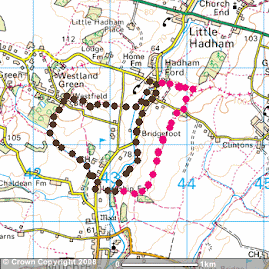
South Westerly route.

South Westerly route.
Black usual, red extended

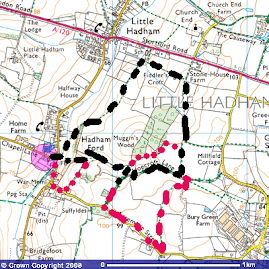
North Easterly walk

North Easterly walk
black short, walk. Red, extended

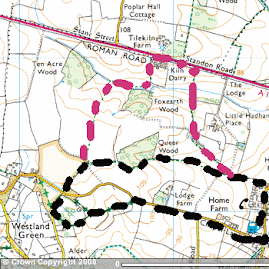
North West Patch

North West Patch
black route regular. Red route the extended wander