Thursday, 16 January 2014

Sri Lanka: part 1: 4th - 8th January, Kegalle.

A 12 day visit to Sri Lanka to start the New Year seemed like a good idea, so off to Heathrow for the direct overnight flight with Sri Lankan air to Colombo. A 9 hour flight, plus time difference meant we were met by our driver, Ari at Colombo at 1pm Saturday morning. Then, a 2 hour drive east to our first residence. This was a fantastic place, way off the beaten track in thick hillside forests at a place called The Estate House, Rosyth.
Estate House setting

dining pavilion

estate house

ground squirrel

red vented bulbul and juvenile
We spent the first afternoon just recovering from the long journey and me sitting on the lawn with a beer and binoculars. purple rumped sunbirds visited the garden flowers as common mynas, rose ringed parakeets, large billed crows and red vented bulbuls were both heard and seen. Getting used to all the calls was tricky so I concentrated on the birds that seemed to be most prevalent, so that later on I could eliminate these when I heard other calls.
black headed oriole

common myna

purple rumped sunbird

large billed crow

the forest, with flying cattle egret

2 cattle egrets giving perspective.
The forest here held loads of birds as well as plenty of macaque monkeys, mongooses, local cattle and more ground squirrels. Latter were the most common mammals around.
The following morning, I took a walk along the lanes, chatting with locals who were all keen to share my cigarettes. Birds were to be found all along the telegraph wires, including yellow billed babblers, more red vented bulbuls, oriental magpie robins, black headed orioles and the occasional parakeet. Another bird, seen on several occasions was the brown shrike.
brown shrike
large billed crow

macaque

 
red vented bulbul and oriental magpie robin


mongoose
After a superb breakfast we set off for the local elephant orphanage. I had visited this in 1993 but was rather disappointed to discover that it had become very tourist based. Before it had clearly been there for the elephants. Now, young elephants were chained up to be bottle fed with 100's of tourists watching. The lane they were taken down to the river had become full of touristy shops and bars, so not quite what I was expecting. However, down at the river were great white egrets, little and indian cormorants and the ubiquitous white throated kingfisher. The afternoon was spent back at the estate house enjoying their hospitality and wandering around.


white throated kingfisher
The next morning we were again off for a visit to the amazing Botanical gardens at Kandy followed by a trip to the Temple of the Tooth. The gardens were superb, with more monkeys, huge numbers of fruit bats, yellow billed babblers and, at the drained lake, asian openbill, white breasted waterhen, cattle and little egret, more sunbirds and common tailor bird whilst overhead brahminy kites. The temple of the tooth was fascinating and a very peaceful place set amongst the hubhub that is Kandy. We then headed back to the Estate House for our last night and more wanderings. On this, I met several locals sitting enjoying some beer. Chatting, they pointed out that 2 of them had lost legs in the recent fighting. they showed me several of the local birds, giving me the local names for them.
 
asian openbill

cattle egrets

fruit bat

great white egret

local ex army lads on their day off

Sri Lankan grey hornbill

white breasted waterhen

yellow billed babbler
Back in the garden I watched more rose ringed parakeets coming into roost as well as my first endemic, a Sri Lankan grey hornbill.
The following morning we set off for a long drive south. It took 8 hours, with stops, to drive to the south east of the island to Yala. This is a National Nature Reserve I have wanted to visit since I first read about it sometime back in the early 70's. Our long drive gave views of plenty of birds en route, especially the last 10 miles as we approached the Jetwing Yala hotel, including beeaters, peacocks, waders and much more. We headed south through Kandy, Nuwara Eliya and then down the endless A2 trunk road through incredible scenery, tea plantations and plenty of poverty.

Bird list so far:
asian openbill, indian pond heron, grey heron, cattle egret, little egret, little cormorant, indian cormorant, brahminy kite, white breasted waterhen, spotted dove, rose ringed parakeet, chestnut winged cuckoo, asian palm swift, house swift, white throated kingfisher, crimson fronted barbet, sri lankan grey hornbill, brown shrike, black headed oriole, large billed crow, barn swallow, white bellied drongo, red vented bulbul, white browed bulbul, common tailorbird, white browed fantail, yellow billed babbler, common myna, oriental magpie robin, purple rumped sunbird, house sparrow.
Many of these birds were not photographable due to the sheer density of the vegetation, but not a bad start for a "non birding" holiday.

from the Estate House garden


cattle egret

as yet, not id'd

little cormorant

spotted dove
 
local lane side vegetation

Friday, 3 January 2014

Local wander

In amazingly mild conditions, I took a wabder through the west and south of the parish this morning. Ground is absolutely saturated and, in places, the footpaths were more like streams. New birds for the year were long tailed tit, linnet, mistle thrush, song thrush, black headed gull, herring gull and common gulls. There was a large (200+) flock of fieldfare on the closed golf course, which is where I also registered the gulls. A party of 10 linnets flew overhead near the club house. A search around local woods for marsh tit was unsuccessful, but I did get the long tailed variety.
In all, 5 hares were spotted, 2 shown below with an inquisitive jackdaw. in another photo, a black headed gull in the foregrpound with 2 common gulls behind.


Year listers
 
27. long tailed tit
28. song thrush
29. mistle thrush
30. linnet
31. black headed gull
32. common gull
33. herring gull


Thursday, 2 January 2014

New Year; New Year List

After the constant rain of yesterday, I managed a few hours out around the village this afternoon, checking a few roosts and a variety of habitats. The common buzzard at Hadham Hall was in its usual site, atop the dead tree. However, a wander to the irrigation lagoon produced nothing apart from moorhen, fieldfare, redwing, skylark and blackbird. A wander along hedged lanes gave a few regulars whilst a check on the garden gave up a few more species, but all in all, a very slow start.


Year list
1. mallard
2. common buzzard
3. moorhen
4. stock dove
5. wood pigeon
6. collared dove
7. tawny owl
8. great spotted woodpecker.
9. skylark
10. pied wagtail
11. dunnock
12. robin
13. fieldfare
14. redwing
15. blackbird
16. great tit
17. blue tit
18. magpie
19. jackdaw
20. rook
21. carrion crow
22. starling
23. house sparrow
24. chaffinch
25. goldfinch
26. bullfinch

Tuesday, 31 December 2013

Final Bird Year list. 2013

great crested grebe, cormorant, grey heron, mute swan, greylag goose, canada goose, mallard, gadwall, shoveler, teal (10sp) wigeon, pochard, tufted duck, scaup, goldeneye, smew, red kite, common buzzard, kestrel, moorhen (20 sp) coot, lapwing, black headed gull, common gull, herring gull, lesser black backed gull, greater black backed gull, collared dove, wood pigeon, dunnock (30sp) robin, blackbird, great tit, blue tit, long tailed tit, jay, magpie, jackdaw, rook, carrion crow (40 sp) house sparrow, starling, chaffinch, goldfinch, siskin, reed bunting, waxwing, fieldfare, redwing, pied wagtail (50 sp) egyptian goose, great spotted woodpecker, treecreeper, mistle thrush, wren, bullfinch, red legged partridge, yellowhammer, stock dove, pheasant (60sp) green woodpecker, nuthatch, marsh tit, song thrush, tawny owl, little grebe, barn owl, little owl, woodcock, sparrowhawk (70 sp) coal tit, little egret, red throated diver, guillemot, razorbill, common scoter, gannet, kittiwake, brent goose, turnstone (80 sp) great northern diver, tree sparrow, oystercatcher, shelduck, pintail, cetti's warbler, stonechat, marsh harrier, snipe, great white egret (90 sp) water rail, dunlin, golden plover, snow bunting, dartford warbler, linnet, greenfinch, redshank, ring necked parakeet, ringed plover (100 sp) pink footed goose, chiffchaff, lesser redpoll, meadow pipit, grey partridge, great grey shrike, merlin, caspian gull, green sandpiper, skylark (110 sp) grey wagtail, brambling, little stint, fulmar, curlew, spotted redshank, black tailed godwit, bar tailed godwit, knot, whooper swan, (120 sp) sanderling, grey plover, avocet, ruff, corn bunting, long tailed duck, purple sandpiper, shore lark, hen harrier, hawfinch, (130 sp)Jack snipe, .
Added since April
black redstart, greenshank, goldcrest, mandarin, kingfisher, swallow, yellow legged gull, water pipit, house martin, (140 sp) sand martin, cuckoo, blackcap, goosander, grasshopper warbler , little ringed plover, sandwich tern, arctic tern, rock pipit, white wagtail, (150 sp) yellow wagtail, wheatear, whinchat, sedge warbler, reed warbler, willow warbler, lesser whitethroat, corn bunting, swift, common tern, (160 sp)garden warbler, turtle dove, hobby, bittern, golden oriole, savi's warbler, stone curlew, spotted flycatcher, little gull, little tern, (170 sp) bearded reedling, spoonbill, garganey, red crested pochard, common crane, curlew sandpiper, wood sandpiper,, mediterranean gull, common sandpiper, whimbrel,(180 sp) red necked phalarope.
Added since August
arctic skua, redstart, pied flycatcher, wryneck, citrine wagtail, red backed shrike, raven, pomarine skua, tree pipit, (190 sp)nightingale, balearic shearwater, peregrine, shag,spotted crake, black tern
196 species at 02.10.13.

Added since October
common crossbill, yellow browed warbler, red breasted flycatcher, ring ouzel (200sp) velvet scoter, grey phalarope, glossy ibis, black necked grebe, barnacle goose, mealy redpoll, slavonian grebe, red breasted merganser, short eared owl (210 sp) bewick's swan

Year Review; Part 4; October - December

October:
The autumn and winter months are busy times for me, with 12 RSPB local group presentations and where possible, I try to fit in some birding before I arrive at the venue. With talks booked for Stevenage, East Grinstead, Hemel Hempstead, Sandwich Bay Bird Observatory, Aylesbury and Thanet there would be opportunities to visit sites such as Tring, Oare, Dungeness etc. All good stuff.

The moth trap was surprisingly busy on the 1st, with this frosted orange being a new for year secies. Also new were blairs shoulder knot and black rustic.
A trip to Tring Reservoirs on the 5th gave up some good birds, including this feeding grey heron. Then onto Hemel Hempstead for a talk on North Norfolk.
The following day, Gary and I set off for another North Norfolk day. I scored with 3 year listers, a briefly seen yellow browed warbler at Titchwell, a red breasted flycatcher at the bottom of Garden Drove on Warham Greens and then common crossbill at Lyndford. The latter being my 200th bird for the year. Also noted on our travels were these two waders: curlew and ruff.

I noted a Nikon camera body in our local camera shop, a 2nd hand Nikon D2x, which I bought. Obviously eager to give it a test run, I set off, once again for Norfolk on the 19th, hoping for some migrants in Wells Woods. Nothing noteworthy were to be found but crossbills and blackcaps abounded. Other year listers were a grey phalarope at Cley, a ring ouzel along Garden Drove and several velvet scoter at Titchwell Beach. I finished off at Titchwell, getting some pleasing shots as I slowly mastered the basics of a very technical piece of kit. Here a chiffchaff, wigeon and blackcap. I was pleased with the camera results.


An evening wander locally didn't give up the hoped for barn owls, but I was treated to a spectacular sunset over Hadham Hall. Redwing and fieldfare were beginning to arrive although it was still surprisingly mild.
Another local walk on the 24th from the local town to the village, some 4 miles gave great views of a red kite and a female great spotted woodpecker.

Finally, for October, I decided upon visiting Dungeness the day of the "storm" 90mph winds along the coast by the power station meant it was difficult to set up the scope, never mind try to photo the gulls and cormorants passing. After the sea watch I headed to the RSPB reserve where this fox greeted my arrival before another year lister, glossy ibis.


A very late beautiful hooktip was taken towards the end of October. Up to 2006 no specimen of this species had been taken this late in the year. Over the next few days I had several before an even later, and this very small yellowshell moth broke all Herts records by being taken so late. Testimony to the cold and wet spring and warm and drier autumn that we were experiencing.


November:
On the 7th I was booked for a talk at Sandwich Bay Bid Observatory and so headed off for a day at Dungeness before making my way round to Sandwich after dusk. A much calmer day and one that gave year listers in the shape of barnacle goose and black necked grebe. Good birds were hard to come by, but still, as always, a pleasure to be there.Also, shown here, a great white egret which is becoming Dungeness' speciality bird. One that I believe will continue to spread across the south of England over the next 5 years.


The following morning I spent time with the Sandwich ringing group, where another year lister was seen. In amongst a flock of 40+ lesser redpolls were several mealy redpolls, some of which were trapped, ringed and released. Good to note differences close at hand.
On the 14th I thought it was time for a parish check. Usual fare all around with this common buzzard near the A120 being particularly good, along with one of many fieldfare.

On the 17th I was once again, off to Norfolk with Gary. Here, I added 2 more to the list in the form of red breasted merganser and slavonian grebe. Both were off Holkham Gap, but plenty of good birds off Titchwell and a walk through Holkham Pines was also good, although very little in the latter and certainly no sign of a hoped for firecrest. At Cley beach, we missed another red breasted flycatcher by minutes. Shown here, Titchwell golden plovers, Holkham pink foots and  a Cley black headed gull


Over the last few days of November I had another trip to Wilstone where I got my 2nd water pipit of the year as well a trip to Oare Marshes where I got year lister 211, a short eared owl. Also at this brilliant site, where I had seen spotted crake earlier in the year, I had barn owl and hen harrier.
A local walk around the village on the last day of the month didn't give up anything other than a small flock of siskin over the golf course, as well as the regular residents. Sunset photo of Oare Marshes, near Faversham.

December:
On the 2nd I popped out for a quick trip around Amwell. A first year male smew was present, but many birds moved off as the reed cutter boat was noisily in action.
On the 4th I took my last new moth of the year, this finely marked mottled umber, before the trap was packed away as I knew what few moths that would be about this month.
On the 5th I thought it was time for a walk along my old patch: the River Stort from Bishop's Stortford to Spellbrook village. I try to visit this area once a year as I covered the tow path here many times a week for 3 years, becoming familiar with all that went on along the 2 mile stretch. Today, cormorants were at their usual roost and the winter little grebes were still where they used to be. Plenty of storm damage to willows and no kingfishers were noted. Siskins in their usual alders but a large increase in mallard numbers, up for a handful to 24.


19th saw me whizzing off for a quick trip to Welney and Ouse Marshes, where there was poor light. Bewick's swan became species 212 and I was amazed at the number of plovers and godwits at Welney and the huge number of wigeon and teal at Ouse Marshes.
 
On the 21st Gary and I paid our last visit to Norfolk for 2013. Bit of a dipping day with no Richards pipit, parrot crossbills or 2 barred crossbills. However, great views of red breasted mergansers at Titchwell. Being the shortest day we were constantly battling very poor light so just a photo of some teal shown here and the damage done by the storm surge on the 6th. Salthouse beach road shown here, 100 yards short of the original car park. 2014 is going to be a busy time sorting out the damage all the way along the Norfolk coast.


On the 28th we both headed off for a few hours at Amwell. We both left our cameras in the car as the light was so poor. Consequently, we were treated to a great flypast by a peregrine falcon hunting the lapwing.
I finished the year with 2 walks, one to the west of the parish on the 29th in bright sunlight and heavy frost where this kestrel gave a flypast and then one to the east of the parish on the 30th in constant drizzle where little was noted until I returned home to find a female bullfinch in the garden. Not a common garden visitor, so great to finish the year on.
2013 has been a great year with 3 trips abroad, plenty of Norfolk visits plus several to Kent reserves as well as a few days at Portland. However, the most enjoyment I get is being out in the fields around the village, where, this year I recorded 76 species of bird out of my overall total of 103. My garden moth count now nears 300, so still plenty to look forward to in 2014, with trips to Sri Lanka and Poland alreasy planned. Should be fantastic.

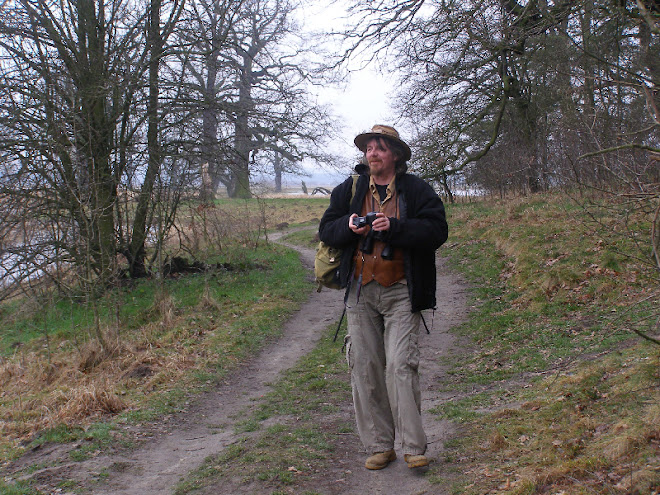
This is me

This is me
At the end of another Norfolk Coastal footpath walk. 47 miles, 3 days 99 species of bird. September 2009

Caley Wood view

Caley Wood view
sunshine through the canopy 29.05.08

A walk along the Warta Valley, Poznan, Poland. Feb 2007

A walk along the Warta Valley, Poznan, Poland. Feb 2007
Best birds on this walk: black and middle spotted woodpecker and short toed treecreeper

About Me

My photo
A primary school teacher for 30 years, I retired from teaching in July 2009 to set up my own science enhancement and communication company. The Primary Works offers science clubs, workshops and staged science shows nationwide. I have always been interested in bird watching since my early years. Apparently my first tick was after inquiring about a chaffinch and then receiving the Observer book of birds. By the age of 9 I had moved on to Tory Peterson's collins guide and was now involved on YOC birding holidays to Northumbria, Essex coast, Slimbridge and Yorkshire. My twitching rule is that I will willingly travel 1km for each gram the bird weighs. However, I have had many rarities just by being in the right place. I have travelled widely throughout Europe and also visited Australia and Sri Lanka. In 2016 I spent time at Portland Bird Obs and two trips to Aviero, Portugal. 2017 found me back in Sri Lanka in Feb/March, then July and back for New Year's Eve celebrations in December. Also returned to The Camargue in May for a 4 day trip. Few plans for 2018, but nothing yet booked apart from a trip to the IOW.

Grey heron

Grey heron
Over the allotment 28.09.08

Southern Hawker

Southern Hawker
Ridge footpath 27.08.08

Juvenile green woodpecker (17.08.08)

Juvenile green woodpecker (17.08.08)
Note the stripes, denoting a bird fledged this year.

common blue

common blue
Ash Valley G.C. 15.08.08

Indian balsam (impatiens glandulifera)

Indian balsam (impatiens glandulifera)
River Ash

azure damselfly

azure damselfly
River Ash 28.07.08

marbled white

marbled white
Discovered at Westland Green 22.07.08

ruddy darter

ruddy darter
Bush Wood 21.07.08

honeysuckle 19.07.08

honeysuckle 19.07.08
growing in hedgerow in Chapel Lane

cinnabar moth caterpillar

cinnabar moth caterpillar
Photographed on ragwort 19.07.08

Bittersweet

Bittersweet
Study of petals 11.06.08

male yellowhammer

male yellowhammer
08.06.08

common blue butterfly

common blue butterfly
06.06.08

River Ash

River Ash
looking south from the bridge at Hadham Ford

Common poppy (papaver rhoeas)

Common poppy (papaver rhoeas)
in rape field 29.05.08

Caley Wood sunshine

Caley Wood sunshine
29.05.08

Millenium Wood fox

Millenium Wood fox
24.05.08

common comfrey (symphytum officinale)

common comfrey (symphytum officinale)
06.05.08 banks of the River Ash

Garlic Mustard or Jack by the Hedge,(Alliara petiolata)

Garlic Mustard or Jack by the Hedge,(Alliara petiolata)
flowers, leaves and fruit edible . Good in salad and pesto

April showers

April showers
Double rainbow 30.04.08

Caley Wood bluebells

Caley Wood bluebells
22.04.08

Yellow Archangel

Yellow Archangel
Chapel Lane (20.04.08)

sunlight 16.04.08

sunlight 16.04.08
looking south west from Bush Wood

snowy buds

snowy buds
06.04.08 in Bush Wood

Looking north west

Looking north west
05.04.08 evening shower approaching

Back Garden

Back Garden
Easter Sunday (23.03.08)

Brick Kiln Hill

Brick Kiln Hill
Looking east (23.03.08)

No play today

No play today
The 2nd hole at Ash Valley golf course

Teasel head

Teasel head
Bush Wood (21.03.08)

Reflections

Reflections
daffodils at Bush Wood pond (21.03.08)

Swollen River Ash

Swollen River Ash
The river at the bottom of Winding Hill 16.03.08

Daybreak over the chapel

Daybreak over the chapel
Thursday 13th March

Wild daffodils (narcissus pseudonarcissus)

Wild daffodils (narcissus pseudonarcissus)
growing in Bush Wood

January snowdrops

January snowdrops
Banks of River Ash, north of Much Hadham

Good Moon

Good Moon
From garden 24.01.08

Village Green

Village Green
Looking east towards Acremore Street

Looking south before Hadham Ford

Looking south before Hadham Ford
rare January blue sky

Useful sites

The following are some useful websites that may interest readers of this blog.
Firstly, Bishop's Stortford Natural History Society http://bsnhs.webplus.net/

Fellow birder, Gary Whelan's blog. Gives reports from our trips out together plus reports from his trips abroad. http://hairybirders.blogspot.co.uk
http://www.hertsbirdclub.org.uk/ The official herts bird club website. Frequently updated, listing bird sightings around the county. Offers links to many other websites. Both of these sites also offer links to yahoo discussion groups.
http://www.birdforum.net/ An international site. You can enter as a guest but become a member( free) to post comments, bird sightings and just about anything to do with wild birds. Good news updates, classified section for binoculars, cameras etc.
http://www.guidedbirdwatching.com/ A new site set up where you can contact people worldwide who will help you find good birds in their country. UK section being set up presently.
http://www.britainsbirder.co.uk/
Fellow birders blog. Strtford resident, Graeme Smith regulary birds the area south of Stortford as well as around Spellbrook and the River Stort from Spellbrook to Twyford Locks. Some superb bird photography: Graeme uses a digital camera attached to his powerful telescope to get detailled images of the birds he sees. Well worth a browse.
Two local sites that may be of interest can be found at
http://www.thehadhams.com/ www.thepelhams.net/content/section/12/139/

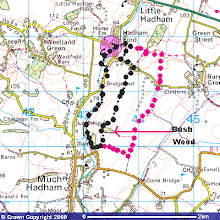
South Easterly walk

South Easterly walk
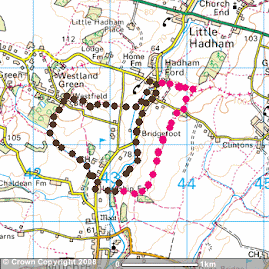
black, normal, red extended walk

South Westerly route.

South Westerly route.
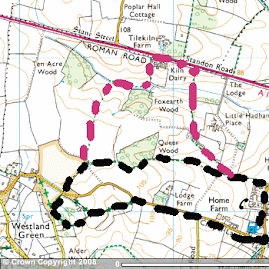
Black usual, red extended

North Easterly walk

North Easterly walk
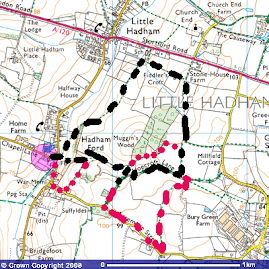
black short, walk. Red, extended

North West Patch

North West Patch
black route regular. Red route the extended wander