Friday, 31 July 2009

Norfolk visit 30th July


A visit to North Norfolk yesterday gave up 80 species of birds. Terrible weather throughout the morning (thunder and lightning overhead and torrential rain) meant I was drenched on more than one occasion. Starting at Cley reserve I was lucky to catch a glimpse of a summer plumaged curlew sandpiper as well as common and green sandpiper along with expected waders. Gannets fed out to sea as sandwich terns headed out on fishing missions. Upon leaving here the total species recorded was 56. Along to Stiffkey marshes, where it poured. I added several more regular woodland sp as well as little egret before leaving for a long stop at Titchwell. Here eiders, spotted redshanks, whimbrel (a distant photo of this small curlew above) and more sandpipers took the list to 78, with great spotted woodpecker and jay being seen on the drive home. Other birds of note for the day were 13 westerly manx shearwaters seen from Titchwell beach, plenty of reed and sedge warblers and numerous avocets. A super day, where the photography was hampered by the severe conditions, with more shots of clouds than birds. The weather limited butterfly sightings and no dragonflies were recorded. Shown here, another painted lady and a common blue.

Tescos to home 27th July


A walk in rather damp underfoot conditions gave views of all the resdent birds without offering anything unusual. A kestrel performed well overhead as an immature wren posed for the camera. The recently recorded little egret was again at Hadham Hall lake, as were 5 mallards, numerous swallows, swifts and house martins as well as the resident grey heron. However, the highlight was managing to get some pleasing photos of insects, especially of a southern hawker dragonfly which was intent on staying put whilst I managed some good close up shots. Also shown here are a bright, newly emerged peacock butterfly as well as a comma, feeding on the local knapweed. Note, too the tiny black pollen beetles feeding on the plant. Also worthy of note was my first recording of a common darter dragonfly for 2009.
The southern hawker dragonfly can be identified to species when observed closely. On the second segment of the abdomen, below the thorax that has the wing attachments, you can see a yellow triangle. This is diagnostic of southern hawker, whereas the similar migrant hawker has a golf tee shape here.

Friday, 24 July 2009

Bury Green, Green Street and Hadham Ford 24th July


A wander to the east of the parish this morning gave up 21 species of birds, with highlights being a male bullfinch on Brick Kiln Hill and several chiffchaffs calling in Millennium Wood. The butterflies were again very evident with all usual suspects being recorded, 11 species in all. However, an orchid type plant was the highlight, as yet unidentified. Both the flower and leaf are shown here and I shall await confirmation of the exact species.
Other photos attached show a small skipper butterfly (above) and a good shot of a ringlet (below) feeding on knapweed. Finally, the berries of a plant known as lords and ladies.
Plant now identified as Betony: a good local find with only small colonies known locally (Harlow and Hertford Heath) I have forwarded details to the county plant recorder.

Wednesday, 22 July 2009

Tescos to Hadham Hall and on to Little Hadham


A super walk this morning, beginning in the parish at 9.30am. Exciting news was that I recorded 2 new bird species for the parish, even more amazingly that they both were in the same binocular view at the same time. Firstly, I mounted the slope to the man made lake east of Hadham Hall and immediately registered a little egret. As I peered through nmy binoculars a tufted duck (female or 1st year bird) swam into view. Other birds of note were grey heron, common buzzard and several linnets in the rape field. 2 broods of moorhen from the same parents were photographed at Hadham Hall. The larger brown birds being 2 - 3 months old whilst the smaller black ones are probably 2 - 3 days old.
Mainly however, it was a morning of dragonflies, damselflies and butterflies. All the usual buttereflies were recorded, some in large numbers, many shown here. The peacock butterflies looked to have recently emerged, as the phtos of both upper and underwings show bright colours, especially the black underwings as depicted here.Click to enlarge and run the cursor over the snap to see the species name. Another first for 2009 was a common darter dragonfly, along with 2 black tailed skimmers (female) and 1 emperor dragonfly. Both azure and common blue damsels were observed near the lake and in adjacent hedgerows. A new moth for the parish was found in hedgerow, namely a black and white species known as clouded border. A very distinct moth that is shown above.

Monday, 20 July 2009

Nature walk and picnic 18th July


7 adults and 3 children met at 10.30 at the village hall car park for a walk to Millennium Wood and a wander down Hoecroft Lane. A picnic was taken in the wood, where butterflies and insects were observed and identified. In all, 10 species of butterfly were discovered, with highlights being a splendid painted lady (shown above) on Brick Kiln Hill, a red admiral in Acremore Street and several speckled woods in Millennium Wood. Also seen were: meadow brown, gatekeeper, small and large white, green veined white, comma, and small skipper.
An oederma nobilis beetle was found feeding on pollen, as were thousands of pollen beetles. A hoverfly of the order xanthogramma pedissequum was found near the polo fields, a new species for the parish, whereas a common hoverfly, episyrphus balteatus (shown above) were seen abundantly.
A kestrel was seen over Brick Kiln Hill and a sparrow hawk was observed chasing a mistle thrush. Yellowhammers and goldfinches called and a chiffchaff sang in Millennium Wood.

Chapel Lane wander 14th July


An evening wander along Chapel Lane gave up 27 species of birds, with a family of long tailed tits observed near Westland Green. Pied wagtails were seen near the golf course and skylarks were heard in open fields west of the Ford.
Butterflies were seen on all plants, especially the flowering brambles found in the Chapel Lane verges. All the expected species were found, with a 6 spot burnet moth witnessed on the Green at Westland Green. In all, meadow brown (100’s), small white (20+), gatekeeper (20+), ringlet (5), large white (10), comma (3), small skipper (40+), essex skipper (6)
Click on the photo to enlarge and then run the cursor over to see the photo title giving the species.
Also of note: 2 red admirals and 1 marbled white were found near Bury Green on a walk back home from Tescos on the 9th and a new bird for my garden; a nuthatch, was watched in the apple tree on the 13th. I also received a report of a hummingbird hawkmoth in a garden in Ford Hill.

Wednesday, 8 July 2009

To Standon and back: 05.07.09


A long lunchtime walk offered the opportunity to use new paths within the parish boundary, before entering Standon parish and enjoying a pint at the Star in the High Street.
At Westland Green a new butterfly for my records was seen briefly: a purple hairstreak. This small and high flying creature is found around established oaks. One was witnessed near the road adjacent to the Green, where also, some 6 spot burnet moths were also recorded. These were the first for the year. The brambles along the verges of Chapel Lane were full of all the common species of butterfly, many shown here. Today's photos show: the br

ight black and red burnet moth, the underwing and upperwing of a gatekeeper (note the two white dots in the "eye spot" and a ringlet. Latter takes its name from the small rings on the hindwing.

05.07.09: Behind Hadham Hall and 1 new butterfly for 2009


Due to the increasingly hot weather, I thought a morning walk to the ponds behind and around Hadham Hall would be good for butterflies and dragonflies. However, it turned into a reasonable birding session. To start with a turtle dove was heard purring near the war memorial in the village before common buzzard was seen soaring over the hall. A whitethroat called from the undergrowth near a pond and plenty of martins and swallows were using the largest lake for drinking. An autumnal sight was a party of 50+ linnets perched on the wires east of the Hall. A little early for such a large group but perhaps they’d finished their first brood having enjoyed nesting in and near the rape.
As I arrived at the largest sand of water an emperor dragonfly was hawking over the water, shown here and numerous common blue, azure and blue tailed damselflies were evident. The latter being a new species for the parish records No sign of last week’s black tailed skimmers.
New butterfly for the year was noted in the shape of a gatekeeper along with all usual specimens as noted in the previous report.
Other interesting insects observed around the large lake were oedemera nobilis, a bright green beetle with swollen hind legs (male only) as shown here. Also a grasshopper, thought to be a field grasshopper, but in the process of being properly identified by an expert. Many soldier beetles were also seen, mostly feeding on pollen of the cow and hedge parsley
As I left an unusual sight were 3 green woodpeckers on one telegraph pole, shown here in rather poor light. other photos show the grasshopper, an immature azure damselfly, the oederma nobilis and the emperor dragonfly in flight.

Butterfly walk along the Ash Valley 01.07.09


A first walk of the month on a hot July evening. In all 24 species of birds were observed and, without anything being outstanding my attention turned to the numerous butterflies to be found on the wild majoram that is now flowering along the River Ash south of the Ford.
A total of 12 species were seen, including numerous meadow browns (shown here), along with ringlets, green veined whites, large and small whites, commas, small tortoiseshell, small skipper, essex skipper, large skipper, painted lady and peacock.. All these were within an hour between 5.30pm and 6.30pm. Certainly shaping up to be a good butterfly yea.
Of the birds, the highlights were a solitary herring gull returning to winter quarters, several skylarks and yellowhammers as well as numerous swallows and swifts overhead. Photos attached show a small tortoiseshell, green veined white

, essex skipper (here) and a large skipper (top photo) as well as the meadow brown. Latter identifiable by the "eye" and 2 small black dots.

This is me

This is me
At the end of another Norfolk Coastal footpath walk. 47 miles, 3 days 99 species of bird. September 2009

Caley Wood view

Caley Wood view
sunshine through the canopy 29.05.08

A walk along the Warta Valley, Poznan, Poland. Feb 2007

A walk along the Warta Valley, Poznan, Poland. Feb 2007
Best birds on this walk: black and middle spotted woodpecker and short toed treecreeper

About Me

My photo
A primary school teacher for 30 years, I retired from teaching in July 2009 to set up my own science enhancement and communication company. The Primary Works offers science clubs, workshops and staged science shows nationwide. I have always been interested in bird watching since my early years. Apparently my first tick was after inquiring about a chaffinch and then receiving the Observer book of birds. By the age of 9 I had moved on to Tory Peterson's collins guide and was now involved on YOC birding holidays to Northumbria, Essex coast, Slimbridge and Yorkshire. My twitching rule is that I will willingly travel 1km for each gram the bird weighs. However, I have had many rarities just by being in the right place. I have travelled widely throughout Europe and also visited Australia and Sri Lanka. In 2016 I spent time at Portland Bird Obs and two trips to Aviero, Portugal. 2017 found me back in Sri Lanka in Feb/March, then July and back for New Year's Eve celebrations in December. Also returned to The Camargue in May for a 4 day trip. Few plans for 2018, but nothing yet booked apart from a trip to the IOW.

Grey heron

Grey heron
Over the allotment 28.09.08

Southern Hawker

Southern Hawker
Ridge footpath 27.08.08

Juvenile green woodpecker (17.08.08)

Juvenile green woodpecker (17.08.08)
Note the stripes, denoting a bird fledged this year.

common blue

common blue
Ash Valley G.C. 15.08.08

Indian balsam (impatiens glandulifera)

Indian balsam (impatiens glandulifera)
River Ash

azure damselfly

azure damselfly
River Ash 28.07.08

marbled white

marbled white
Discovered at Westland Green 22.07.08

ruddy darter

ruddy darter
Bush Wood 21.07.08

honeysuckle 19.07.08

honeysuckle 19.07.08
growing in hedgerow in Chapel Lane

cinnabar moth caterpillar

cinnabar moth caterpillar
Photographed on ragwort 19.07.08

Bittersweet

Bittersweet
Study of petals 11.06.08

male yellowhammer

male yellowhammer
08.06.08

common blue butterfly

common blue butterfly
06.06.08

River Ash

River Ash
looking south from the bridge at Hadham Ford

Common poppy (papaver rhoeas)

Common poppy (papaver rhoeas)
in rape field 29.05.08

Caley Wood sunshine

Caley Wood sunshine
29.05.08

Millenium Wood fox

Millenium Wood fox
24.05.08

common comfrey (symphytum officinale)

common comfrey (symphytum officinale)
06.05.08 banks of the River Ash

Garlic Mustard or Jack by the Hedge,(Alliara petiolata)

Garlic Mustard or Jack by the Hedge,(Alliara petiolata)
flowers, leaves and fruit edible . Good in salad and pesto

April showers

April showers
Double rainbow 30.04.08

Caley Wood bluebells

Caley Wood bluebells
22.04.08

Yellow Archangel

Yellow Archangel
Chapel Lane (20.04.08)

sunlight 16.04.08

sunlight 16.04.08
looking south west from Bush Wood

snowy buds

snowy buds
06.04.08 in Bush Wood

Looking north west

Looking north west
05.04.08 evening shower approaching

Back Garden

Back Garden
Easter Sunday (23.03.08)

Brick Kiln Hill

Brick Kiln Hill
Looking east (23.03.08)

No play today

No play today
The 2nd hole at Ash Valley golf course

Teasel head

Teasel head
Bush Wood (21.03.08)

Reflections

Reflections
daffodils at Bush Wood pond (21.03.08)

Swollen River Ash

Swollen River Ash
The river at the bottom of Winding Hill 16.03.08

Daybreak over the chapel

Daybreak over the chapel
Thursday 13th March

Wild daffodils (narcissus pseudonarcissus)

Wild daffodils (narcissus pseudonarcissus)
growing in Bush Wood

January snowdrops

January snowdrops
Banks of River Ash, north of Much Hadham

Good Moon

Good Moon
From garden 24.01.08

Village Green

Village Green
Looking east towards Acremore Street

Looking south before Hadham Ford

Looking south before Hadham Ford
rare January blue sky

Useful sites

The following are some useful websites that may interest readers of this blog.
Firstly, Bishop's Stortford Natural History Society http://bsnhs.webplus.net/

Fellow birder, Gary Whelan's blog. Gives reports from our trips out together plus reports from his trips abroad. http://hairybirders.blogspot.co.uk
http://www.hertsbirdclub.org.uk/ The official herts bird club website. Frequently updated, listing bird sightings around the county. Offers links to many other websites. Both of these sites also offer links to yahoo discussion groups.
http://www.birdforum.net/ An international site. You can enter as a guest but become a member( free) to post comments, bird sightings and just about anything to do with wild birds. Good news updates, classified section for binoculars, cameras etc.
http://www.guidedbirdwatching.com/ A new site set up where you can contact people worldwide who will help you find good birds in their country. UK section being set up presently.
http://www.britainsbirder.co.uk/
Fellow birders blog. Strtford resident, Graeme Smith regulary birds the area south of Stortford as well as around Spellbrook and the River Stort from Spellbrook to Twyford Locks. Some superb bird photography: Graeme uses a digital camera attached to his powerful telescope to get detailled images of the birds he sees. Well worth a browse.
Two local sites that may be of interest can be found at
http://www.thehadhams.com/ www.thepelhams.net/content/section/12/139/

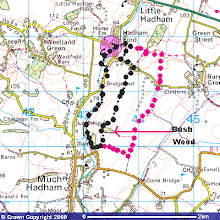
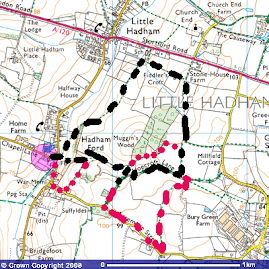
South Easterly walk

South Easterly walk
black, normal, red extended walk

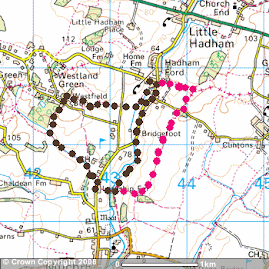
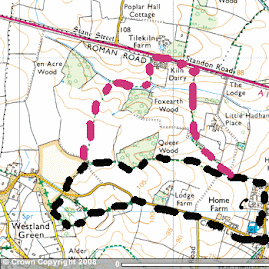
South Westerly route.

South Westerly route.
Black usual, red extended

North Easterly walk

North Easterly walk
black short, walk. Red, extended

North West Patch

North West Patch
black route regular. Red route the extended wander