Saturday, 23 August 2008

Camargue Visit

Presently just some photos. Comments to follow but a more detailed report can be read at
http://www.birdforum.net/showthread.php?t=121440 Click on photos to enlarge.
Photo 1: greater flamingo
Photo 2: grey heron
Photo 3: greater flamingo and black winged stilt
Photo 4: Camargue cheval blanc
Photo 5: Roman amphitheatre, Nimes
Photos 6 and 7 greater flamingos
Photo 8: sacred ibis
Photos 9 and 10: more flamingos
Photos 11 and 12: bee eaters
Photo 13: lesser emperor dragonfly
Photo 14: bee eater tree
Photo 15: cattle egret
Photo 16: short toed eagle
Photo 17: swallows
Photo 18: general view of main lake (Etang les Vaccares)
Photos 19 and 20: cattle egrets.


Sunday, 17 August 2008

Golf course wander


A walk across the golf course this afternoon yielded few birds. Small numbers of swallows were recorded over the course and a lesser black backed gull was photographed here as well; a 2nd year bird. Also a chiffchaff called in Alder Woods whilst another was registered in Chapel Lane. Good numbers of house sparrows (50+) were seen having a dust bath in Chapel Lane and large numbers of corvids, mainly jackdaws, were in the newly harvested wheat fields to the south of the village. A green woodpecker was also photographed on the golf course, shown here. Note the use of the tail, where strong feathers help the bird hold the tree trunk.

5 migrant hawker dragonflies were seen and a few large whites and peacocks, with 1 speckled wood, shown here. I managed to get a quick snap shot of a muntjac as it crossed the path near Chapel Lane, but all in all, very quiet.

Friday, 15 August 2008

new species, 15.08.08


An early start this morning found me on the Ridge path, heading south towards Bush Wood and Winding Hill. All the usual suspects showed, with early highlights being a cormorant heading up the Ash Valley and common whitethroats and yellowhammers calling from the hedgerows. However, whilst observing a large party of long tailed tits I was drawn to a small warbler, which at first I presumed to be a chiffchaff or willow warbler. After finding it in my binoculars it became immediately apparent that it was a wood warbler, a much less common species and one that is probably migrating south each day. It moved continually, not permitting any worthwhile photos. The yellow eye stripe (supercillium) was diagnostic and its wings showed hints of a lime green/yellow. A first for me in the area and 1st new species since mid July.

Upon arriving at Bush Wood 2 fox cubs showed on the path, startling 4 jays from the oak tree. A quick snap shot was taken before they dived into the hedge. Shortly after a hobby flew low over the bean field, calling as it headed south. Only my 3rd record of this superb bird of prey this year and another sign of migration.

Over the golf course a common buzzard was heard "mewing" and a great black backed gull glided north west. Most noticeable was the lack of any swifts, swallows or martins.

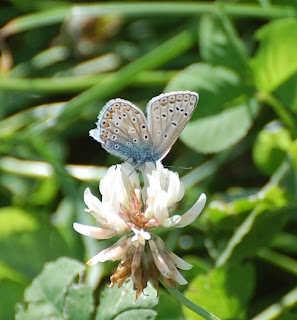
2 migrant hawkers were observed along with 25+ meadow browns, 2 peacocks, 5 large whites 15+ small whites, 1 comma, 1 red admiral, 1 small skipper and 2 common blues. A most successful wander.
Today's photos show the splendidly inquisitive fox cubs along with a female yellowhammer. 2 views of a common blue, showing both the underwings and fore wings and finally a chance snap of a green woodpecker flying past on the golf course. Looks rather odd with its wings folded completely back. This flight pattern gives the bird its tell tale dipping flight.

Thursday, 14 August 2008

Garden butterflies


An hour in the sunny conditions this morning enabled me to snap the visitors to the buddliea bush in the garden. Click on the photos to enlarge. The top photo depicts either a female or juvenile kestrel. The first butterfly shown is a large white, the scourge of gardens if you're growing brassicas or nasturtiums, where the female lays the eggs on the plant and the green and yellow caterpillar hatch with voracious appetites, devouring whole cabbages, sometimes in a day. The second shows a red admiral, a migrant butterfly that arrives here in April/May from the continent and then lays eggs that hatch in the second emergence, around the beginning of August. Some of the later hatching eggs will hibernate over winter and emerge to lay eggs in April time. The 3rd is the unmistakable peacock whilst the 4th is the common small white. Finally, a very old and faded example of a comma, showing the wear and tear from a month or so on the wing. Probable causes of the damage will be territorial fights with other butterflies and also pecks from birds
Also of note this evening, 6 sand martins flew over the chapel, heading south.

Wet walk 13.08.08


An afternoon wander across the golf course and back alng the River Ash in squally conditions didn't offer much of note. Black Headed gulls (23) were loafing around on the now ploughed rape fields adjacent to the golf course and a grey heron flew north east. Also, 2 lesser black backed gulls headed west. 3 swallows and 1 swift headed south, probably on migration. I have noted a marked decrease in the swifts around the village this week, the wet weather telling them it is time to move. Over the next few weeks there should be good numbers of swallows and martins overhead, all moving south.
A Migrant hawker dragonfly was observed along the Ash, but the conditions deterred most butterflies from flying. A comma, large white, speckled wood and several meadow browns were noted. However, the garden buddliea continues to attract red admiral and peacocks. Also, having filled the garden feeders, there has been the return of great, blue and coal tits to the garden.

Photographs show the fruit of the bittersweet plant. Looks very enticing but is poisonous!

Tuesday, 12 August 2008

French trip


Just returned from a trip to North Eastern France, Lac Du Der. The lake is a man made lake, with a massive 77km shoreline. It is of international importance for migating common crane that over winter around the lake, as well as white tailed eagles, ospreys and waterfowl. Although quiet at present, and with a very limited time for birding, I still managed 66 species for the trip. Need to make another visit during September/October time to se the environs in their full glory. For those interested a more detailed reprt can be viewed at http://www.birdforum.net/showthread.php?t=120531

Photographs attached depict the black redstart, an uncommon breeding bird in the UK but a regular sight on the continent. Another 2 photos of this bird are shown, one feeding a juvenile whilst the other sits under a tree. In fact the German name for this bird is house redstart. The bird on the water in a first year great crested grebe, still showing its juvenile striped neck plumage. The silhouette of the bird of prey is a black kite, again an uncommon visitor to these shores. However, 5 recently escaped from the aviary at London Zoo, so they may breed and become more common in the south east. Presently, no reports of black kites in the home counties are being treated as anything other than these escapees. The dragonfly is a ruddy darter and the small wading bird a common sandpiper. The other 2 snaps show views of the lake and its surrounds.

General round up to 06.08.08


Very little around bird wise at present but a marked increase in butterfly numbers, with red admirals, shown here, and peacocks now showing daily. Bird numbers are indicating that they are entering their autumn period. Finches, espcially linnets and goldfinches are now beginning to congregate into their wintering parties and gull movements, mostly south easterly, show that their breeding period has finished and they are heading back to their wintering feeding grounds. Most of these are either black headed gulls, but also small groups, numbering a maximum of 8, of the larger lesser black backed gulls. The local ones of those being Amwell gravel pits and Kings Mead between Ware and Hertford under the A10 flyover.

Friday, 1 August 2008

Chapel Lane and Golf course wander


A short and breezy walk this lunchtime. Very little on offer, with the usual suspects for both birds and butterflies. Several kestrels were observed over and around the golf course, especially around the 2nd green where I had a picnic, watching the swallows feeding and the kestrels hovering. Due to the wind speed (gusting to at least force 5) all butterflies appeared to be heading uncontrollably in a northern direction. Peacock, large and small white as well as gatekeepers and meadow browns flashed past. A speckled wood had bolted itself to vegetation as shown here. A new plant for the list is also depicted here, lords and ladies (arum maculatum.) Shown here with the fruit displayed. Other birds of note were the skylarks in the fields close to the G.C. and the inevitable yellowhammers. Hoping that August will bring a few new migratory species into the district and also prove successful for the autumnal based dragonflies.

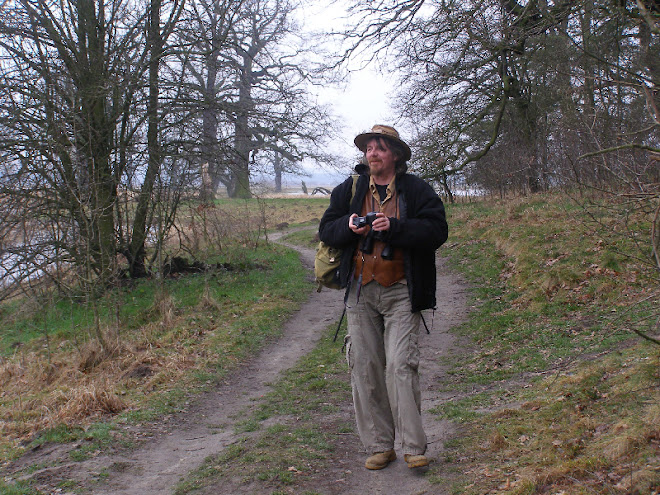
This is me

This is me
At the end of another Norfolk Coastal footpath walk. 47 miles, 3 days 99 species of bird. September 2009

Caley Wood view

Caley Wood view
sunshine through the canopy 29.05.08

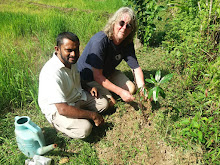
A walk along the Warta Valley, Poznan, Poland. Feb 2007

A walk along the Warta Valley, Poznan, Poland. Feb 2007
Best birds on this walk: black and middle spotted woodpecker and short toed treecreeper

About Me

My photo
A primary school teacher for 30 years, I retired from teaching in July 2009 to set up my own science enhancement and communication company. The Primary Works offers science clubs, workshops and staged science shows nationwide. I have always been interested in bird watching since my early years. Apparently my first tick was after inquiring about a chaffinch and then receiving the Observer book of birds. By the age of 9 I had moved on to Tory Peterson's collins guide and was now involved on YOC birding holidays to Northumbria, Essex coast, Slimbridge and Yorkshire. My twitching rule is that I will willingly travel 1km for each gram the bird weighs. However, I have had many rarities just by being in the right place. I have travelled widely throughout Europe and also visited Australia and Sri Lanka. In 2016 I spent time at Portland Bird Obs and two trips to Aviero, Portugal. 2017 found me back in Sri Lanka in Feb/March, then July and back for New Year's Eve celebrations in December. Also returned to The Camargue in May for a 4 day trip. Few plans for 2018, but nothing yet booked apart from a trip to the IOW.

Grey heron

Grey heron
Over the allotment 28.09.08

Southern Hawker

Southern Hawker
Ridge footpath 27.08.08

Juvenile green woodpecker (17.08.08)

Juvenile green woodpecker (17.08.08)
Note the stripes, denoting a bird fledged this year.

common blue

common blue
Ash Valley G.C. 15.08.08

Indian balsam (impatiens glandulifera)

Indian balsam (impatiens glandulifera)
River Ash

azure damselfly

azure damselfly
River Ash 28.07.08

marbled white

marbled white
Discovered at Westland Green 22.07.08

ruddy darter

ruddy darter
Bush Wood 21.07.08

honeysuckle 19.07.08

honeysuckle 19.07.08
growing in hedgerow in Chapel Lane

cinnabar moth caterpillar

cinnabar moth caterpillar
Photographed on ragwort 19.07.08

Bittersweet

Bittersweet
Study of petals 11.06.08

male yellowhammer

male yellowhammer
08.06.08

common blue butterfly

common blue butterfly
06.06.08

River Ash

River Ash
looking south from the bridge at Hadham Ford

Common poppy (papaver rhoeas)

Common poppy (papaver rhoeas)
in rape field 29.05.08

Caley Wood sunshine

Caley Wood sunshine
29.05.08

Millenium Wood fox

Millenium Wood fox
24.05.08

common comfrey (symphytum officinale)

common comfrey (symphytum officinale)
06.05.08 banks of the River Ash

Garlic Mustard or Jack by the Hedge,(Alliara petiolata)

Garlic Mustard or Jack by the Hedge,(Alliara petiolata)
flowers, leaves and fruit edible . Good in salad and pesto

April showers

April showers
Double rainbow 30.04.08

Caley Wood bluebells

Caley Wood bluebells
22.04.08

Yellow Archangel

Yellow Archangel
Chapel Lane (20.04.08)

sunlight 16.04.08

sunlight 16.04.08
looking south west from Bush Wood

snowy buds

snowy buds
06.04.08 in Bush Wood

Looking north west

Looking north west
05.04.08 evening shower approaching

Back Garden

Back Garden
Easter Sunday (23.03.08)

Brick Kiln Hill

Brick Kiln Hill
Looking east (23.03.08)

No play today

No play today
The 2nd hole at Ash Valley golf course

Teasel head

Teasel head
Bush Wood (21.03.08)

Reflections

Reflections
daffodils at Bush Wood pond (21.03.08)

Swollen River Ash

Swollen River Ash
The river at the bottom of Winding Hill 16.03.08

Daybreak over the chapel

Daybreak over the chapel
Thursday 13th March

Wild daffodils (narcissus pseudonarcissus)

Wild daffodils (narcissus pseudonarcissus)
growing in Bush Wood

January snowdrops

January snowdrops
Banks of River Ash, north of Much Hadham

Good Moon

Good Moon
From garden 24.01.08

Village Green

Village Green
Looking east towards Acremore Street

Looking south before Hadham Ford

Looking south before Hadham Ford
rare January blue sky

Useful sites

The following are some useful websites that may interest readers of this blog.
Firstly, Bishop's Stortford Natural History Society http://bsnhs.webplus.net/

Fellow birder, Gary Whelan's blog. Gives reports from our trips out together plus reports from his trips abroad. http://hairybirders.blogspot.co.uk
http://www.hertsbirdclub.org.uk/ The official herts bird club website. Frequently updated, listing bird sightings around the county. Offers links to many other websites. Both of these sites also offer links to yahoo discussion groups.
http://www.birdforum.net/ An international site. You can enter as a guest but become a member( free) to post comments, bird sightings and just about anything to do with wild birds. Good news updates, classified section for binoculars, cameras etc.
http://www.guidedbirdwatching.com/ A new site set up where you can contact people worldwide who will help you find good birds in their country. UK section being set up presently.
http://www.britainsbirder.co.uk/
Fellow birders blog. Strtford resident, Graeme Smith regulary birds the area south of Stortford as well as around Spellbrook and the River Stort from Spellbrook to Twyford Locks. Some superb bird photography: Graeme uses a digital camera attached to his powerful telescope to get detailled images of the birds he sees. Well worth a browse.
Two local sites that may be of interest can be found at
http://www.thehadhams.com/ www.thepelhams.net/content/section/12/139/

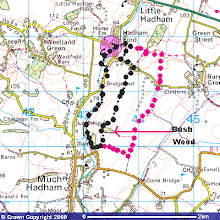
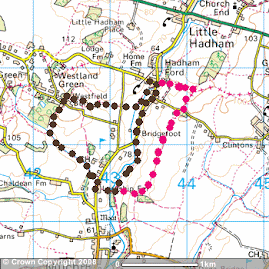
South Easterly walk

South Easterly walk
black, normal, red extended walk

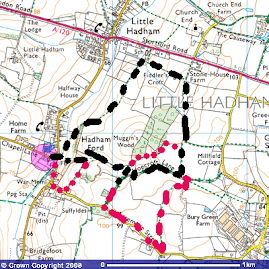
South Westerly route.

South Westerly route.
Black usual, red extended

North Easterly walk

North Easterly walk
black short, walk. Red, extended

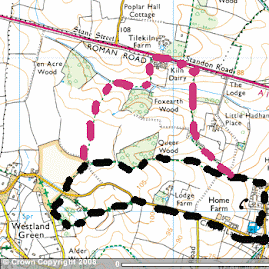
North West Patch

North West Patch
black route regular. Red route the extended wander