Tuesday, 13 February 2018

Year List update

So far this year, I have had 2 trips to North Norfolk, a visit to local reserve at Amwell and a few walks around my patch. Also, a frequent walk, somewhere within 5 miles of the Bishop's Stortford town centre for my fortnightly column in the Bishop's Stortford Independent. Wednesday 14th Feb, a trip to Frampton Marsh RSPB Reserve added 3 to the year list. On 17th Feb Gary and I had a Saturday in North Norfolk where I added 2 more species to the year list, both at Holkham.
Consequently, year list is as follows, with first sightings listed.
Update:
Several more trips to North Norfolk, plus a successful Dungeness trip have added several more to the list. Now updated 03.05.18
Red breasted merganser (Brancaster Harbour)

  1. Red throated diver (Holkham)
  2. Little Grebe (Titchwell)
  3. Great crested grebe (Titchwell)
  4. Cormorant (Cley)
  5. Little egret (Cley)
  6. Grey heron (Little Hadham)
  7. Mute swan (Cley)
  8. Pink footed goose (Holkham)
  9. Greylag goose (Cley)
  10. Canada goose (Amwell)
  11. Barnacle goose (Holkham)
  12. Brent goose (Cley)
  13. Shelduck (Titchwell)
  14. Egyptian goose (Cley)
  15. Mallard (B. Stortford)
  16. Gadwall (Titchwell)
  17. Pintail (Cley)
  18. Shoveler (Cley)
  19. Wigeon (Cley)
  20. Teal (Titchwell)
  21. Pochard (Amwell)
  22. Red crested pochard (Titchwell)
  23. Tufted duck (Amwell)
  24. Common scoter (Titchwell)
  25. Long tailed duck (Titchwell)
  26. Goldeneye (Titchwell)
  27. Smew (Amwell)
  28. Red breasted merganser (Brancaster harbour)
  29. Red kite (Little Hadham)
  30. Marsh harrier (Cley)
  31. Common buzzard (Little Hadham)
  32. Kestrel (Little Hadham)
  33. Peregrine falcon (Green Tye)
  34. Merlin (Brancaster)
  35. Red legged partridge (Little Hadham)
  36. Grey partridge (Standon)
  37. Pheasant (Little Hadham)
  38. Water rail (Titchwell)
  39. Moorhen (Little Hadham)
  40. Coot (Little Hadham)
  41. Oystercatcher (Wells)
  42. Avocet (Cley)
  43. Ringed plover (Titchwell)
  44. Grey plover (Titchwell)
  45. Golden plover (Cley)
  46. Lapwing (Cley)
  47. Knot (Titchwell)
  48. Sanderling (Titchwell)
  49. Turnstone (Salthouse)
  50. Dunlin (Cley)
Knot (Titchwell)

51. Redshank(Cley)
52. Black tailed godwit (Cley)
53. Bar tailed godwit (Titchwell)
54. Curlew (Cley)
55. Woodcock (Little Hadham)
56. Snipe (Holkham)
57. Ruff (Titchwell)
58. Black headed gull (Little Hadham)
59. Common gull (Little Hadham)
60. Herring gull (Little Hadham)
61. Lesser black backed gull (Little Hadham)
62. Great black backed gull (Titchwell)
63. Stock dove (Holkham)
64. Wood pigeon (Little Hadham)
65. Collared dove (Little Hadham)
66. Tawny Owl (Little Hadham)
67. Barn Owl (Little Hadham)
68. Little Owl (Little Hadham)
69. Kingfisher (B. Stortford)
70. Rose ringed parakeet (Alexandra Palace)
71. Green woodpecker (Little Hadham)
72. Great spotted woodpecker (Little Hadham)
73. Skylark (Little Hadham)
74. Shore lark (Holkham)
75. Rock pipit (Cley)
Rock Pipit (Morston)

76. Meadow pipit (Cley)
77. Pied wagtail (Little Hadham)
78. Wren (Little Hadham)
79. Dunnock (Little Hadham)
80. Robin (Little Hadham)
81. Black redstart (Sheringham)
82. Stonechat (Holkham)
83. Song thrush (Little Hadham)
84. Redwing (Little Hadham)
85. Mistle thrush (Little Hadham)
86. Fieldfare (Little Hadham)
87. Blackbird (Little Hadham)
88. Cetti's warbler (Holkham)
89. Goldcrest (Little Hadham)
90. Great tit (Little Hadham)
91. Coal tit (Little Hadham)
92. Blue tit (Little Hadham)
93. Long tailed tit (Little Hadham)
94. Nuthatch (Little Hadham)
95. Treecreeper (Little Hadham)
96. Magpie (Little Hadham)
97. Jay (Little Hadham)
98. Jackdaw (Little Hadham)
99. Carrion crow (Little Hadham)
100. Rook (Little Hadham)
Black redstart (Sheringham)
101. Starling (Little Hadham)
102. House sparrow (Little Hadham)
103. Chaffinch (Little Hadham)
104. Brambling (Titchwell)
105. Linnet (Little Hadham)
106. Lesser redpoll (B. Stortford)
107. Goldfinch (Little Hadham)
108. Greenfinch (B. Stortford)
109. Siskin (B. Stortford)
110. Bullfinch (Little Hadham)
111. Reed bunting (Titchwell)
112. Snow bunting (Salthouse)
113. Yellowhammer (Little Hadham)
114. Whooper swan (Frampton Marsh)
115 Tree sparrow (Frampton Marsh)
116. Spotted redshank (Frampton Marsh)
117. Rough legged buzzard (Holkham)
118. Black throated diver (Holkham)
119. Marsh Tit (Turner's Spring)
Lesser redpoll (Bishop's Stortford)
On 19th March I ventured down to Dungeness for a superb day's birding. As well as adding a fair few expected year listers, I got my first UK lifer since a flyover white stork at Cley in August of last year. However, this bluethroat was a first for me anywhere and a bird I had given up expecting to see. 4 trips to Poland, numerous occasions in The Camargue and Portugal and not a sniff of bluethroat. Also, many near misses in the UK, so this was certainly a red letter day. Apart from Sri Lankan birds (white rumped sharma, Kottawa Rainforest Jan 2018 being my last world wide lifer) the bluethroat was my first international lifer in the UK since the 2011 Western sandpiper at Cley.


adult male Bluethroat
120. Slavonian grebe (Dungeness)
121. Gannet (Dungeness)
122. Caspian gull (Dungeness)
123. Guillemot (Dungeness)
124. Razorbill (Dungeness)
125. Bluethroat (Dengemarsh Gully)
126. Firecrest (Dengemarsh Gully)
127. Chiffchaff (Dungeness)
128. Mandarin (Little Hadham)
129. Blackcap (Bishop's Stortford)
130. Wheatear (Bishop's Stortford)
131. Sedge warbler (Thorley Wash)
132. Cuckoo (Thorley Wash)
133. Whitethroat (Thorley Wash)
134. House martin (Bishop's Stortford)
135. Reed warbler (Amwell)

Dengemarsh Gully Firecrest

Bluethroat at same site, a different bird from one shown above.
136: swallow (Bishop's Stortford)
137. great white egret (Cley)
138. spoonbill (Titchwell)
139. whimbrel (Burnham Overy Staithe)
140. sandwich tern (Titchwell)
141. Wood lark (Kelling Heath)
142. House martin (Salthouse)
143. whinchat (Kelling water meadows)
144. garden warbler (Kelling Heath)
145. lesser whitethroat (Kelling Water Meadows)
146. willow warbler (Kelling Heath)
147. Bearded reedling (Titchwell)

Lesser whitethroat on track to Kelling Water Meadows

148. Hobby (Cley)
149. Common sandpiper (Titchwell)
150. Little tern (Blakeney Point)
151. Arctic tern (Blakeney Point)
152. swift (Cley)
153. sand martin (Kelling water meadows)
154. Grey wagtail (Cley)
155. Little ringed plover (Titchwell)

Little ringed plover (Titchwell from Parrinder Hide)

Little Tern at Blakeney Point


These additions follow a 3 day visit to North Norfolk with friend Anoma, visiting from Galle, Sri Lanka for his 1st UK visit. During this trip we managed over 100 species of birds, staying at the excellent Blakeney Manor Hotel. Highly recommended: great breakfast, clean and tidy rooms, superb bar service and sensible prices (£60 per night for a single room with breakfast.)
Next planned trip is a weekend coming up at Portland Bird Obs. Should add a few more to the year list.
Portland was both very sunny and hot, but also dense fog around Saturday lunchtime. Several year listers as I'd anticipated.
156. Rosy starling (Portland)
157. Manx shearwater (Portland)
158. Kittiwake (West cliffs, Portland)
159. Fulmar (West cliffs, Portland)
160. Shag (West cliffs, Portland)
161. Raven (Portland)

Rosy starling x 2 if you look closely

splendid raven
Next trip away: this Sunday off to the Isle of Wight for a week with Wendy. may get out for a spot of birding but not expecting too much. Norfolk on Friday 22nd June, guiding Trevor around some of the West Norfolk sites may offer a more realistic chance to add to the list.

Friday, 9 February 2018

Amwell Visit

This morning I set off for my local reserve, Amwell, managed by the Herts and Middlesex Wildlife Trust. An excellent reserve, offering great views from 3 hides and several viewing points.
I arrived at the main viewing point to scan Great Hardmead Lake. As usual, plenty of coot, black headed gulls, tufted duck but pleasingly, a good quantity of wigeon and pochard and 4 rather flighty goldeneye. These couldn't make up their mind as to which area of the lake was best so they seemed to be up and down, but always too far for a photo. I wandered along to the Gladwin Hide, where the usual suspects were noted: canada geese, more wildfowl and a large group of greylags coming in from Stansted Abbotts direction. A short sequence of their arrival here.


2 drake pochard

From here, I walked north, firstly checking Tumbling Bay where more tufteds and pochards were to be seen. I scoped the whole length of the lake and a fair way off a single red headed smew was constantly diving near overhanging willows. As I walked back along the tow path both dunnock and goldcrest were noted in the hedgerow, as was, a little later, a most confiding robin.
Dunnock

Next year's Christmas Card design sorted!
A quick check on a small pool where a pair of great crested grebes were beginning to come into breeding plumage. Lovely to see at such close quarters. Overhead, a red kite and in the distance, a calling Common buzzard.


From here, I visited the James Hide to see if any bitterns, water rails or kingfishers were about, but after 20 minutes nothing had stirred so off to the largest hide on the reserve, the White Hide. This place gives great views over the island where heron and cormorant were to be found, roosting in trees. It also permits views all the way down Gt Hardmead lake. Near the hide, a party of wigeon and, in the far distance, the 4 goldeneye. Not too much else to note here apart from 2 carrion crow on the small island feeding on what looked like a dead greylag goose.
Back over the River Lea and into the wooded area where the alders had attracted a large group of siskin of 75+. In amongst these, several lesser redpoll whilst a treecreeper called from a tree trunk. By now the light was too poor for woodland shots.
moorhen

Female pochard

mute swan

pair of wigeon

Great crested grebe in non breeding plumage

more wigeon


redwing
Species list for Amwell:

  1. Great crested grebe
  2. Cormorant
  3. Grey heron
  4. Mute swan
  5. Greylag goose
  6. Canada goose
  7. Egyptian goose
  8. Mallard
  9. Gadwall
  10. Shoveler
  11. Wigeon
  12. Teal
  13. Pochard
  14. Tufted duck
  15. Goldeneye
  16. Smew (new for 2018 year list)
  17. Red kite
  18. Common buzzard
  19. Pheasant
  20. Moorhen
  21. Coot
  22. Black headed gull
  23. Common gull
  24. Lesser black backed gull
  25. Wood pigeon
  26. Collared dove
  27. Green woodpecker
  28. Wren
  29. Dunnock
  30. Robin
  31. Redwing
  32. Blackbird
  33. Goldcrest
  34. Great tit
  35. Blue tit
  36. Coal tit
  37. Long tailed tit
  38. Treecreeper
  39. Magpie
  40. Jackdaw
  41. Carrion crow
  42. Chaffinch
  43. Bullfinch
  44. Goldfinch
  45. Siskin
  46. Lesser redpoll. (New for 2018 list)

Tuesday, 6 February 2018

Another super day in Norfolk

Another early start, 6.15am for a Norfolk Day. I arrived at Cley beach for a quick sea watch, but not much of note, apartfrom a large flock of golden plover landing near the Eye Pool.As I drove along the Beach Road I noticed several rock pipits fly over near the sluice, first new bird for 2018 of the trip I arrived at the East Bank and noted the wind chill factor. Not often I am forced to wear gloves but this was one occasion when I was.
Little seen as I wandered towards the marsh: godwits, wigeon, brents, a distant marsh harrier, mute swans and a huge flock of golden plover. From the Richie Richardson hide, a pair of drake pintails were new for the year but the combination of distance and decreasing light quality meant no photos. Rest as usual here: cormorants, shelduck, curlew, redshank, several dunlin cowering behind sedge. I headed back, in need of a hot drink at HQ.
I thought a quick trip to Salthouse beach but by now very bad light and plenty of snow. I set off for the beach but was sidetracked by a large party of brent geese in a field. I stopped and took the footpath adjacent to the field where they were just to check they were all brents. They were! 3 Egyptian geese were closer to the road and the entire Norfolk population of lapwings seemed to be in the air here, too.
Black tailed godwits over Cley reedbed in early morning light

Egyptian geese

Large flock of brent geese

Yep, all brent geese here, I think

Few more arriving

a swarm of golden plover coming into land in the Eye Field, Cley beach car park

Golden plover at the Eye Pool
I then decided not to visit Salthouse beach, where I was a fortnight ago and planned on popping into a few places I didn't visit last time. Off to Stiffkey Marsh/Warham Greens. Parking near the the camp site, I walked a short distance west, scoring with little egrets, linnets and pheasants. Not too much in the vegetation as it was still fairly breezy, so back to the car and off to Wells Woods. I parked by the boating lake, spotting tufted duck here before a walk into the woods. A goldcrest in the conifers and a jay were my total for the 15 minute wander before I decided to check the harbour and buckthorn plants near the Lifeboat station. In the buckthorn: bullfinch, dunnock, song thrush, blackbird and blue tits whilst feeding on the harbour mud, 200+ oystercatchers. A red kite circled over East Hills.
I then popped along to Lady Anne's Derive where I noted pink foots and brents along with wigeon. Here I just spotted from the car and time was getting on and I wanted to check a few more sites. Before arriving at Wells, I spent a little time checking the creeks around the National Trust car park at Morston. Here, a posing, but distant rock pipit.
Rock pipit on a boat.

more brent geese

Looking towards Blakeney Point from Morston Quay

Tufted duck, Wells boating lake

Jay in Wells Woods

Female blackbird feeding successfully on the muddy path at Warham Greens
female bullfinch by the lifeboat station

Flyby Oystercatchers, Wells harbour

Sheltering pied wagtail at the Beach cafe, Wells

Pink foot goose, Holkham

More pink foots
Next stop was the layby just half a mile west of Lady Anne's Drive to check a flock of geese, just greylags and pinkfoots, no hoped for white fronts. So, on to Brancaster Harbour where a fortnight ago I got merlin flying over. At Burnham Norton there was a male merlin on a telegraph pole, that is, until I had it in the camera lens, was just focussing when it flew off!
At the  harbour, usual fare of teal, wigeon, dunlin, redshank etc before a diving "duck" caught my eye some way up the main channel. It emerged on the surface: a red breasted merganser that continued toswim towards where I was in the car. I got out and quietly wandered to the water's edge and waited, hoping it would continue past me. Indeed it did, giving pleasing photo opportunities. Best views I have had for a long time, normally confined to scope views, 50 metres out to sea.

Couple of decent red breasted merganser shots
It had now clouded over, making the light poor again but the breeze had ceased and it appeared to be warmer as I parked at Titchwell. A quick check for the showy woodcock along the Fen Trail failed to realise the bird, but a water rail, skulking in the ditch by the main path was great to watch. So dark in the undergrowth I really had to stretch the camera to get anything worthwhile at all. These were the best which was a shame as this shy bird doesn't often give these sort of photo opportunities.


Red crested pochard were noted on the Fresh marsh, another new for the year species and the Salt marsh was well populated with usual fare in the wader department: ringed plover, grey plover, avocet, black tailed godwit, redshank, along with gulls, teal and little grebes.
On to the beach for a sea watch where Common scoter were recorded in good numbers along with a pair of goldeneye and 3 long tailed duck. It looked like we were in for rain or snow, so after 30 minutes I headed back towards the Visitors' Centre and the car park. A resplendent male brambling popped into an alder near the car park and a quick scan for a reported water pipit failed to come up with the goods. I then shot off for a quick twite search at Thornham, but by now too dark for this, so on to the road back to Burnham Market, South Creake and Fakenham.
drake, 2 duck red crested pochard amongst lapwings

shoveler

redshank

Tough going in this mud for this ringed plover that is missing a middle toe.

strutting curlew on the Salt marsh

The Meet and Greet black headed gull that stations itself at the end of the beach path by the old viewing stand.

Ominous clouds towards Thornham.
A great day again, with a few new for the 2018 species list, along with pleasing views of other birds such as rock pipit, water rail, merlin and red breasted merganser. In total, 85 species.
Species list for North Norfolk 05.02.18. Bold type indicates new bird for the year.

  1. Little grebe
  2. Little egret
  3. Cormorant
  4. Grey heron
  5. Mute swan
  6. Pink footed goose
  7. Greylag goose
  8. Brent goose
  9. Shelduck
  10. Egyptian goose
  11. mallard
  12. Gadwall
  13. Pintail
  14. Shoveler
  15. Wigeon
  16. Teal
  17. Red crested pochard
  18. Tufted duck
  19. Common scoter
  20. Long tailed duck
  21. Goldeneye
  22. Red breasted merganser
  23. Red kite
  24. Marsh harrier
  25. Common buzzard
  26. Kestrel
  27. Merlin
  28. Pheasant
  29. Water rail
  30. Moorhen
  31. Coot
  32. Oystercatcher
  33. Avocet
  34. Ringed plover
  35. Golden plover
  36. Grey plover
  37. Lapwing
  38. Sanderling
  39. Turnstone
  40. Dunlin
  41. Redshank
  42. Black tailed godwit
  43. Bar tailed godwit
  44. Curlew
  45. Ruff
  46. Black headed gull
  47. Common gull
  48. Herring gull
  49. Lesser black backed gull
  50. Greater black backed gull
  51. Woodpigeon
  52. Collared dove
  53. skylark
  54. Rock pipit
  55. Meadow pipit
  56. Pied wagtail
  57. Wren
  58. Dunnock
  59. Robin
  60. Stonechat
  61. Song thrush
  62. Redwing
  63. Fieldfare
  64. Mistle thrush
  65. Blackbird
  66. Cetti's warbler 
  67. Goldcrest
  68. Great tit
  69. Coal tit
  70. Blue tit
  71. Long tailed tit
  72. Magpie
  73. Jay
  74. Jackdaw
  75. Rook
  76. Carrion crow
  77. Starling
  78. House sparrow
  79. Chaffinch
  80. Brambling
  81. Linnet
  82. Goldfinch
  83. Greenfinch
  84. Bullfinch
  85. Reed bunting.

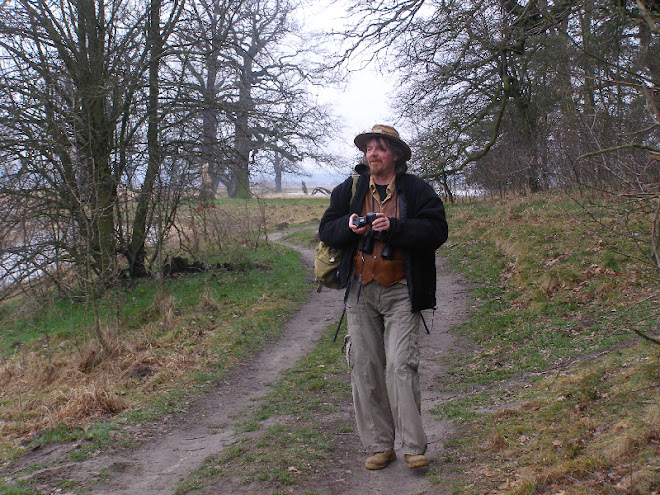
This is me

This is me
At the end of another Norfolk Coastal footpath walk. 47 miles, 3 days 99 species of bird. September 2009

Caley Wood view

Caley Wood view
sunshine through the canopy 29.05.08

A walk along the Warta Valley, Poznan, Poland. Feb 2007

A walk along the Warta Valley, Poznan, Poland. Feb 2007
Best birds on this walk: black and middle spotted woodpecker and short toed treecreeper

About Me

My photo
A primary school teacher for 30 years, I retired from teaching in July 2009 to set up my own science enhancement and communication company. The Primary Works offers science clubs, workshops and staged science shows nationwide. I have always been interested in bird watching since my early years. Apparently my first tick was after inquiring about a chaffinch and then receiving the Observer book of birds. By the age of 9 I had moved on to Tory Peterson's collins guide and was now involved on YOC birding holidays to Northumbria, Essex coast, Slimbridge and Yorkshire. My twitching rule is that I will willingly travel 1km for each gram the bird weighs. However, I have had many rarities just by being in the right place. I have travelled widely throughout Europe and also visited Australia and Sri Lanka. In 2016 I spent time at Portland Bird Obs and two trips to Aviero, Portugal. 2017 found me back in Sri Lanka in Feb/March, then July and back for New Year's Eve celebrations in December. Also returned to The Camargue in May for a 4 day trip. Few plans for 2018, but nothing yet booked apart from a trip to the IOW.

Grey heron

Grey heron
Over the allotment 28.09.08

Southern Hawker

Southern Hawker
Ridge footpath 27.08.08

Juvenile green woodpecker (17.08.08)

Juvenile green woodpecker (17.08.08)
Note the stripes, denoting a bird fledged this year.

common blue

common blue
Ash Valley G.C. 15.08.08

Indian balsam (impatiens glandulifera)

Indian balsam (impatiens glandulifera)
River Ash

azure damselfly

azure damselfly
River Ash 28.07.08

marbled white

marbled white
Discovered at Westland Green 22.07.08

ruddy darter

ruddy darter
Bush Wood 21.07.08

honeysuckle 19.07.08

honeysuckle 19.07.08
growing in hedgerow in Chapel Lane

cinnabar moth caterpillar

cinnabar moth caterpillar
Photographed on ragwort 19.07.08

Bittersweet

Bittersweet
Study of petals 11.06.08

male yellowhammer

male yellowhammer
08.06.08

common blue butterfly

common blue butterfly
06.06.08

River Ash

River Ash
looking south from the bridge at Hadham Ford

Common poppy (papaver rhoeas)

Common poppy (papaver rhoeas)
in rape field 29.05.08

Caley Wood sunshine

Caley Wood sunshine
29.05.08

Millenium Wood fox

Millenium Wood fox
24.05.08

common comfrey (symphytum officinale)

common comfrey (symphytum officinale)
06.05.08 banks of the River Ash

Garlic Mustard or Jack by the Hedge,(Alliara petiolata)

Garlic Mustard or Jack by the Hedge,(Alliara petiolata)
flowers, leaves and fruit edible . Good in salad and pesto

April showers

April showers
Double rainbow 30.04.08

Caley Wood bluebells

Caley Wood bluebells
22.04.08

Yellow Archangel

Yellow Archangel
Chapel Lane (20.04.08)

sunlight 16.04.08

sunlight 16.04.08
looking south west from Bush Wood

snowy buds

snowy buds
06.04.08 in Bush Wood

Looking north west

Looking north west
05.04.08 evening shower approaching

Back Garden

Back Garden
Easter Sunday (23.03.08)

Brick Kiln Hill

Brick Kiln Hill
Looking east (23.03.08)

No play today

No play today
The 2nd hole at Ash Valley golf course

Teasel head

Teasel head
Bush Wood (21.03.08)

Reflections

Reflections
daffodils at Bush Wood pond (21.03.08)

Swollen River Ash

Swollen River Ash
The river at the bottom of Winding Hill 16.03.08

Daybreak over the chapel

Daybreak over the chapel
Thursday 13th March

Wild daffodils (narcissus pseudonarcissus)

Wild daffodils (narcissus pseudonarcissus)
growing in Bush Wood

January snowdrops

January snowdrops
Banks of River Ash, north of Much Hadham

Good Moon

Good Moon
From garden 24.01.08

Village Green

Village Green
Looking east towards Acremore Street

Looking south before Hadham Ford

Looking south before Hadham Ford
rare January blue sky

Useful sites

The following are some useful websites that may interest readers of this blog.
Firstly, Bishop's Stortford Natural History Society http://bsnhs.webplus.net/

Fellow birder, Gary Whelan's blog. Gives reports from our trips out together plus reports from his trips abroad. http://hairybirders.blogspot.co.uk
http://www.hertsbirdclub.org.uk/ The official herts bird club website. Frequently updated, listing bird sightings around the county. Offers links to many other websites. Both of these sites also offer links to yahoo discussion groups.
http://www.birdforum.net/ An international site. You can enter as a guest but become a member( free) to post comments, bird sightings and just about anything to do with wild birds. Good news updates, classified section for binoculars, cameras etc.
http://www.guidedbirdwatching.com/ A new site set up where you can contact people worldwide who will help you find good birds in their country. UK section being set up presently.
http://www.britainsbirder.co.uk/
Fellow birders blog. Strtford resident, Graeme Smith regulary birds the area south of Stortford as well as around Spellbrook and the River Stort from Spellbrook to Twyford Locks. Some superb bird photography: Graeme uses a digital camera attached to his powerful telescope to get detailled images of the birds he sees. Well worth a browse.
Two local sites that may be of interest can be found at
http://www.thehadhams.com/ www.thepelhams.net/content/section/12/139/

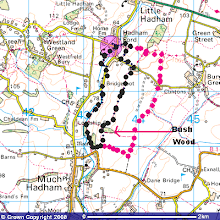
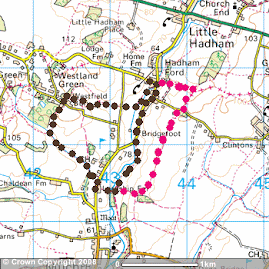
South Easterly walk

South Easterly walk
black, normal, red extended walk

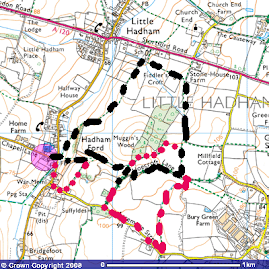
South Westerly route.

South Westerly route.
Black usual, red extended

North Easterly walk

North Easterly walk
black short, walk. Red, extended

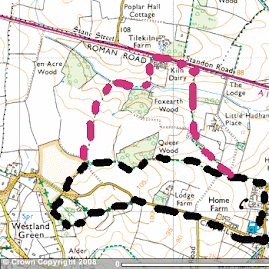
North West Patch

North West Patch
black route regular. Red route the extended wander