Sunday, 6 October 2013

200 up: North Norfolk

Saturday 5th October and a hastily put together Norfolk trip, picking up Gary at 5.30a.m. in Bishop's Stortford. Plenty had been reported over the previous couple of days so it was fingers crossed for a few rares and a chance to add 3 year listers to bring up the magical 200 species.
After a strong coffee break near Ely we arrived at Titchwell at 7.30 and almost immediately heard yellow browed warbler near the car park.At this time, in the dense vegetation it was not worth checking to see it, that would be later, so we headed off to the reserve and the island hide.
Here regular waders in the shape of snipe, ruff, dunlin with a solitary avocet and splendid grey plover. However, the highlight was, as we watched a jack snipe, a most territorial water rail emerged to see it off. Being a jack it was up and down in a few seconds and we later saw the same rail chase off a common snipe, too. This legged it over to the reed beds from Fresh Marsh. A med gull in flight before we headed to the beach. Plenty of westerly gannet movement and 3 red throated divers. A great crested grebe on the sea along with waders on the beach. Sanderlings ran and turnstones messed about on the broken pill box on the beach. Oystercatchers, godwits, curlew and redshank were also noted. As we walked back a confiding curlew on the Brakish Marsh.

dunlin

snipe

water rail

Back to the Parrinder Hide and a spotted redshank and golden plover before checking the meadow trail for the yellow browed. Brief glimpses as it moved between the dense willows, calling upon take off. #198 for the year and a lifer for Gary report here

ruff

turnstone

sanderling

1st year and adult herring gull

After another coffee we headed for Burnham Overy Dunes hoping for some migrants but got little else apart from wheatear and stonechat. Dunnocks, skylarks, house sparrows and linnets were all checked but they turned out to be what they were!

confiding curlew

pleasing shot

more dunlin

same curlew

 A trek back to the car and off to Holkham Pines for more searching. The Washington hide was our first stop after listening in the woods, but nothing was giving itself away. In the hide was a party of pensioners enjoying their picnic. One set of bins between them, enjoying views of greylags. A distant hobby was noted over the hall estate as well as 2 spoonbills. More variety clubbers arrived, complaining about Gary's scope so we left before choice words were uttered! On to the Tower Hide where we scored with 100's of greylag and a marsh harrier. Upon leaving long tailed, great and blue tits were heard along with glimpses of goldcrests. A check for firecrest was unsuccessful and we didn't hear one, either.

common darter

Agrarian revolution memorial: Holkham Hall

female marsh harrier

greylags using airbrakes

kestrel

greylags unsettled by microlight.

As we were ahead of schedule we thought, after a discussion, it maybe worth going for the Warham Greens red breasted flycatcher. Once parked and a wander to the Norfolk Coastal footpath, we saw plenty of folk in a small copse. Here indeed was the rbf, deep in the tree. Fortunately it moved as the only chap on it wasn't too good at describing its position. Phrases like "up the trunk and along the diagonal" and "behind the green leaves" don't actually pinpoint the quarry! However, by climbing a tree I was lucky that the bird flew into binocular vision and I got good, if brief views, as did Gary. #199! A lifer for him.
By this time it was gone 3 and we both needed to be home by 7, so off to the Three Horseshoes at Warham for a pint. Pub closed so on to The Swan at Hilborough for an excellent pint of Growler and a strangely tasty packet of poppadoms with a carton of jam to dip. Revolutionary and a talking point in the pub. Very modern, I thought.
Seeing as we were passing Lyndford Arboretum it seemed only right that we should pop in. Once parked we were immediately onto common crossbills. #200 for 2013 and the 3rd lifer of the day for Gary. No sign of the 2 barred crossers but large numbers of siskins flew to roost and plenty of nuthatches called.
Home by 6.30 was much appreciated. Great day and a good list which, with a little more time and another habitat could have easily topped 100.
Species list:
red throated diver, little grebe, great crested grebe, gannet, cormorant, little egret, grey heron, spoonbill, mute swan, pink footed goose,(10 sp) greylag goose, canada goose, brent goose, shelduck, egyptian goose, mallard, gadwall, shoveler, wigeon, teal, (20 sp) pochard, tufted duck, marsh harrier, kestrel, hobby, pheasant, water rail, moorhen, coot, oystercatcher, (30 sp)avocet, ringed plover, grey plover, golden plover, lapwing, knot, sanderling, turnstone, dunlin, redshank (40 sp) spotted redshank, greenshank, black tailed godwit, bar tailed godwit, curlew, snipe, jack snipe, ruff, black headed gull,common gull (50 sp) mediterranean gull, herring gull, lesser black backed gull, great black backed gull, wood pigeon, collared dove, skylark, swallow, meadow pipit, pied wagtail (60 sp) wren, dunnock, robin, wheatear, stonechat, song thrush, blackbird, cettis warbler, reed warbler, chiffchaff (70 sp) yellow browed warbler, goldcrest, red breasted flycatcher, great tit, blue tit, long tailed tit, nuthatch, treecreeper, magpie, jay (80 sp) jackdaw, rook, carrion crow, starling, house sparrow, chaffinch, linnet, goldfinch, greenfinch, siskin, (90 sp) common crossbill

Tring Reservoirs

An afternoon visit to Tring reservoirs on Friday was a good way to complete the week. As appears to be the case, especially at Wilstone reservoir, the wind blew hard and the hat was seldom donned. A flyby group of 3 black tailed godwits were the highlight, along with 2 dunlin and a ringed plover. Views from the hide offered excellent opportunity to count in excess of 500 teal, 100 pochard, numerous tufties, 5+ pintail, 25+ shoveler, 16 little egrets, 20+ cormorants and several hundred black headed gulls.
Marsworth and Startops were also checked with out adding anything noteworthy, although a few others made the list, such as pied wagtail and coots. Several chiffchaff were calling from the trees around Wilstone hide and small numbers of swallows darted over the water at all 3 sites.
grey heron

pochard

demise of a perch

great crested grebe

Friday, 4 October 2013

Excellent moth night

The temperatures were set for warm last night and so it proved. 14C at 11pm meant there were good numbers of moths about. Highlight before bed was a beautiful hooktip. In 2006 there was a partial 2nd generation of this June to early August flyer. Even more strangely, 2 more arrived at the trap overnight and noted this morning.
Another strangely out of flight season creature was a yellowshell. No Herts records of this species in October.

beautiful hooktip

very late yellowshell
Other moths were present in good number. 9 setaceous hebrew character, 3 brown spot pinions, 2 blair's shoulder knot as well as 2 yellow line quakers, 1 common quaker, 2 beaded chestnut, 3 barred sallow, 1 red line quaker, 2 lesser yellow underwing, 3 large yellow underwing, 1 lunar underwing and a solitary common marbled carpet.
All in all, an interesting haul.

red line quaker

yellow line quaker

barred sallow

Local wander

Returning to the village via Green Street and Cradle End yesterday in warm conditions was good for a few late birds. A singing garden warbler at Plantings Wood was a real surprise. Record sent to county recorder. Also, overhead, a migratory party of 20+ swallow also needed to be sent off. Otherwise, regular birds with green woodpeckers, a single common buzzard and two bullfinches were noted. Plenty of pheasant about, so I suspect local farmers have released them from the rearing pens for the forthcoming November shoots.
juvenile wood pigeon

teasel

wood pigeon portrait

Muggins Wood beginning to take on lovely colours.

Wednesday, 2 October 2013

Updated year list

 
great crested grebe, cormorant, grey heron, mute swan, greylag goose, canada goose, mallard, gadwall, shoveler, teal (10sp) wigeon, pochard, tufted duck, scaup, goldeneye, smew, red kite, common buzzard, kestrel, moorhen (20 sp) coot, lapwing, black headed gull, common gull, herring gull, lesser black backed gull, greater black backed gull, collared dove, wood pigeon, dunnock (30sp) robin, blackbird, great tit, blue tit, long tailed tit, jay, magpie, jackdaw, rook, carrion crow (40 sp) house sparrow, starling, chaffinch, goldfinch, siskin, reed bunting, waxwing, fieldfare, redwing, pied wagtail (50 sp) egyptian goose, great spotted woodpecker, treecreeper, mistle thrush, wren, bullfinch, red legged partridge, yellowhammer, stock dove, pheasant (60sp) green woodpecker, nuthatch, marsh tit, song thrush, tawny owl, little grebe, barn owl, little owl, woodcock, sparrowhawk (70 sp) coal tit, little egret, red throated diver, guillemot, razorbill, common scoter, gannet, kittiwake, brent goose, turnstone (80 sp) great northern diver, tree sparrow, oystercatcher, shelduck, pintail, cetti's warbler, stonechat, marsh harrier, snipe, great white egret (90 sp) water rail, dunlin, golden plover, snow bunting, dartford warbler, linnet, greenfinch, redshank, ring necked parakeet, ringed plover (100 sp) pink footed goose, chiffchaff, lesser redpoll, meadow pipit, grey partridge, great grey shrike, merlin, caspian gull, green sandpiper, skylark (110 sp) grey wagtail, brambling, little stint, fulmar, curlew, spotted redshank, black tailed godwit, bar tailed godwit, knot, whooper swan, (120 sp) sanderling, grey plover, avocet, ruff, corn bunting, long tailed duck, purple sandpiper, shore lark, hen harrier, hawfinch, (130 sp)Jack snipe, .
Added since April
black redstart, greenshank, goldcrest, mandarin, kingfisher, swallow, yellow legged gull, water pipit, house martin, (140 sp) sand martin, cuckoo, blackcap, goosander, grasshopper warbler , little ringed plover, sandwich tern, arctic tern, rock pipit, white wagtail, (150 sp) yellow wagtail, wheatear, whinchat, sedge warbler, reed warbler, willow warbler, lesser whitethroat, corn bunting, swift, common tern, (160 sp)garden warbler, turtle dove, hobby, bittern, golden oriole, savi's warbler, stone curlew, spotted flycatcher, little gull, little tern, (170 sp) bearded reedling, spoonbill, garganey, red crested pochard, common crane, curlew sandpiper, wood sandpiper, grasshopper warbler, mediterranean gull, (180 sp)common sandpiper, whimbrel, red necked phalarope.
Added birds:
arctic skua, redstart, pied flycatcher, wryneck, citrine wagtail, red backed shrike, raven, pomarine skua, tree pipit, nightingale, balearic shearwater, peregrine, shag,spotted crake.
197 species at 02.10.13.
nes in red were not recorded in 2012.

Amwell Visit

A quick trip to Amwell this morning to see if yesterday's osprey had roosted. No sign after heavy overnight rain. A digger clearing channels and adding a new scrape meant that many birds were not present. Several male pochard and shoveler have arrived over the last few days but no sign of waders or anything unusual. A check on Hollycross lake and Tumbling Bay gave views of plenty of tufted duck and 2 juvenile great crested grebe, but another shower forced me back to the car and into the cafe at Stansted Abbotts for a warming coffee.

drake pochard in poor light

juvenile great crested grebes

shaggy inkcap

cormorant and coots.

Moth update.

A few noteworthy moths in the trap in the pouring rain this morning. 2 black rustics, blair's shoulder knot and a late frosted orange were the highlights, along with the regular setaceous hebrew characters and assorted underwings. Tonight looks like another reasonable night.

black rustic

frosted orange

Blair's shoulder knot.

Kent trip 30.09.13

Last Monday saw me heading for North Kent at 5a.m. First stop was Oare Marshes near Faversham. Always a pleasant reserve, easy to park and view. The target was a spotted crake that had been present for a while, in a ditch behind the East Hide. I arrived at first light and immediately noted in excess of 750 black tailed godwits and 200 redshank. A flock of 33 avocet flew in as I made my way around the sea wall to the hide at the promontory. Plenty more redshank, some dunlin and 30+ little egrets along with several calling sandwich terns on the estuary. I continued to the east hide where, after a few minutes, the spotted crake showed ofr less than 30 seconds before heading back to the bullrushes and out of view. It called several times but was not seen again. Olly Frampton, up from Hants, waited 2 hours but a no show. See http://thedirtyburtonbirder.blogspot.co.uk for his birding blog.

sunrise at Oare Marshes

Sunrise over the estuary

lapwings

black tailed godwits and redshanks

more black tailed godwits and redshank


Looking east
After returning to the car, I made my way to Cliffe Reserve. Here was a lesser yellowlegs, but as I had plenty of time I wandered off to the distant flamingo pool first, checking the redshanks and ruffs for the el yell. No sign. Several kestrel were hunting and good numbers of little and great crested grebe along with over 50 little egrets. Usual wildfowl were also noted. I met up again with Olly who had not ticked the sp crake. We checked the pools before he drove us to the far Black Barn pools. Strangely a report came up the the lesser yellow legs had just been seen here, but with only 5 of us on the reserve and no one having seen it, seemed strange to be on rare bird network. A check, into the sun. of the black barn pools gave little new, so I thanked Olly for the lift and headed back to the car park. All in all, a rather disappointing reserve that was, if I recall correctly, going to be the RSPB flagship reserve when first purchased. Plenty of anti London's 3rd airport money was pumped into the purchase of this vast reserve, but there has been no development whatsoever. In fact, there seem to be fewer birds present than 15 - 20 years ago. There seems to be no management plan, no water level management and, I suspect no check on salinity. A shame. Also, trees that held a roost of long eared owls have been removed (to attract nightingales) and the local population of over wintering Short eared owls also appears to be in decline. Not too sure what the RSPB are doing as I see it just being a burden to them unless they make some much needed investment. I shall endeavour to find out. Very little was close for a worthwhile photo, just a few little grebe and a view looking north towards the Thames estuary


Having returned to the car, I headed off to Rainham Marsh as I wanted to be through the Dartford tunnel before rush hour. Here, after a coffee, I had a good wander around, without noting anything wonderful. 5 pintails coming out of eclipse plumage were good and I heard several bearded tits near thew dragonfly pond. Again usual suspects were present but I was soon back on the car park that was the M25. and home.
All in all, not my greatest day birding, but still a joy to be out.
Species list from the day:
little grebe, great crested grebe, cormorant, little egret, grey heron, mute swan, greylag goose, canada goose, brent goose, shelduck, (10 sp) mallard, gadwall, pintail, shoveler, wigeon, teal, pochard, tufted duck, sparrowhawk, kestrel, (20 sp) common buzzard, pheasant, spotted crake, moorhen, coot, oystercatcher, avocet, golden plover, lapwing, dunlin, (30 sp) redshank, greenshank, black tailed godwit, curlew, snipe, ruff, black headed gull, mediterranean gull, herring gull, lesser blcak backed gull (40 sp) great black backed gull, sandwich tern, stock dove, wood pigeon, collared dove, tawny owl, green woodpecker, greateer spotted woodpecker, swallow, meadow pipit, (50 sp) pied wagtail, grey wagtail, wren, dunnock, robin, redwing, mistle thrush, blackbird, blackcap, chiffchaff, (60 sp) great tit, coal tit, blue tit, long tailed tit, bearded tit (heard)magpie, jay, jackdaw, rook, carrion crow, (70 sp) starling, house sparrow, chaffinch, linnet, goldfinch, greenfinch, bullfinch, reed bunting.
In total 78 species.

Short local wander

A quick check around the north east of the parish gave views of the returning mute swan to the ponds east of Little Hadham. Over the last 5 years this swan, normally with mate arrives in early October and over winters. Last year they were accompanied by a single 1 year old, which disappeared with the female before the pen returned alone. This year, just the one so far.
On the telegraph wires were 40+ goldfinches and linnets. A reed bunting was seen in the local hedgerow and 3 chiffchaffs were calling. Not too much to report.

Tuesday, 1 October 2013

Good moths

After several quiet weeks on the moth hunt a good haul was taken this morning. Mallow, barred sallow and Blair's shoulder knot were all new for the year whilst a light emerald, faded to white, was an unexpected find. Also, beaded chestnuts, setaceous hebrew characters, large yellow underwings, broad bordered yellow underwings, lunar underwings and lesser yellow underwings.
1. Blair's shoulder knot
2. Mallow
3. Barred sallow
4. 2 forms of Beaded chestnut
5. Very faded light emerald
Sent from my BlackBerry® smartphone www.blackberry.com

This is me

This is me
At the end of another Norfolk Coastal footpath walk. 47 miles, 3 days 99 species of bird. September 2009

Caley Wood view

Caley Wood view
sunshine through the canopy 29.05.08

A walk along the Warta Valley, Poznan, Poland. Feb 2007

A walk along the Warta Valley, Poznan, Poland. Feb 2007
Best birds on this walk: black and middle spotted woodpecker and short toed treecreeper

About Me

My photo
A primary school teacher for 30 years, I retired from teaching in July 2009 to set up my own science enhancement and communication company. The Primary Works offers science clubs, workshops and staged science shows nationwide. I have always been interested in bird watching since my early years. Apparently my first tick was after inquiring about a chaffinch and then receiving the Observer book of birds. By the age of 9 I had moved on to Tory Peterson's collins guide and was now involved on YOC birding holidays to Northumbria, Essex coast, Slimbridge and Yorkshire. My twitching rule is that I will willingly travel 1km for each gram the bird weighs. However, I have had many rarities just by being in the right place. I have travelled widely throughout Europe and also visited Australia and Sri Lanka. In 2016 I spent time at Portland Bird Obs and two trips to Aviero, Portugal. 2017 found me back in Sri Lanka in Feb/March, then July and back for New Year's Eve celebrations in December. Also returned to The Camargue in May for a 4 day trip. Few plans for 2018, but nothing yet booked apart from a trip to the IOW.
Grey heron

Grey heron
Over the allotment 28.09.08

Southern Hawker

Southern Hawker
Ridge footpath 27.08.08

Juvenile green woodpecker (17.08.08)

Juvenile green woodpecker (17.08.08)
Note the stripes, denoting a bird fledged this year.

common blue

common blue
Ash Valley G.C. 15.08.08

Indian balsam (impatiens glandulifera)

Indian balsam (impatiens glandulifera)
River Ash

azure damselfly

azure damselfly
River Ash 28.07.08

marbled white

marbled white
Discovered at Westland Green 22.07.08

ruddy darter

ruddy darter
Bush Wood 21.07.08

honeysuckle 19.07.08

honeysuckle 19.07.08
growing in hedgerow in Chapel Lane

cinnabar moth caterpillar

cinnabar moth caterpillar
Photographed on ragwort 19.07.08

Bittersweet

Bittersweet
Study of petals 11.06.08

male yellowhammer

male yellowhammer
08.06.08

common blue butterfly

common blue butterfly
06.06.08

River Ash

River Ash
looking south from the bridge at Hadham Ford

Common poppy (papaver rhoeas)

Common poppy (papaver rhoeas)
in rape field 29.05.08

Caley Wood sunshine

Caley Wood sunshine
29.05.08

Millenium Wood fox

Millenium Wood fox
24.05.08

common comfrey (symphytum officinale)

common comfrey (symphytum officinale)
06.05.08 banks of the River Ash

Garlic Mustard or Jack by the Hedge,(Alliara petiolata)

Garlic Mustard or Jack by the Hedge,(Alliara petiolata)
flowers, leaves and fruit edible . Good in salad and pesto

April showers

April showers
Double rainbow 30.04.08

Caley Wood bluebells

Caley Wood bluebells
22.04.08

Yellow Archangel

Yellow Archangel
Chapel Lane (20.04.08)

sunlight 16.04.08

sunlight 16.04.08
looking south west from Bush Wood

snowy buds

snowy buds
06.04.08 in Bush Wood

Looking north west

Looking north west
05.04.08 evening shower approaching

Back Garden

Back Garden
Easter Sunday (23.03.08)

Brick Kiln Hill
Brick Kiln Hill
Looking east (23.03.08)

No play today

No play today
The 2nd hole at Ash Valley golf course

Teasel head

Teasel head
Bush Wood (21.03.08)

Reflections

Reflections
daffodils at Bush Wood pond (21.03.08)

Swollen River Ash

Swollen River Ash
The river at the bottom of Winding Hill 16.03.08

Daybreak over the chapel

Daybreak over the chapel
Thursday 13th March

Wild daffodils (narcissus pseudonarcissus)

Wild daffodils (narcissus pseudonarcissus)
growing in Bush Wood

January snowdrops

January snowdrops
Banks of River Ash, north of Much Hadham

Good Moon

Good Moon
From garden 24.01.08

Village Green

Village Green
Looking east towards Acremore Street

Looking south before Hadham Ford

Looking south before Hadham Ford
rare January blue sky

Useful sites

The following are some useful websites that may interest readers of this blog.
Firstly, Bishop's Stortford Natural History Society http://bsnhs.webplus.net/

Fellow birder, Gary Whelan's blog. Gives reports from our trips out together plus reports from his trips abroad. http://hairybirders.blogspot.co.uk
http://www.hertsbirdclub.org.uk/ The official herts bird club website. Frequently updated, listing bird sightings around the county. Offers links to many other websites. Both of these sites also offer links to yahoo discussion groups.
http://www.birdforum.net/ An international site. You can enter as a guest but become a member( free) to post comments, bird sightings and just about anything to do with wild birds. Good news updates, classified section for binoculars, cameras etc.
http://www.guidedbirdwatching.com/ A new site set up where you can contact people worldwide who will help you find good birds in their country. UK section being set up presently.
http://www.britainsbirder.co.uk/
Fellow birders blog. Strtford resident, Graeme Smith regulary birds the area south of Stortford as well as around Spellbrook and the River Stort from Spellbrook to Twyford Locks. Some superb bird photography: Graeme uses a digital camera attached to his powerful telescope to get detailled images of the birds he sees. Well worth a browse.
Two local sites that may be of interest can be found at
http://www.thehadhams.com/ www.thepelhams.net/content/section/12/139/

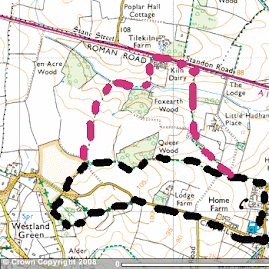
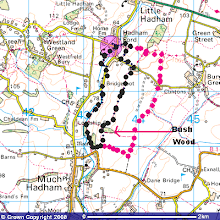
South Easterly walk

South Easterly walk
black, normal, red extended walk

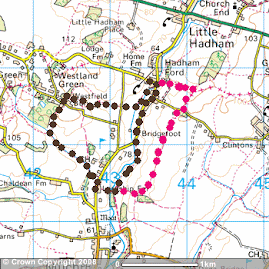
South Westerly route.

South Westerly route.
Black usual, red extended

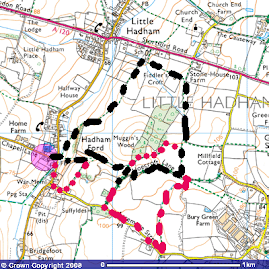
North Easterly walk

North Easterly walk
black short, walk. Red, extended

North West Patch

North West Patch
black route regular. Red route the extended wander